Why Your Bathroom Needs a Humidity Sensor (And How to Pick the Right One)
Transparency Note: We independently select these products based on research and user reviews. If you buy something through our links, we may earn a commission.
In fifteen years of renovation work I have opened up a lot of bathroom walls. The ones with mold problems almost always share one thing: a perfectly functional exhaust fan that nobody was running long enough. The fan was there. The ductwork was correct. But because it ran on a wall switch, it stopped the moment the person left the room, which is typically thirty to sixty seconds after turning the shower off. The air still had a relative humidity of eighty or ninety percent. The moisture was still on every surface. It just had nowhere to go anymore because the fan had stopped.
A humidity-sensing fan solves this problem entirely by removing the human decision from the equation. It turns on when the humidity rises and keeps running until the air reaches a target relative humidity, typically fifty to sixty percent, regardless of whether anyone is in the room. It does not matter if you forgot to turn it on before the shower. It does not matter if you turned it off too soon. The sensor handles both decisions automatically.
Here is how they work, what the specifications mean, when they are worth the upgrade over a standard fan, and the three options that consistently perform best at every price point in 2026.
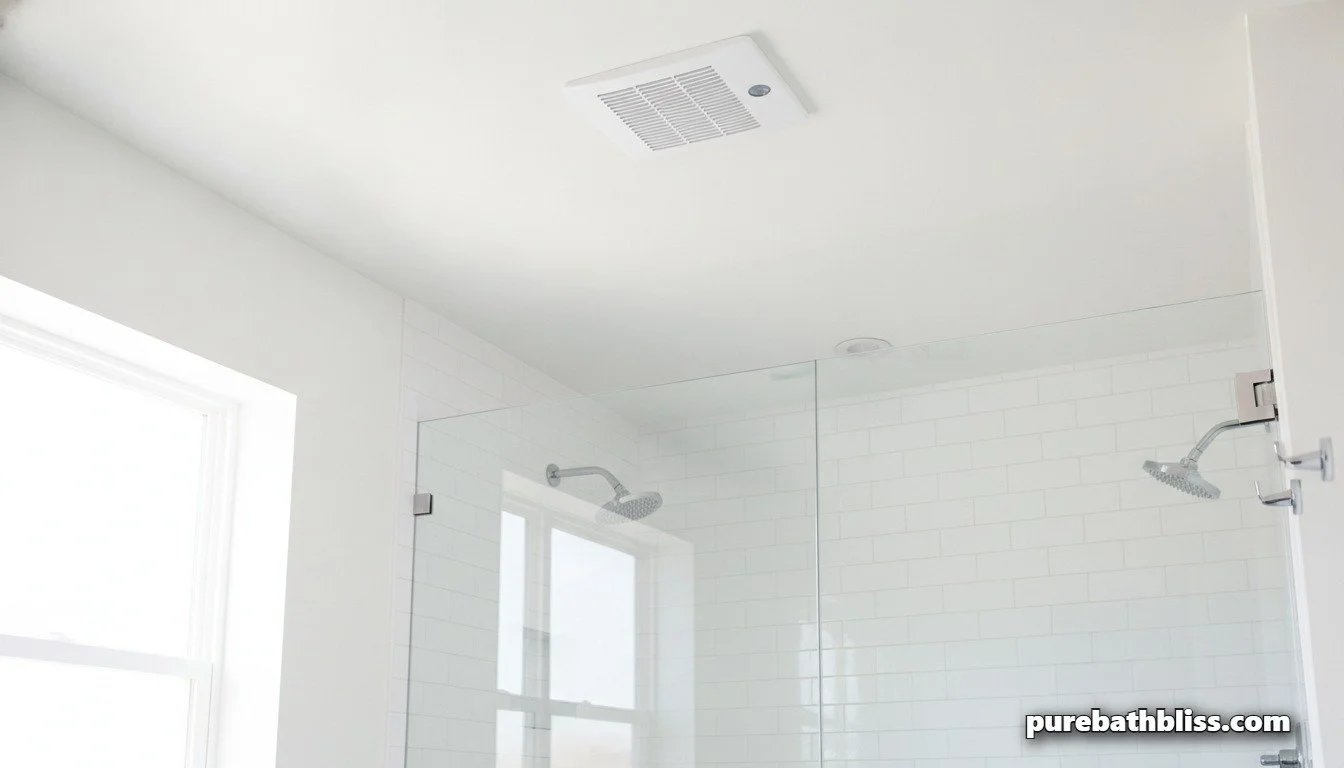
The Moisture Problem in Plain Terms
A ten-minute hot shower introduces a significant volume of water vapour into your bathroom. When that vapour condenses on the cooler surfaces of walls, tile, grout, caulk, and the ceiling, it creates the sustained moisture layer that mold and bacteria need to establish themselves. The pink slime covered in our guide to stopping pink bathroom mold, the black mold on the windowsill and ceiling, the grout discolouration that keeps returning despite regular cleaning — all of these are downstream consequences of the same root cause: humidity that was not removed quickly enough after a shower.
The ASHRAE ventilation standard for residential bathrooms recommends a minimum of fifty air changes per hour during shower use and continued ventilation until relative humidity returns to fifty percent or below. In a typical bathroom, achieving that with a correctly sized fan running from the start of the shower and for twenty to thirty minutes afterward is the technical requirement. Most people run their fan for about three minutes total.
A humidity-sensing fan is the only practical solution for a household where nobody is going to reliably remember to run the fan for twenty minutes after every shower. Which in a family with kids is essentially every household.
How Humidity Sensors Work
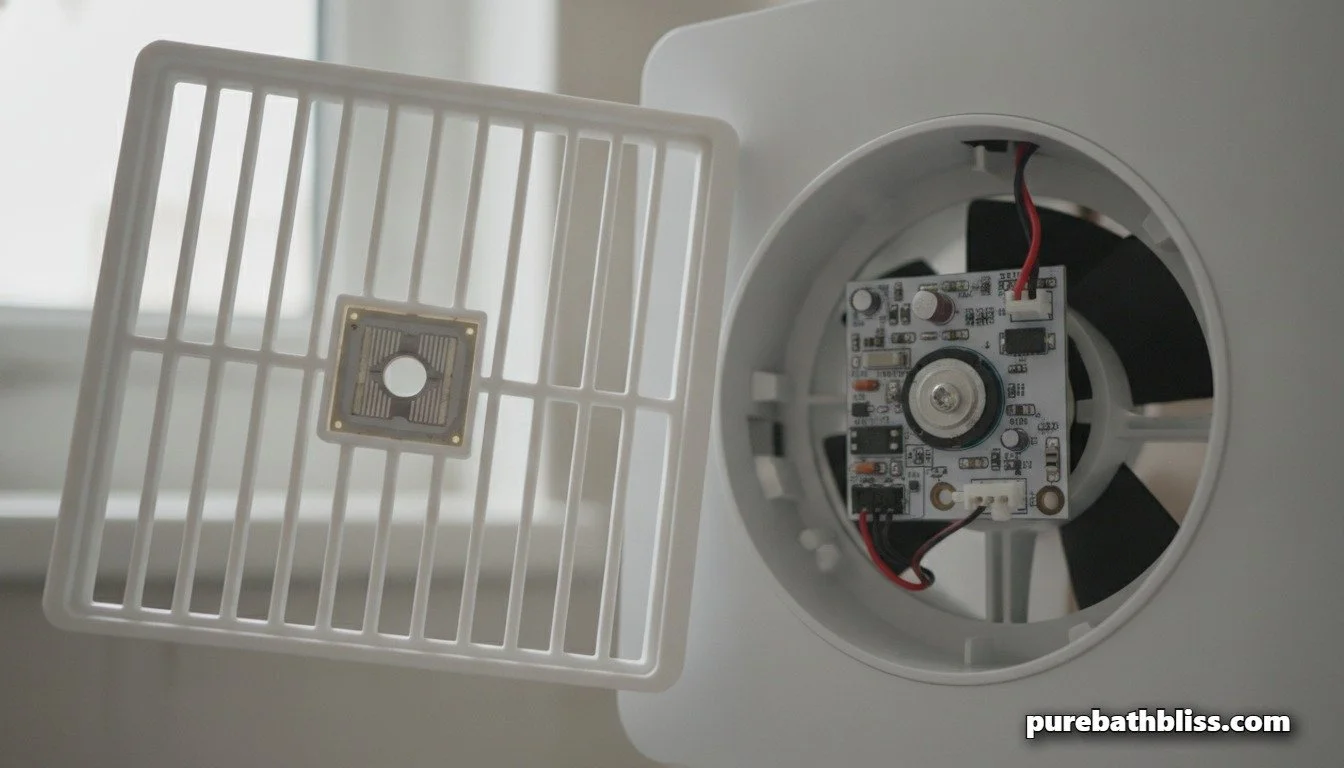
Modern humidity-sensing fans use a capacitive humidity sensor, a small electronic component whose electrical capacitance changes as water vapour molecules adsorb onto its surface. As relative humidity rises, more moisture is present and the capacitance reading increases. The fan's control board monitors this reading and activates the motor when the reading exceeds a set threshold, typically around sixty percent relative humidity for a bathroom context.
The better sensors distinguish between a short-term humidity spike, someone breathing near the sensor, for example, and sustained moisture from a shower. This prevents false triggers that would run the fan unnecessarily. Digital sensors with algorithmic filtering are more accurate than simple analogue sensors and less likely to activate from a brief humidity pulse that does not represent a genuine ventilation need.
Most sensors have an adjustable set-point that allows you to choose when the fan activates, typically with settings around thirty, sixty, or eighty percent relative humidity. For a bathroom, sixty percent is the right activation threshold for most climates. Below sixty percent, the humidity level is not high enough to warrant fan operation. Above sixty percent consistently, mold risk begins to climb.
The fan runs until the humidity drops back below the set-point and then shuts off automatically. In a typical bathroom after a shower, this takes between fifteen and thirty minutes depending on the bathroom size, the CFM rating of the fan, and the ambient humidity of the home.
Humidity Sensor vs Motion Sensor vs Timer: Which Is Best?
| Control Type | How It Works | Runs Until Room Is Dry? | Requires Action? | Best For |
|---|---|---|---|---|
| Wall switch | Manual on/off | Only if user remembers | Yes — remember to turn on and off at the right time | Very disciplined single-person households |
| Timer switch | Runs for a set countdown after activation | Sometimes — depends on timer length vs shower intensity | Yes — remember to activate before or after shower | Forgetful households who don't want to rewire |
| Motion sensor | Activates when occupied, deactivates when empty | No — stops when you leave, not when room is dry | No — automatic activation | Utility rooms, powder rooms without showers |
| Humidity sensor | Activates when humidity rises, runs until air is dry | Yes — always | No — fully automatic | Family bathrooms, mold-prone bathrooms, any shower room |
A humidity sensor beats both a motion sensor and a timer for the core job of moisture management because it responds to the actual condition in the room rather than to a proxy for it. A motion sensor turns the fan off when you leave, which is usually well before the room has dried. A timer runs for a fixed period regardless of how steamy the shower was, which means it either runs unnecessarily on quick showers or stops before the room is dry after a long one. The humidity sensor is the only control type that keeps the fan running for exactly as long as it needs to and no longer.
The Specifications That Matter
CFM Rating
CFM stands for cubic feet per minute, the volume of air the fan moves. For bathrooms up to 100 square feet, the HVI (Home Ventilation Institute) recommends a minimum of 100 CFM. For larger bathrooms, calculate one CFM per square foot of floor area and round up. For bathrooms with high ceilings (above eight feet), add ten to fifteen percent to the calculated CFM. Undersizing is the most common fan selection mistake and produces a fan that runs constantly without achieving the target humidity because it simply cannot move enough air.
Sone Rating
Sones measure noise. One sone is roughly equivalent to the sound of a quiet refrigerator. Most people find anything above 1.5 sones noticeably loud in a bathroom. The best humidity-sensing fans operate at 0.3 to 0.5 sones, which is near-silent in practice. This matters for a humidity sensor specifically because the fan runs longer than a switch-operated fan, extending the period during which noise is present in the bathroom and adjoining rooms. A 0.5 sone fan running for twenty-five minutes is a non-event. A 2.0 sone fan running for twenty-five minutes is a constant irritation that leads people to switch it off early, defeating the purpose.
DC vs AC Motor
DC motors are quieter, more energy efficient, and typically longer-lasting than AC motors at the same CFM output. The energy efficiency advantage is meaningful for a fan that runs more hours per day than a standard switch-operated fan. Panasonic's WhisperFit DC line, which uses an Energy Star certified DC motor, consumes as little as 0.0179 kW across its rated 70,000-hour lifespan, which is effectively a negligible operating cost even running several hours per day.
Installation Type
Standard installation requires attic access to connect to ductwork and electrical wiring from above. Roomside installation fans, like the Broan-NuTone BES8, can be installed entirely from below without attic access, which is a significant practical advantage for retrofit projects in finished homes. Both types are hardwired installations that require connection to the home's electrical system. In most jurisdictions this means a licensed electrician for the wiring, though a competent DIYer can handle the fan mounting and ductwork connection.
When a Humidity-Sensing Fan Is Not the Right Answer
There are a few scenarios where a humidity-sensing fan is not the right solution and it is worth being honest about them before you buy.
If your bathroom has no exterior wall or attic to duct to, a humidity-sensing fan cannot help. All exhaust fans require ductwork that vents moisture to the outside. Venting into the attic or into a wall cavity simply moves the moisture problem out of sight and creates mold where you cannot see it. If you cannot duct to the outside, a standalone bathroom dehumidifier is the alternative, combined with an openable window if the room has one.
If your existing fan is properly sized, correctly ducted, and you consistently run it for twenty minutes after every shower, a countdown timer switch is a cheaper solution that achieves the same result without replacing the fan. A timer switch costs $20 to $30 and installs in the existing switch position in under an hour. It does not respond to actual humidity but eliminates the forgetfulness problem by running for a fixed countdown after you leave the room.
If your bathroom mold problem is structural, in failing caulk, behind wall tile, or in a subfloor with chronic water ingress, improved ventilation will slow the mold but not resolve it. The source needs to be addressed first. Our guide to recaulking your tub professionally covers the sealing protocol that eliminates one of the most common structural moisture entry points in a bathroom.
The Three Best Options in 2026
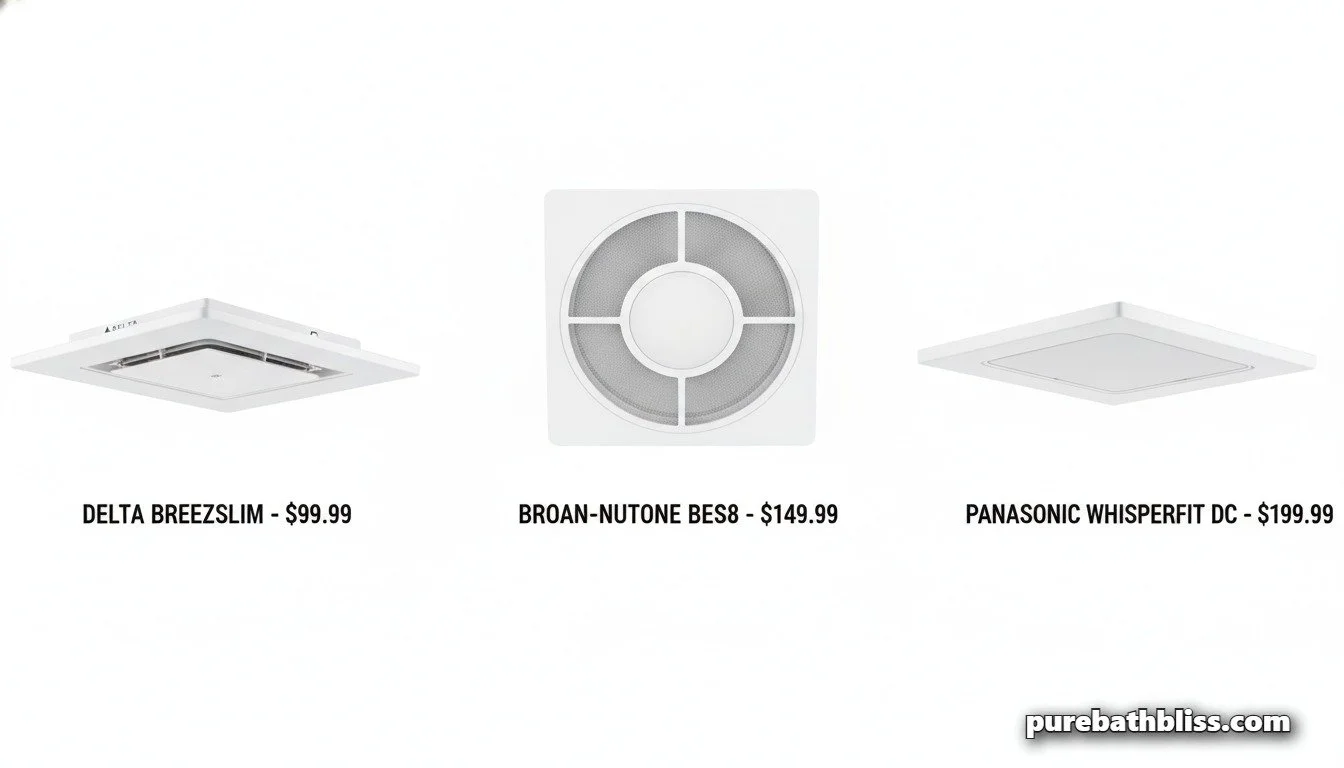
Budget Pick: Delta BreezSlim SLM70H ($69)
The Delta BreezSlim is the entry point into genuine humidity sensing at a price that makes the upgrade decision straightforward. It delivers 70 CFM at 0.3 sones, making it one of the quietest fans in any category at this price point, and includes an adjustable humidity sensor with a set-point you can tune to your bathroom's needs. It is Energy Star certified and suitable for bathrooms up to 65 to 70 square feet. The main limitation is CFM: for a bathroom over 70 square feet it is undersized and should be stepped up to the 110 CFM version. For a standard small to medium family bathroom it is a genuinely excellent value that delivers all the core functionality of fans costing two to three times as much. Find the Delta BreezSlim on Amazon.
Mid-Range Pick: Broan-NuTone BES8 Roomside Series ($83.98)
The Broan-NuTone BES8 is the fan to choose if attic access is difficult or impossible in your home. Its roomside installation design allows the entire installation to be completed from below the ceiling without requiring anyone to go into the attic, which is a significant practical advantage in finished homes or older houses where attic access is constrained. It delivers 80 CFM at 0.9 sones with an adjustable humidity sensor and Energy Star certification. The noise level is slightly higher than the Delta and Panasonic options but remains within the range most people find acceptable. The CleanCover grille is designed for easy removal and cleaning, which is a practical detail that matters over years of use since a clogged grille reduces effective CFM meaningfully. Find the Broan-NuTone BES8 on Amazon.
Premium Pick: Panasonic WhisperFit DC FV-0511VFC1 ($176.99)
The Panasonic WhisperFit DC is the benchmark product in this category and has been for several years. It delivers 50 to 110 CFM with adjustable speed via Pick-A-Flow technology, operates at an almost inaudible 0.3 to 0.5 sones depending on speed setting, includes built-in dew-point sensing that is more sophisticated than a simple relative humidity threshold, and carries a rated lifespan of 70,000 hours on its DC motor. This Old House and Consumer Reports both consistently rank Panasonic's WhisperFit line at the top of their bathroom fan roundups. The dew-point sensing is the key differentiator at this price: rather than simply activating at a set relative humidity percentage, it calculates the actual moisture content of the air and runs until conditions are genuinely safe rather than just at a lower percentage. For a primary bathroom in a home where mold prevention is a priority, this is the right buy. Find the Panasonic WhisperFit DC on Amazon.
Quick Selection Guide
| Your Situation | Best Choice | Price (2026) |
|---|---|---|
| Small bathroom under 70 sq ft, standard installation, budget conscious | Delta BreezSlim SLM70H | $69 |
| No attic access, retrofit installation from below, medium bathroom | Broan-NuTone BES8 Roomside Series | $83.98 |
| Primary bathroom, mold prevention priority, want the quietest and best | Panasonic WhisperFit DC FV-0511VFC1 | $176.99 |
| Large bathroom over 100 sq ft, high ceilings, or heavy shower use | Panasonic WhisperGreen Select (110 CFM) | $277.95 |
| Existing fan is properly sized and ducted, just need better control | Lutron Humidity Sensor Switch (add-on control) | $40 to $60 |
What a Humidity Sensor Cannot Fix On Its Own
A correctly sized, humidity-sensing exhaust fan running properly is the most effective single thing you can do to prevent bathroom mold. It is not a complete solution on its own. The fan manages airborne moisture. It does not address moisture that has already penetrated behind tiles from a leaking shower, beneath the floor from a failing wax ring, or into the wall cavity from a caulk line that has been failing for months.
If mold is already present in your bathroom, the sequence is to address the structural moisture source first, remove and treat the mold, and then install improved ventilation to prevent recurrence. Installing a better fan over an active structural moisture problem produces a slightly drier bathroom that still has mold because the source is not the air, it is the water getting in from outside the air.
Our guide to diagnosing what is causing your bathroom to smell covers the seven common sources of persistent bathroom odour and moisture problems, including the ones that ventilation alone cannot fix. If your bathroom has a smell that persists even with the fan running, the source is almost certainly structural rather than ventilation-related and that guide will help you identify it.
The Maintenance Your New Fan Needs
A humidity-sensing fan requires two maintenance steps that a standard fan also needs but that matter more here because sensor performance degrades when the sensor or grille is dirty.
Clean the grille every three months. Most fan grilles pop off with gentle downward pressure. Soak in warm water with a few drops of dish soap for fifteen minutes, rinse, dry fully, and reinstall. A grille clogged with dust and lint reduces effective CFM by twenty to thirty percent, which means the fan may be running at full speed but moving significantly less air than its rating suggests.
Check the sensor accuracy annually. The simplest check is to run a hot shower for ten minutes and confirm the fan activates automatically. If it does not, the sensor may have drifted or accumulated debris. A gentle wipe of the sensor element with a dry cotton swab, visible through the grille openings on most models, is often sufficient to restore accuracy. If the fan consistently fails to activate after cleaning, the sensor element itself has failed and the fan needs replacement.