Transparency Note: We independently select these products based on research and user reviews. If you buy something through our links, we may earn a commission.
Every December the plug-in display at the hardware store fills with Christmas scents. Fresh pine. Peppermint snowfall. Holiday hearth. Cinnamon wreath. They smell appealing in the aisle for the same reason autumn plug-ins do, the scent memory of Christmas is powerful, and the association is immediate. They smell noticeably synthetic in an enclosed bathroom after three days of continuous operation, and they produce exactly the impression you do not want in a room that every guest uses during the holiday season.
Christmas scent in a bathroom does not need to come from a plug-in, a spray, or anything with a label that says "fragrance" rather than listing actual ingredients. The five scent families that define Christmas, evergreen, peppermint, warm spice, citrus, and incense all exist as pure essential oils that cost less per season than a commercial plug-in refill pack and smell dramatically better in a steam environment.
Here are five natural methods, the specific Christmas blends for each, and the layering approach that creates a bathroom that guests walk into and immediately recognize as Christmas.
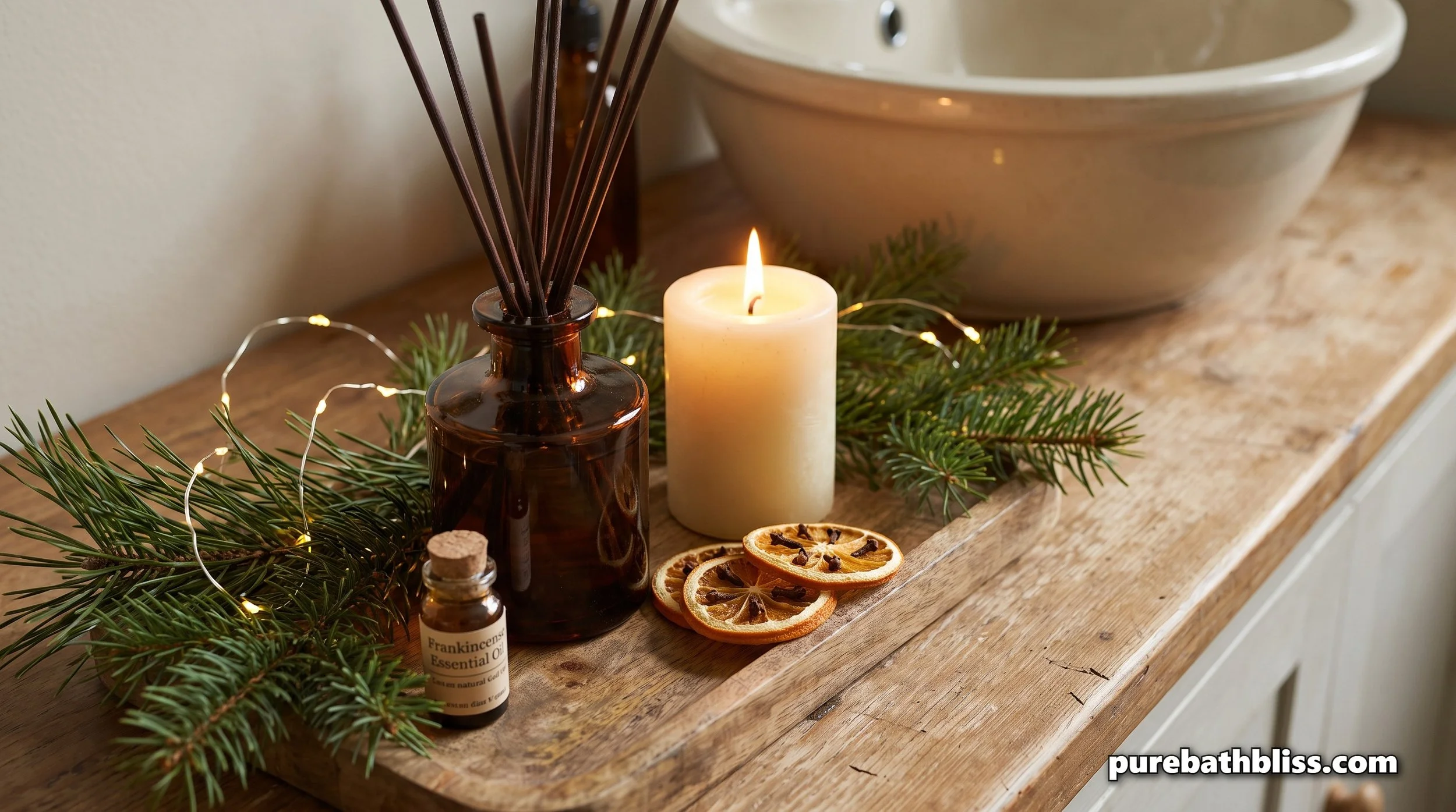
The Christmas Scent Families That Work in a Bathroom
Christmas has a more specific and universally recognizable olfactory character than any other season, which makes it both easier and more important to get right. The five scent families that define Christmas each contribute a distinct layer to the overall effect.
Evergreen. Fir balsam, pine, spruce, and cedarwood. This is the scent of a Christmas tree, of fresh greenery, of cold forest air. It is the most immediately recognizable Christmas scent note and the one that does the most work in establishing the seasonal character of a room. In a bathroom specifically, evergreen essential oils work particularly well because they are also naturally antimicrobial and complement the clean, fresh quality of a recently used bathroom rather than competing with it.
Peppermint. Peppermint and spearmint. The candy cane, the peppermint bark, the after-dinner mint. Cool, sharp, and immediately festive. Peppermint in a bathroom also has the practical benefit of being genuinely deodorizing and sinus-clearing, which suits a bathroom used by multiple people over a long Christmas gathering particularly well.
Warm spice. Cinnamon bark, clove bud, nutmeg, and ginger. The mulled wine, the gingerbread, the warming notes of Christmas baking. Warm spice in a bathroom context needs restraint, the same guidance that applies to autumn spice blends applies here. It should be a supporting note at 10 to 20 percent of any blend rather than the primary character.
Citrus. Sweet orange, mandarin, and clementine. The Christmas bowl of mandarins, the orange and clove pomander, the mulled wine citrus notes. Warm citrus specifically, not lemon or grapefruit, which read as clean and fresh rather than festive. Sweet orange and mandarin sit perfectly between the evergreen base and the spice middle in a Christmas blend.
Incense. Frankincense and myrrh. These are the most underused Christmas essential oils and the ones that produce the most sophisticated and genuinely distinctive result. Frankincense has a warm, resinous, slightly smoky quality that reads as sacred and ancient in a way that pine and peppermint do not. A blend with frankincense as the base note is the Christmas equivalent of cedarwood in an autumn blend, the grounding element that gives the whole composition depth and staying power.
Method 1: The Christmas Reed Diffuser
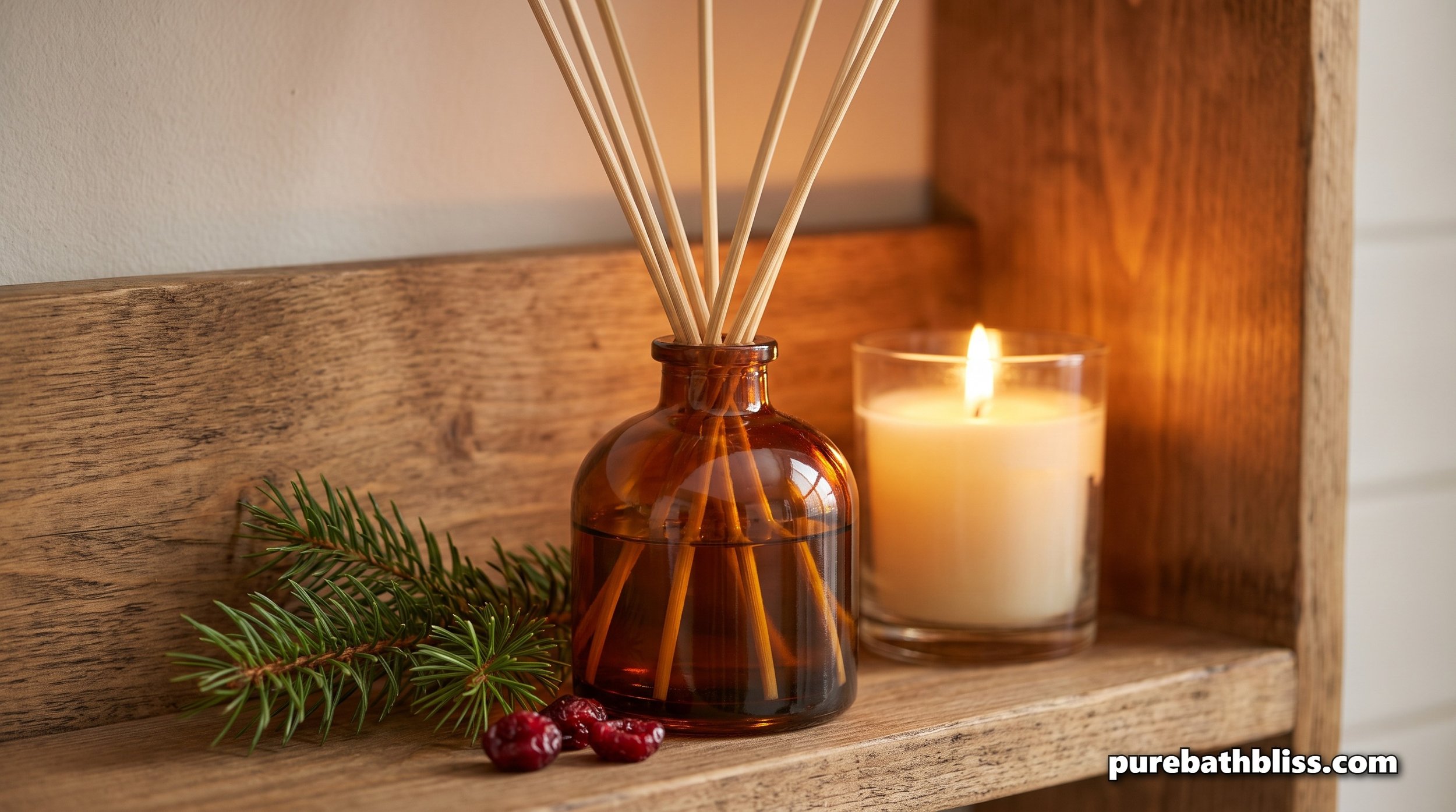
The reed diffuser is the right passive foundation for Christmas bathroom scent for the same reason it works year-round: it provides continuous, consistent fragrance at a gentle level that improves in the steam of daily showers rather than being overpowered by it. Our guide to making a DIY reed diffuser covers the carrier oil ratio and reed choice that produces a commercial-quality scent throw. Swap the oil blend to a Christmas combination at the start of December and run it through to the new year.
The Forest Cathedral blend (most sophisticated): Fir balsam 35 percent, frankincense 30 percent, sweet orange 25 percent, and cedarwood 10 percent. This is the Christmas blend that produces the most genuinely distinctive and memorable result. The fir balsam provides the fresh evergreen top note, the frankincense gives it depth and warmth, the sweet orange brightens it, and the cedarwood grounds the whole composition. It smells like a stone church with a Christmas tree in the corner. Nothing about it reads as synthetic.
The Candy Cane blend (most festive, family-friendly): Peppermint 50 percent, fir balsam 30 percent, and sweet orange 20 percent. Bright, clean, instantly recognizable as Christmas. The most universally appealing Christmas blend for a bathroom used by children and guests across all ages.
The Mulled Wine blend (warmest, best for evenings): Sweet orange 35 percent, cinnamon bark 20 percent, clove bud 15 percent, frankincense 20 percent, and cedarwood 10 percent. The olfactory equivalent of a glass of mulled wine on a cold evening. Rich, spiced, and warming. Best for a primary bathroom used for evening bathing rather than a guest bathroom with heavy morning traffic.
Method 2: The Christmas Beeswax Candle
A beeswax candle with Christmas essential oils produces the most immediate and atmospheric transformation of a bathroom's character during the holiday season. Lit during an evening bath or during a holiday gathering, a peppermint and fir balsam beeswax candle makes the bathroom unmistakably Christmas within sixty seconds.
Our guide to making DIY beeswax candles for the bathroom covers the 160 degree Fahrenheit essential oil addition that is the critical step for scent throw. For Christmas specifically, the peppermint and fir balsam combination is the candle blend that produces the most immediately recognizable result. Peppermint has a low flash point and needs the oils added as soon as the wax comes off the heat to prevent the aromatic compounds from evaporating before the wax sets.
Christmas candle blend: Fir balsam 40 percent, peppermint 35 percent, sweet orange 25 percent of the essential oil portion. At the standard one ounce of essential oil per pound of beeswax, this blend produces a candle that fills a standard bathroom with a genuinely beautiful Christmas scent within five minutes of lighting. Ready-made beeswax Christmas candles with pure essential oils are available if DIY is not on the agenda, but look specifically for beeswax or coconut wax with pure essential oil scenting rather than fragrance oils.
Method 3: The Christmas Shower Bundle
The autumn shower bundle adapted for Christmas is one of the most effective and most underused natural bathroom scent methods for December. A bundle combining eucalyptus with fresh pine needles, a cedar stem, and a sprig of fresh rosemary, bruised with a rolling pin and tied with red twine, turns every December shower into a forest aromatherapy experience that no plug-in or spray can match in a steam environment.
The pine needles release their resinous, evergreen oils into the steam immediately. The eucalyptus provides the familiar shower aromatherapy base. The cedar adds depth and warmth. The rosemary contributes a bright, herbal note that sits naturally with the evergreen family. Add a few drops of frankincense essential oil to the bundle before hanging for the incense note that completes the Christmas forest character.
Our guide to hanging eucalyptus in the shower correctly covers the bruising technique that applies equally to a Christmas bundle, the placement that maximizes steam contact, and the pet safety considerations that are the same for pine and cedar as for eucalyptus. A Christmas shower bundle lasts approximately ten days before drying out and should be replaced twice across December for continuous effect.
Method 4: The Pomander and Botanical Display
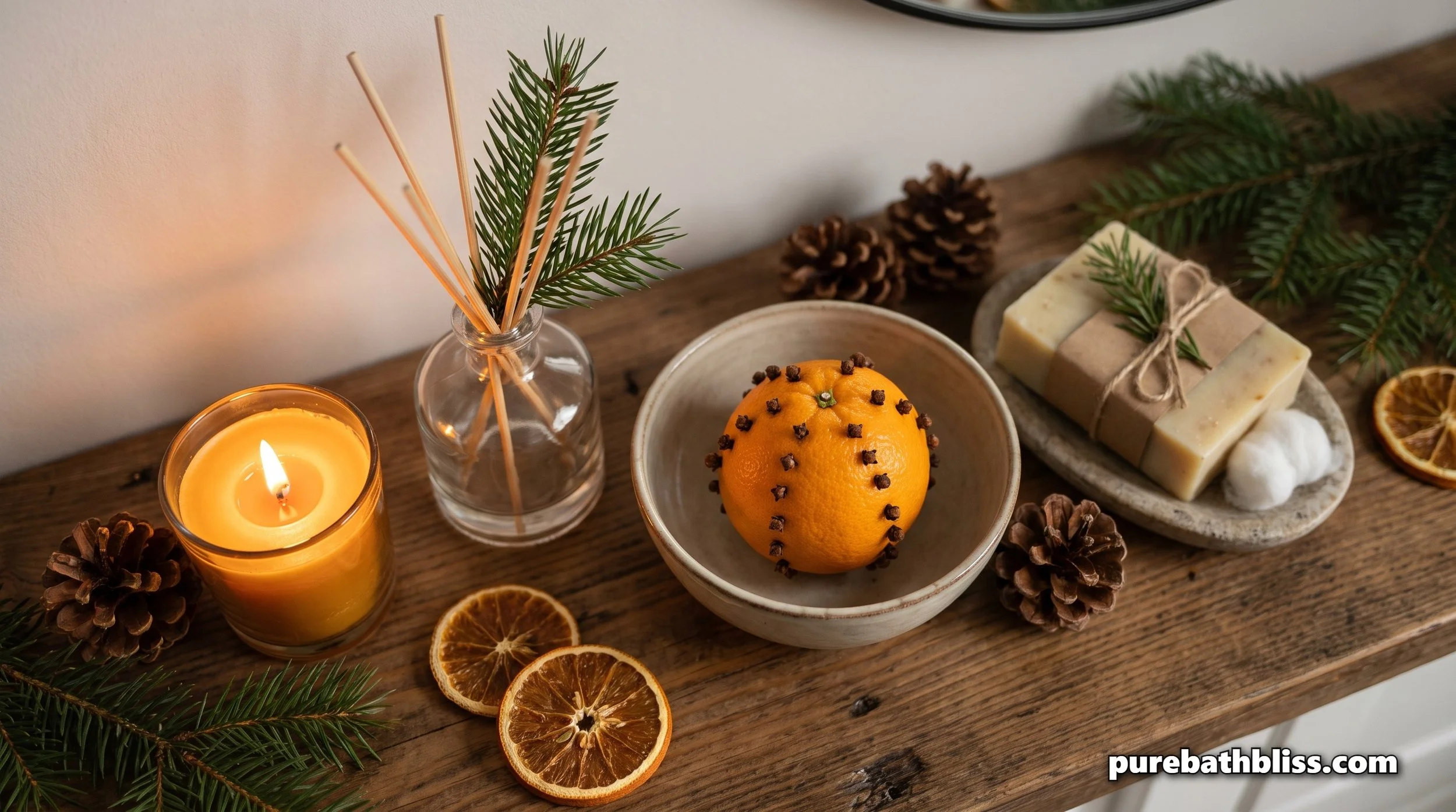
The pomander, an orange studded with whole cloves, is one of the oldest Christmas fragrance traditions in existence and one of the most effective natural scent sources available for a small room. A pomander on the bathroom shelf releases a continuous, gentle combination of citrus and clove that is immediately recognizable as Christmas and requires no heat, electricity, or active maintenance.
Making a pomander takes about twenty minutes and is one of the best activities to do with children in early December. Push whole cloves into an orange in whatever pattern you choose, geometric rows, spirals, or random coverage all produce the same scent effect. The cloves preserve the orange and the pomander lasts several weeks before needing replacement. A small bowl with two or three pomanders on the bathroom vanity, surrounded by a few dried pine cones, cinnamon sticks, and dried cranberries, creates a Christmas botanical display that smells as good as it looks.
For a more immediate scent effect from a botanical display, add five drops of fir balsam essential oil to each pine cone and five drops of frankincense to the cinnamon sticks. The porous surfaces of both materials absorb the essential oils and release them slowly over several days. This is the same principle as the autumn cotton ball hack applied to natural Christmas decorative materials. Replace the essential oil application every five to seven days to maintain the scent intensity.
Method 5: The Christmas Hand Soap
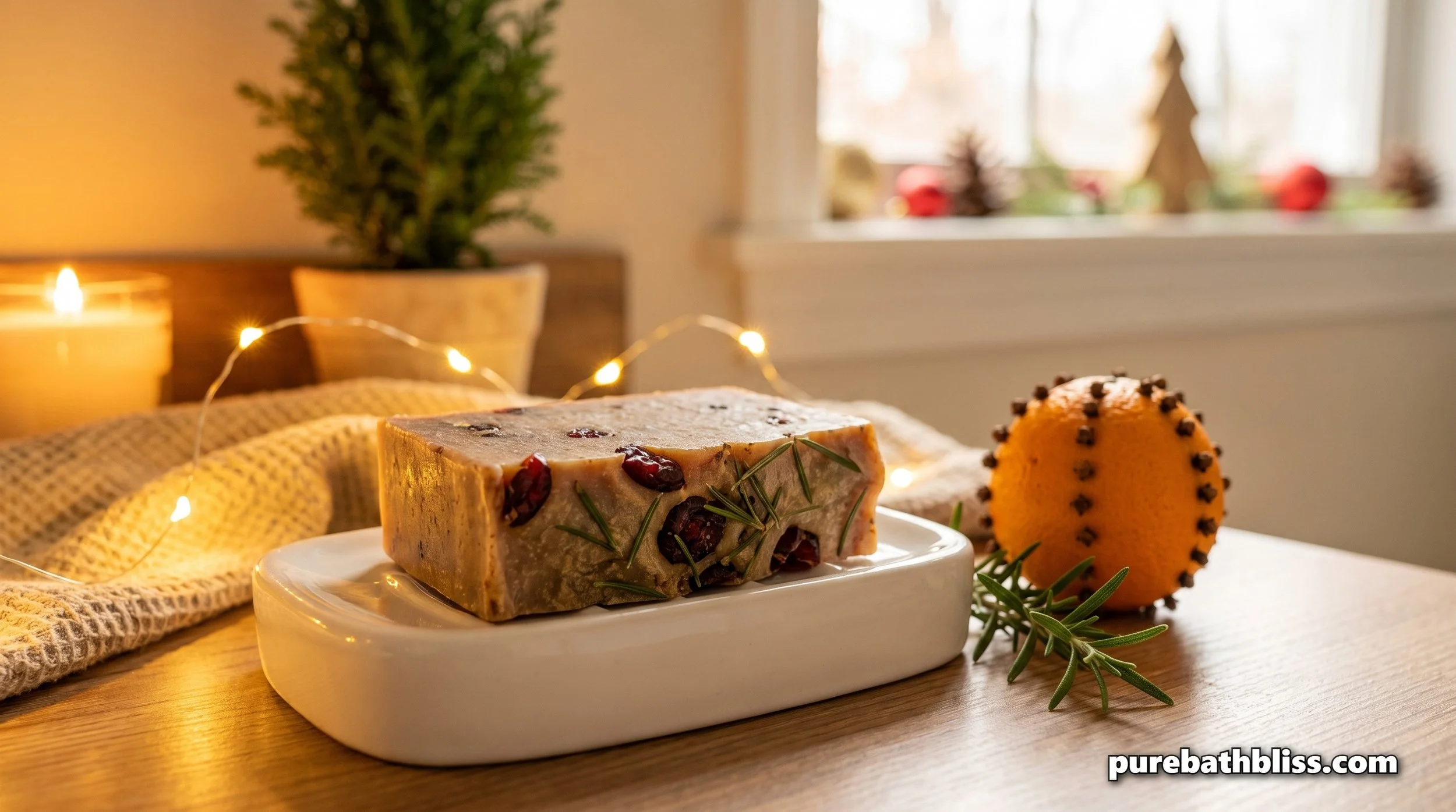
The hand soap is the Christmas scent touchpoint that every single guest interacts with directly during a holiday gathering. A natural hand soap scented with peppermint and sweet orange, or with fir balsam and cedarwood, contributes a close-range Christmas scent layer that is genuinely memorable and that guests associate specifically with the care and intentionality of the bathroom preparation.
Swapping the regular hand soap for a Christmas-scented natural version is the simplest and most immediate single change you can make to a guest bathroom for December. Look for soaps scented with pure essential oils rather than fragrance oils. Peppermint and eucalyptus is the most universally appealing Christmas hand soap combination. Frankincense and orange is the more sophisticated alternative for a primary bathroom used primarily by adults.
Natural Christmas hand soaps with peppermint and fir essential oils are widely available in December and typically cost the same as commercial alternatives. The difference in what guests experience when washing their hands is the difference between a bathroom that smells like Christmas and a bathroom that tries to smell like Christmas.
The Christmas Bathroom Scent at a Glance
| Method | Best Christmas Blend | Scent Intensity | Cost for December | Best Timing |
|---|---|---|---|---|
| Reed diffuser | Forest Cathedral or Candy Cane | Gentle, continuous | $8 to $15 in oils | All day, December 1 through 25 |
| Beeswax candle | Fir balsam, peppermint, sweet orange | Moderate, immediate | $15 to $30 or DIY under $12 | Evening baths, holiday gatherings, Christmas day |
| Christmas shower bundle | Eucalyptus, pine, cedar, rosemary, frankincense drops | Strong during shower | $10 to $15, replace twice in December | Morning shower, daily December use |
| Pomander and botanicals | Clove-studded orange, pine cones with fir balsam oil, cinnamon sticks with frankincense | Subtle, layering note | $3 to $8 in pantry and craft items | Continuous passive scent all December |
| Christmas hand soap | Peppermint and eucalyptus, or frankincense and orange | Close-range, personal | $6 to $15 per bottle | Guest bathrooms, holiday gathering days |
The layering that produces the most complete Christmas bathroom scent environment is the Forest Cathedral reed diffuser as the continuous passive baseline, the peppermint and fir beeswax candle for warmth and atmosphere during evening use and holiday gatherings, and the Christmas shower bundle for the morning aromatherapy experience that sets the tone for December days. The pomander and Christmas hand soap add the visual and close-range scent layers that make the bathroom feel deliberately prepared for the season rather than simply scented.
The Complete Christmas Blend Guide
| Blend Name | Oils and Ratio | Character | Best Method | Best For |
|---|---|---|---|---|
| Forest Cathedral | Fir balsam 35%, frankincense 30%, sweet orange 25%, cedarwood 10% | Deep, resinous, sophisticated. The most genuinely Christmas-like blend available from natural sources. | Reed diffuser, candle | Primary bathroom, adult spaces, evening use |
| Candy Cane | Peppermint 50%, fir balsam 30%, sweet orange 20% | Bright, cool, instantly festive. The most universally recognized Christmas scent combination. | Reed diffuser, shower bundle, cotton ball | Family bathrooms, guest bathrooms, kids bath time |
| Mulled Wine | Sweet orange 35%, frankincense 20%, cinnamon bark 20%, clove bud 15%, cedarwood 10% | Warm, spiced, rich. The most festive and food-adjacent blend. | Beeswax candle, evening reed diffuser | Evening bath ritual, Christmas Eve, holiday gatherings |
| Christmas Morning | Peppermint 40%, eucalyptus 30%, fir balsam 20%, sweet orange 10% | Bright, energizing, clean. The morning version of Christmas scent. | Shower bundle, cotton ball, morning diffuser | Morning showers, Christmas morning, December daily use |
| Frankincense and Myrrh | Frankincense 45%, myrrh 30%, cedarwood 15%, sweet orange 10% | Ancient, resinous, sacred. The most distinctive and unexpected Christmas blend. | Reed diffuser, candle | Primary bathroom, Christmas Eve, adults only spaces |
The same principle that applies to all natural bathroom scenting applies to Christmas: less is more. A bathroom that smells gently and genuinely of pine and frankincense when you open the door is significantly more impressive than one that smells intensely of synthetic Christmas from the hallway. The goal is a scent that guests notice briefly and positively on entry and that fades into a pleasant background within thirty seconds. The complete natural bathroom scent approach covering seasonal blends and layering methods throughout the year is covered in our guide to making your bathroom smell like a spa without synthetic fragrance. The Christmas versions here are simply the most festive expression of the same approach we use year-round.