How to Make a DIY Reed Diffuser for Your Bathroom (Under $10, Lasts 3 Months)
Originally published January 2026, Updated July 2026
Transparency Note: We independently select these products based on research and user reviews. If you buy something through our links, we may earn a commission.
I spent years buying commercial reed diffusers for the bathrooms and never once reading what was actually in them. They smelled good, they looked nice on the shelf, and they were gone in six weeks. When I finally turned one over and read the ingredients, the label listed "fragrance" as the primary scent component, a catch-all term that can legally conceal several hundred individual chemical compounds including phthalates, a class of plasticiser that is classified as an endocrine disruptor. I was diffusing this into a small enclosed room with poor ventilation that my four kids use every day.
The homemade version costs under $10, takes about five minutes to make, lasts three months, and the entire ingredient list is three items. It also smells significantly better than most commercial diffusers because you are working with pure essential oils rather than synthetic fragrance compounds diluted into a petroleum-based carrier.
Here is the exact recipe, the science behind why the ratios matter, the four blends that work best in a bathroom specifically, and the troubleshooting guide for the most common problems.
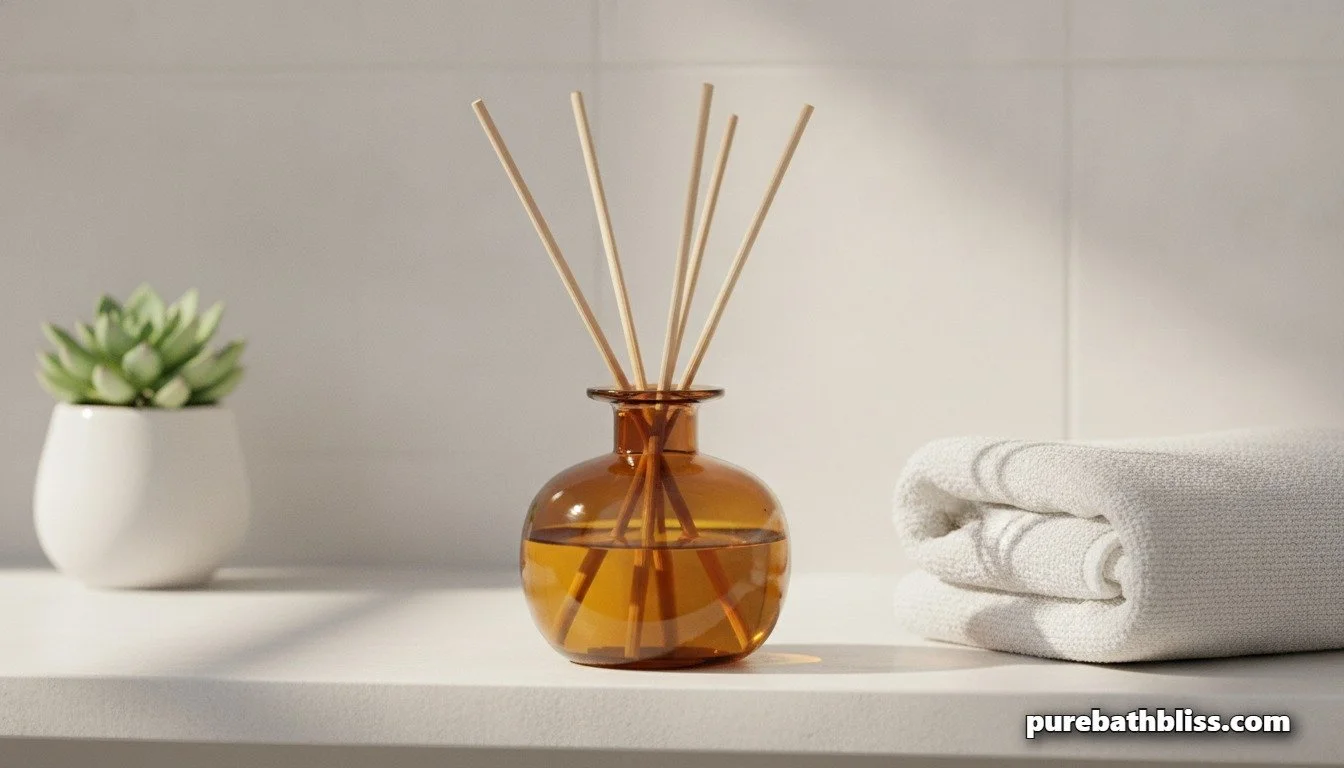
Why Commercial Reed Diffusers Are Worth Replacing
Most commercial reed diffusers use two components: a synthetic fragrance oil and a petroleum-based carrier, typically dipropylene glycol (DPG) or isopropyl myristate. Both are inexpensive, stable, and widely used precisely because they are cheap to produce and have a long shelf life. Neither is something you would choose to diffuse continuously into a small bathroom if you understood what you were inhaling.
The fragrance oil component is the more significant concern. The word "fragrance" on a product label in Canada and the US is a legally protected trade secret term that does not require disclosure of the individual compounds it contains. A single fragrance formulation can contain anywhere from a dozen to several hundred individual chemicals. Research consistently identifies synthetic fragrance as one of the leading sources of indoor VOC exposure in homes where fragrance products are used regularly. In a bathroom, where the room is small and typically has limited ventilation beyond the exhaust fan, the concentration effect is meaningful.
Pure essential oils are not without their own chemistry, but they are compounds that occur naturally in plants, their individual components are known and named, and their effects are studied. When you make a diffuser with fractionated coconut oil and eucalyptus essential oil, you know exactly what you are diffusing. That transparency is the entire point. Our guide to the five toxic chemicals hiding in your bathroom covers the synthetic fragrance category in detail, including why the "fragrance" label is legally permitted to conceal hundreds of individual compounds.
The Three Ingredients and Why Each One Matters
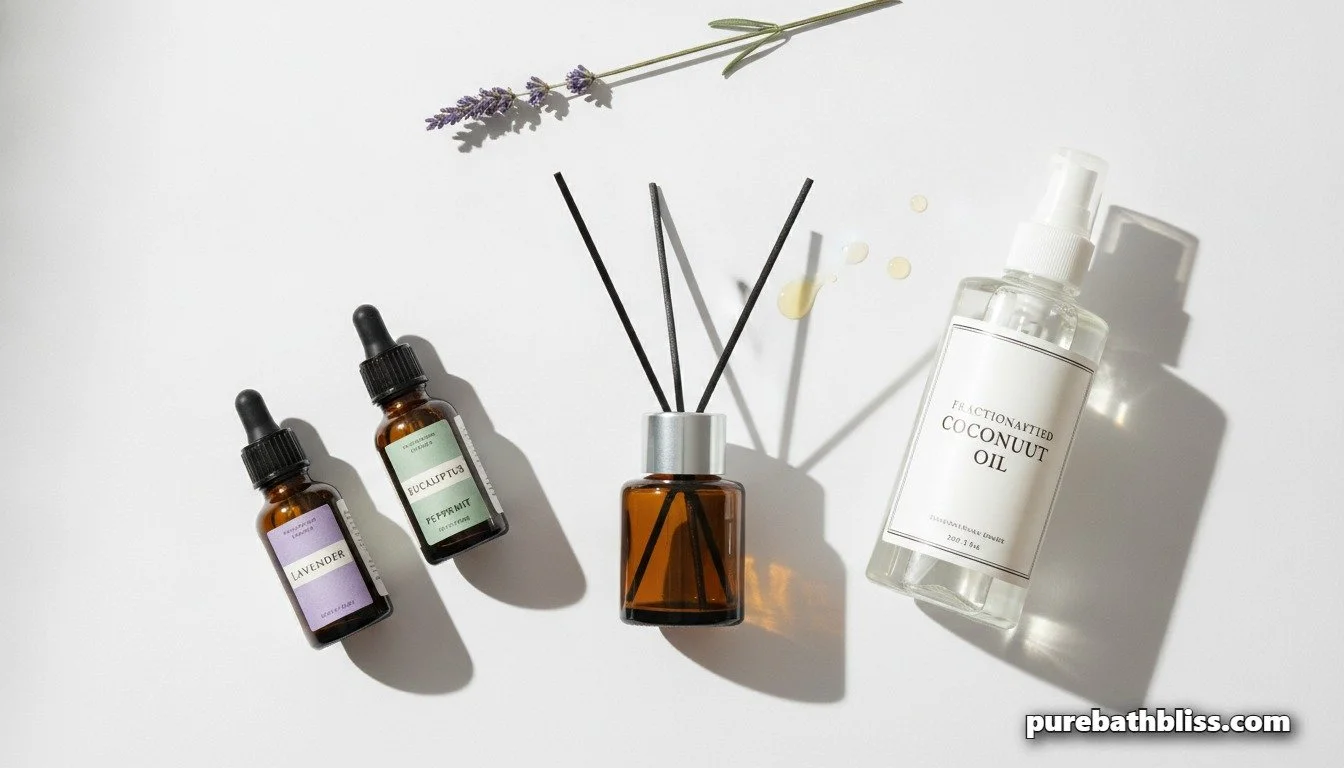
The carrier oil is the base liquid that the reeds draw up and disperse into the air. It needs to be thin enough to travel up the reed's porous channels easily, stable enough not to go rancid over the months the diffuser will be in use, and odour-neutral so it does not compete with the essential oil scent. Fractionated coconut oil is the best all-round choice: it is liquid at room temperature unlike regular coconut oil, has an extremely long shelf life, is completely odourless, and has excellent reed wicking properties. Sweet almond oil is a good alternative with similar properties. Avoid olive oil and regular coconut oil, both are too thick for good wicking and will go rancid within weeks in the warm environment of a bathroom.
The essential oils are the active scent component. For a bathroom diffuser, the oils need to do more than smell pleasant. The best choices for bathroom use are also naturally antimicrobial, meaning they contribute to air quality rather than just masking the existing air. Eucalyptus, tea tree, lavender, peppermint, and cedarwood all have documented antimicrobial or antifungal properties alongside their scent profiles. Citrus oils like lemon and sweet orange are naturally deodorising and pair well with any of the above.
The vessel is not technically an ingredient but it determines how well the diffuser works and how long it lasts. An amber or cobalt glass vessel protects the essential oils from UV degradation that would otherwise reduce their potency over the months the diffuser is in use. The neck opening matters too: a neck that is too wide disperses scent too aggressively and exhausts the oil quickly; too narrow and the reeds cannot sit stably. A 2 to 3 centimetre neck opening is the sweet spot for a bathroom diffuser of 100 to 150ml capacity.
The Ratio: Why This Is the Most Important Part
The single most common reason homemade reed diffusers fail to throw scent adequately is the wrong ratio of essential oil to carrier oil. Too little essential oil and the diffuser smells like nothing. Too much and the scent is overwhelming for the first week then drops off sharply as the concentrated oil exhausts itself.
The proven ratio for a bathroom diffuser is 70 percent carrier oil to 30 percent essential oil by volume. For a standard 100ml diffuser this means 70ml of fractionated coconut oil and 30ml of essential oil, which is approximately 600 drops from a standard essential oil dropper. That sounds like a lot, and it is considerably more than most recipes suggest. The reason most DIY diffuser recipes underperform is that they suggest 20 to 30 drops of essential oil per 100ml of carrier, which is a 1 to 2 percent concentration. Commercial diffusers use 15 to 30 percent essential oil concentration. The 30 percent ratio is what produces a scent throw comparable to a quality commercial diffuser.
For reference, 30ml of essential oil at roughly 20 drops per ml is approximately 600 drops. If you do not want to count drops individually, measure by volume using a small measuring jug or syringe. The investment in getting this ratio right is what separates a diffuser that you actually notice when you walk into the bathroom from one that smells like nothing.
The Recipe
What You Need
An amber glass diffuser vessel, 100 to 150ml with a narrow neck
Natural rattan reeds, 6 to 8 per diffuser. Do not use bamboo skewers: they are too dense and do not wick oil effectively
Fractionated coconut oil as the carrier, 70ml per 100ml batch
Your chosen essential oils, 30ml total per 100ml batch
A small funnel for pouring without spills
Method
Step 1: Pour 70ml of fractionated coconut oil into the vessel using a small funnel.
Step 2: Add your essential oil blend to reach the 100ml mark, roughly 30ml total. If using a combination of oils, measure each individually so the blend ratios are accurate.
Step 3: Place the stopper or cap on the vessel and swirl gently for thirty seconds to combine the oils. Do not shake vigorously as this introduces air bubbles that can disrupt wicking.
Step 4: Insert the reeds, all pointing in the same direction initially. After one hour, flip them so the dry ends are now submerged and the oil-saturated ends are in the air. This initial flip activates the diffuser immediately rather than waiting 12 to 24 hours for the oil to travel the full length of the reed.
Step 5: Place in the bathroom away from direct sunlight and heat sources. Flip the reeds once or twice a week to refresh the scent throw. Top up with fresh oil when the level drops below a third of the vessel.
Four Blends That Work Best in a Bathroom
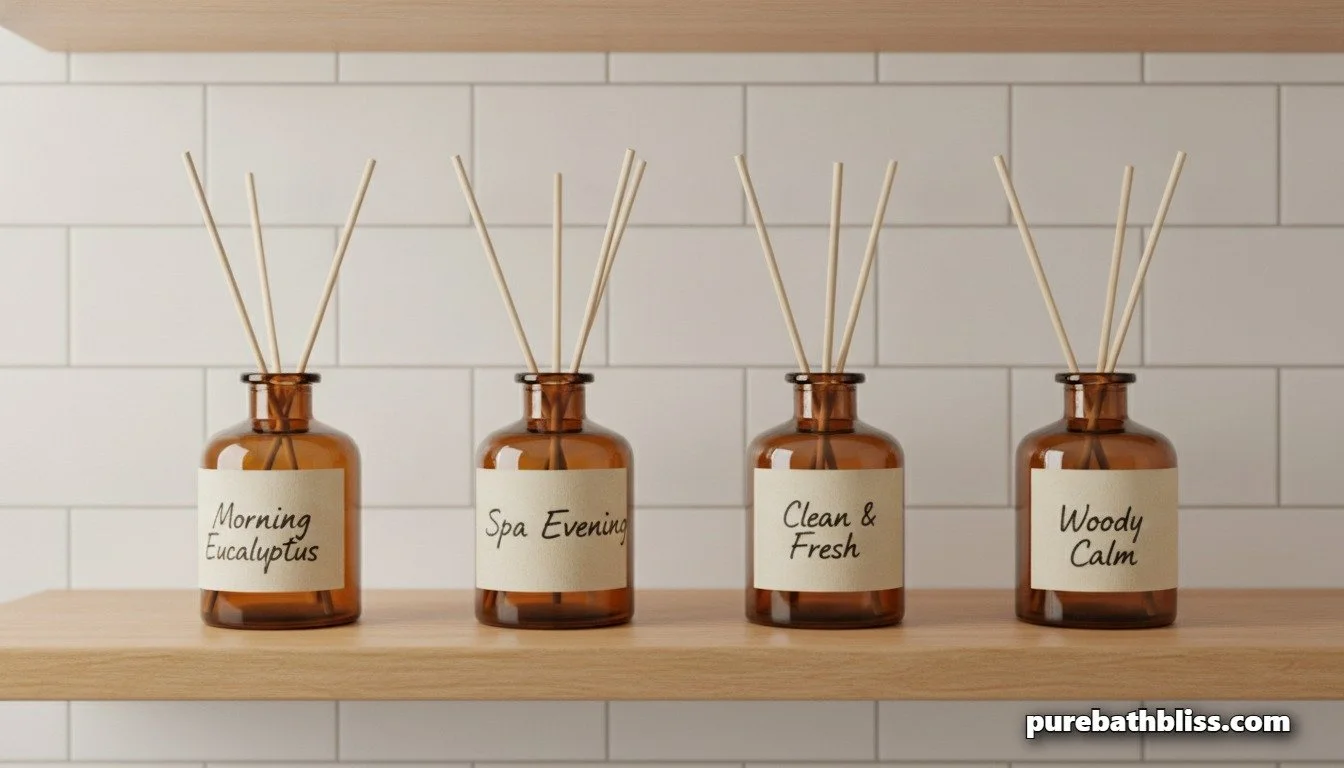
| Blend Name | Oils and Ratio (of the 30ml essential oil portion) | Character | Best For |
|---|---|---|---|
| Morning Eucalyptus | Eucalyptus 50%, Peppermint 30%, Lemon 20% | Sharp, clean, energising. The most deodorising blend. | Family bathrooms, morning use, high-traffic shared bathrooms |
| Spa Evening | Lavender 50%, Cedarwood 30%, Bergamot 20% | Soft, warm, deeply calming. Reads as genuinely luxurious. | Primary bathroom, evening wind-down, guest bathroom |
| Clean and Fresh | Tea Tree 30%, Sweet Orange 40%, Peppermint 30% | Bright, medicinal, genuinely antimicrobial. | Bathrooms with plants, cold and flu season, powder rooms |
| Woody Calm | Cedarwood 40%, Sandalwood 30%, Lavender 30% | Rich, grounding, sophisticated. The most masculine blend. | Primary bathrooms, spa-inspired spaces, year-round use |
A few notes on these blends. The morning eucalyptus blend works particularly well in a family bathroom where multiple people are using it during the school morning rush because eucalyptus and peppermint are energising and deodorising simultaneously. The spa evening blend is the one we keep in our main bathroom, the cedarwood grounds the lavender and prevents it from being too sweet, and the combination reads as genuinely luxurious rather than just floral.
For a bathroom that also has plants, the clean and fresh blend pairs especially well with the natural humidity and organic scents that plants bring to the room. Our guide to bio-filter plants that scrub toxins from bathroom air covers the specific species that complement rather than compete with essential oil diffusers in terms of their own organic compounds.
The Reed Question: Why Rattan and Not Bamboo
This is the detail most DIY diffuser tutorials gloss over and it is the reason many homemade diffusers fail to throw scent even when the oil ratio is correct. Rattan reeds are made from the porous inner core of rattan palm, a natural material that has an open cellular structure ideal for wicking oil upward. Bamboo skewers, which look similar and are far cheaper, are made from solid bamboo and have a closed, dense cellular structure. Oil cannot travel through bamboo skewers effectively. They sit in the oil and do nothing.
Fibre reeds, a synthetic alternative, wick faster than natural rattan and produce a stronger initial scent throw but exhaust the oil more quickly. They are a reasonable option if you flip frequently and do not mind topping up more often. For a low-maintenance three-month diffuser, natural rattan reeds at 6 to 8 per vessel is the right choice.
Troubleshooting
| Problem | Most Likely Cause | Fix |
|---|---|---|
| Weak or no scent throw | Essential oil concentration too low, or bamboo skewers used instead of rattan reeds | Increase to 30% essential oil concentration. Replace bamboo skewers with natural rattan reeds. |
| Scent fades after 2 to 3 weeks | Reeds are saturated and clogged with oxidised oil | Flip reeds more frequently (every 2 to 3 days). Replace reeds entirely at each refill. |
| Oil exhausting too quickly | Too many reeds, fibre reeds instead of rattan, or placement near airflow | Reduce to 6 reeds. Move away from vents, windows, or frequently opened doors. |
| Oil not wicking up the reeds | Carrier oil too thick, or reeds blocked with dried oil from previous use | Switch to fractionated coconut oil. Replace old reeds with fresh ones. |
| Scent smells off or rancid | Carrier oil has oxidised, or diffuser stored in direct sunlight | Discard and start fresh. Use an amber glass vessel and store away from direct light. |
| Scent is overwhelming | Too many reeds or diffuser placed in a very small room | Remove 2 to 3 reeds. Move diffuser further from the door or ventilation area. |
The most common issue by a significant margin is weak scent throw, and the fix is almost always the same: increase the essential oil concentration. Most people make their first batch at too low a ratio because existing recipes are too conservative. The 30 percent concentration feels like a lot until you smell the difference.
Placement and How Long It Lasts
Placement affects how quickly the diffuser exhausts. A diffuser placed near an air vent, an open window, or a frequently opened door disperses its scent faster and depletes more quickly. For longest life, place the diffuser on a shelf or counter away from direct airflow, but where passing air currents from movement in the room can carry the scent naturally. A high shelf is better than a low counter for scent dispersal since warm air carrying the volatile oil compounds rises.
At the 30 percent concentration in a 100ml vessel with 6 to 8 natural rattan reeds flipped twice weekly, a diffuser in an average bathroom should last 10 to 12 weeks before needing a full refill. When topping up, replace the reeds entirely with fresh ones. Reeds that have been saturated and dried repeatedly become clogged with oxidised oil and lose their wicking efficiency. A new set of reeds with each refill is what maintains consistent scent throw over months of use.
The reed diffuser is one layer of a natural bathroom scent approach rather than the whole solution. For the shower specifically, hanging eucalyptus provides a complementary burst of scent during each shower that the diffuser does not match in intensity. Our guide to hanging eucalyptus in your shower correctly covers the bruising technique that doubles the scent release and why the rolling pin step is the one most people skip.
The Cost Breakdown
A 100ml amber glass diffuser vessel costs $3 to $6 and is reusable indefinitely. A pack of 50 natural rattan reeds costs $4 to $6 and covers multiple refills. Fractionated coconut oil at 70ml per batch costs roughly $1 to $2 per batch when bought in a larger bottle. Essential oils at 30ml per batch represent the main variable cost, ranging from $3 to $8 per batch depending on which oils you use. Total cost per 100ml batch: $5 to $12, with the vessel cost amortised across many refills after the first.
A comparable commercial natural reed diffuser at 100ml costs $20 to $45 and lasts 6 to 8 weeks at the lower essential oil concentrations most brands use. The homemade version at 30 percent concentration lasts 10 to 12 weeks and costs a fraction of that. After the first batch where you are buying the vessel and reeds, subsequent refills cost under $5.