The Countertop Trap: Why Your Blow Dryer Needs a Proper Home
In a Sustainable Sanctuary, we prioritize "Invisible Safety." As a parent of four and a Red Seal Carpenter, I look at a hair dryer sitting on a bathroom counter, and I don't just see a styling tool, I see three distinct threats: a structural hazard, an electrical liability, and a "clutter tax" on your peace of mind.
While it seems convenient to leave it plugged in and ready to go, this habit is a breach of your home’s safety protocol. In my 20 years on job sites, I've seen exactly how moisture and electricity play together. They aren't friends. Leaving your hair dryer out isn't just a design faux pas; it’s an invitation for infrastructure failure.
1. The "Hidden Current" Risk: Physics Doesn't Take a Break
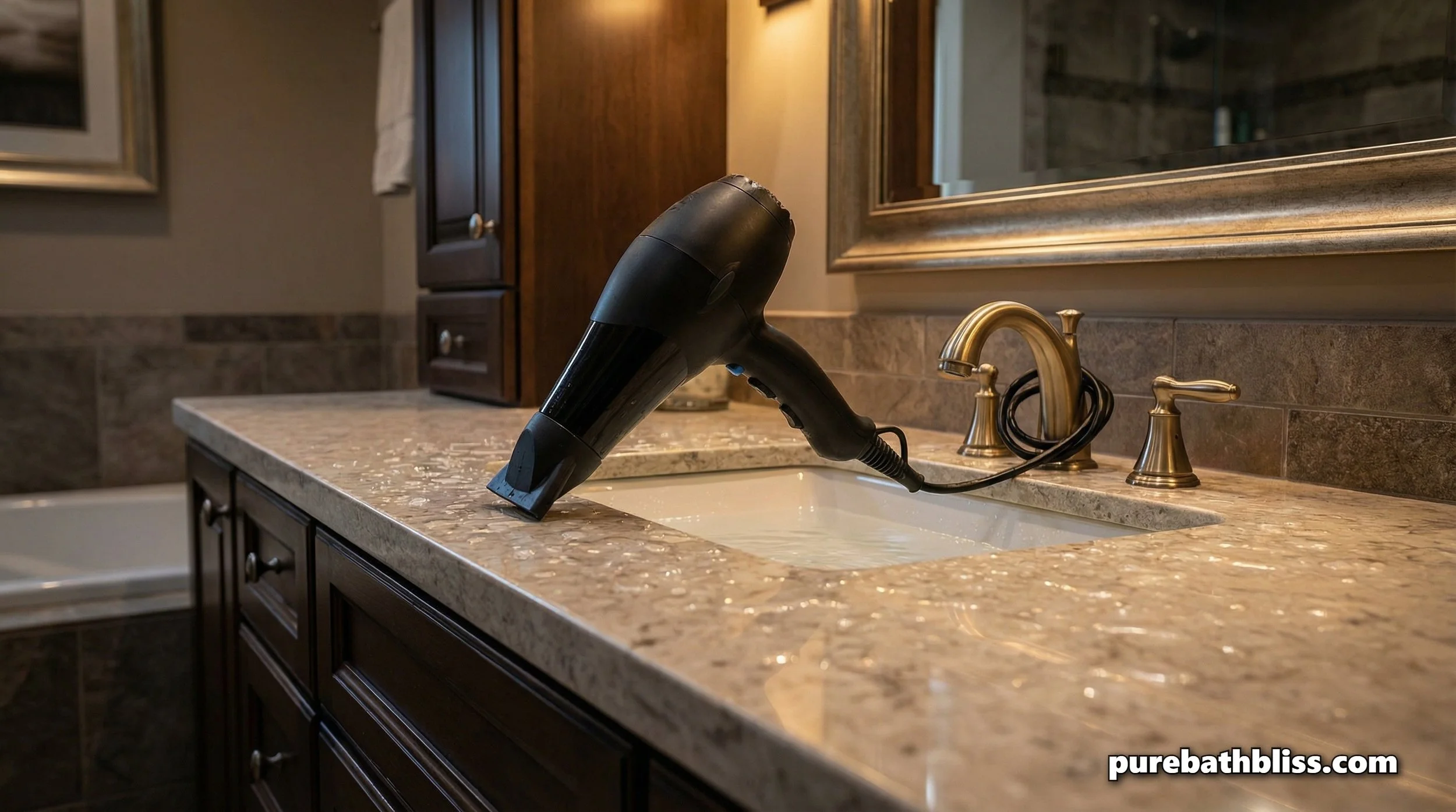
The most immediate danger is the one we all think we’re too smart to fall for: the "sink slide." Even if the hair dryer is turned off, if the cord is pushed into an outlet, the device is live.
The Gravity Factor: Most bathroom counters are slick surfaces (quartz, marble, or polished laminate). A simple nudge of an elbow, a snagged cord, or a curious toddler can send that dryer sliding into a sink full of water.
The GFCI Myth: Many homeowners tell me, "I have a GFCI outlet, I'm safe." While a Ground Fault Circuit Interrupter is a literal lifesaver, it is a mechanical device with a circuit board that can fail over time. Relying on a $15 outlet to prevent a fatal accident while leaving the hazard "live" on the counter is poor risk management. Just as we lower our water heater temperature to prevent accidents, we must manage our electrical environment with the same proactive mindset.
2. Humidity and the "Internal Lung" of the Dryer
As a builder, I am constantly fighting Bathroom Humidity. When you shower, the steam fills the room, rising to the ceiling and eventually settling as condensation on every available surface.
Hair dryers work like a mechanical "lung"; they pull in massive amounts of air through a rear vent to blow it across heated coils. If your dryer sits out on the counter, that damp, humid air settles inside the motor and heating elements.
Internal Corrosion: This moisture leads to "arcing", small electrical jumps between internal parts that weren't meant to touch.
The Warning Signs: If you’ve ever turned on your dryer and seen a brief spark or smelled "burnt dust," it’s often because moisture has degraded the internal components. This shortens the life of your tool and increases the risk of a fire.
3. "Thermal Shock" and Your Countertops
I’ve replaced dozens of expensive vanities over the years because of "styling tool scars." You might think your stone counter is indestructible, but it has a breaking point.
Quartz and Resin: Most modern quartz countertops are actually an engineered product held together by polymer resins. If you set a hot hair dryer down directly on the surface after a 10-minute blowout, you can cause Thermal Shock. This leads to yellowing (scorching) of the resin or even hairline cracks in the stone that cannot be repaired.
The Cord Melt: Hair dryer nozzles can reach temperatures of 140°F to 150°F. If that hot nozzle touches its own power cord while you’re tidying up, it can melt the plastic insulation, exposing live wires and creating a massive fire hazard.
4. The "Pure" Storage Solution
In a house with six people, "out of sight, out of mind" is the only way to keep a bathroom sane. Here is the builder-approved way to store your tools:
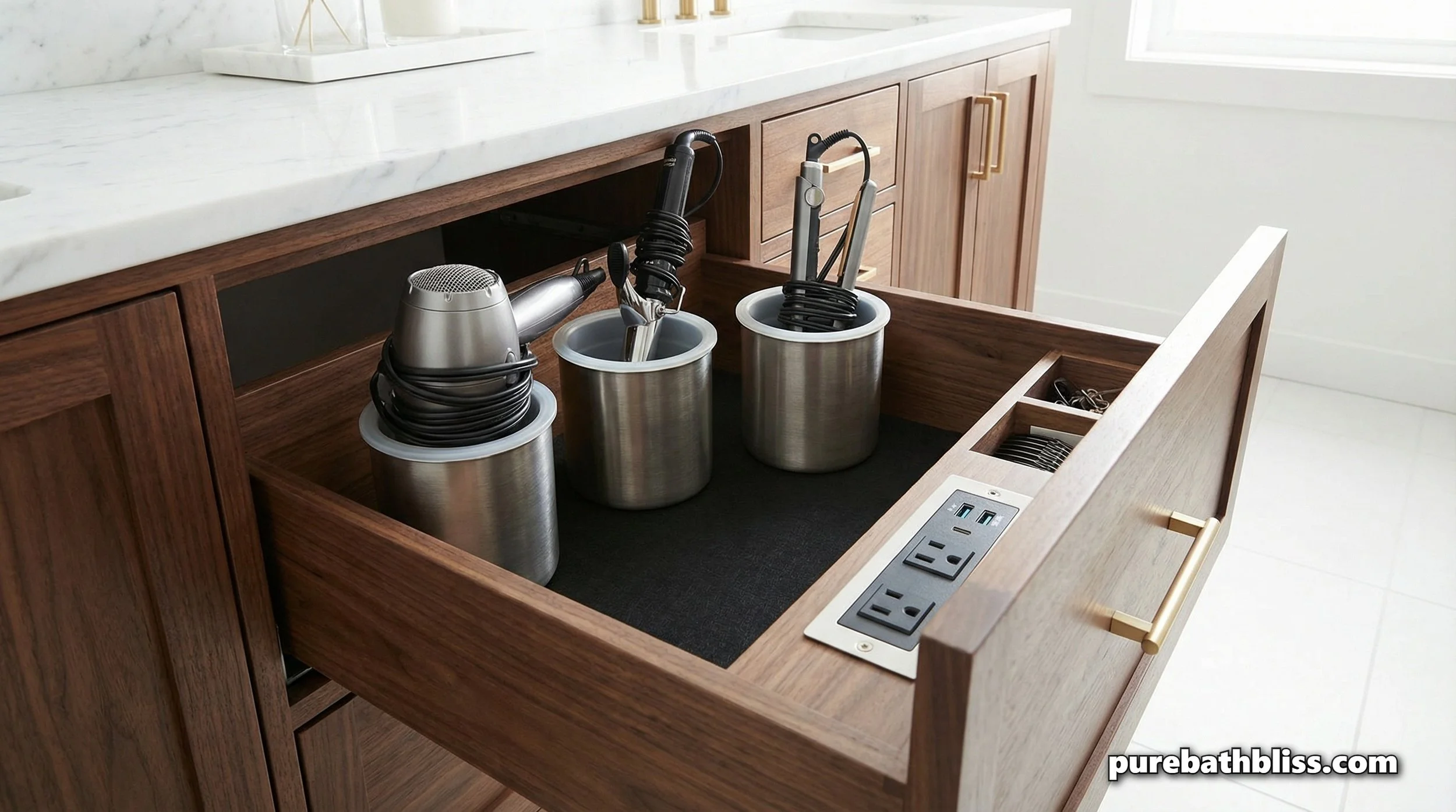
The "Hot" Holster: If you don't have drawer space, install a heat-resistant metal holster on the inside of your cabinet door. This allows you to put the dryer away immediately while it’s still cooling down, keeping the nozzle away from flammable items.
The Power Drawer: If you are remodeling, ask your carpenter to install an Integrated Power Drawer. These have a "safety-switch" outlet at the back of the drawer that only activates when the drawer is open, allowing you to keep tools plugged in inside a closed, dry environment.
The Unplug Ritual: Make it a "Sanctuary Law" in your home: If you aren't using it, unplug it. It takes three seconds and removes 100% of the electrical risk.
5. Summary: Countertop Safety Matrix
| Hazard | Builder’s Prevention |
|---|---|
| Electrocution | Unplug after every single use, no exceptions. |
| Internal Damage | Store in a dry cabinet to avoid shower steam. |
| Surface Burns | Use a silicone heat mat if you must set it down. |
| Trip Hazard | Coil cords; never let them "snake" across the floor. |
6. The Psychology of the "Clear Surface"
There is a profound psychological benefit to a clear counter. In our house, the bathroom is the first place we go in the morning. When that space is cluttered with "cord chaos," it triggers a subtle "stress response" before the day has even begun.
A Sustainable Sanctuary is a place of order. By clearing the cords, you aren't just preventing a fire; you are reclaiming your mental space. You are telling yourself that your home is a place of peace, not a place of unfinished tasks.
Conclusion: Protecting the Integrity of Your Home
A hair dryer on the counter is a small thing, but it represents a larger philosophy of home care. By acknowledging the structural and electrical risks, you are taking a stand for the longevity of your home and the safety of your family.
Unplug the dryer, tuck it away, and let your bathroom return to its state of tranquil, "Pure" perfection.