What Makes a Good Bath Towel? The Complete Guide to GSM, Materials, and Why Cheap Towels Go Crunchy
Originally published Sept 25, 2025; updated July 22, 2026
Transparency Note: We independently select these products based on research and user reviews. If you buy something through our links, we may earn a commission.
I have renovated a lot of bathrooms in my career and spent a lot of time thinking about what goes in them. Towels are one of those purchases that most people get wrong not because they do not care but because the way towels are marketed actively misleads them. The towel that feels softest in the store is the one that has been treated with the most finishing chemicals and fabric softeners during manufacturing. Those treatments wash out over the first few washes and what you are left with is the actual towel underneath, which may be considerably less impressive than what you felt on the shelf.
A genuinely good bath towel does not feel dramatically different from a mediocre one when it is brand new. It feels dramatically different after two years of weekly washing. The qualities that determine whether a towel lasts and performs are fiber length, yarn construction, GSM, weave density, and hem quality, are invisible to touch in a store and require knowing what to look for on a label.
Here is everything you need to know to buy a bath towel that will actually be good after fifty washes rather than just on the day you bring it home. performs, such as
Start Here: What GSM Actually Means
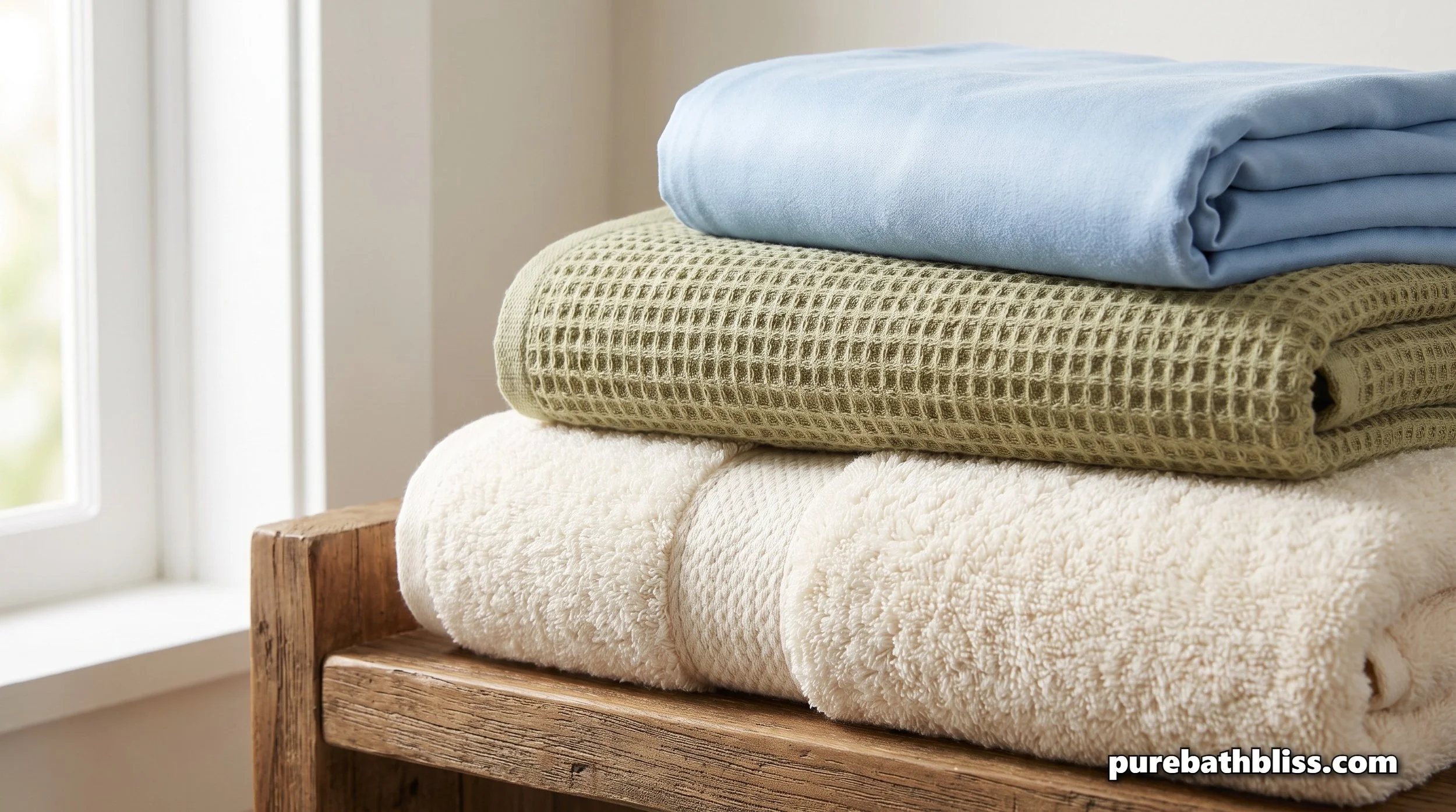
GSM stands for grams per square meter and it is the single most useful number on a towel label. It measures the density of the fabric, how much fiber is packed into each square meter of the weave. A higher GSM means more fiber, which generally means more absorbency, more plushness, and more weight. A lower GSM means a lighter, faster-drying towel with less of the spa-like feel.
The range that matters for bath towels runs from about 300 GSM at the light end to 900 GSM at the heavy end. Here is what each range actually means in practice rather than in marketing language.
| GSM Range | Weight | Absorbency | Drying Time | Best For |
|---|---|---|---|---|
| 300 to 400 GSM | Light | Moderate | Very fast, 1 to 2 hours | Travel, gym, beach, children's bathrooms, warm climates |
| 400 to 550 GSM | Medium-light | Good | Fast, 2 to 4 hours | Daily use, children's towels, bathrooms with limited ventilation |
| 550 to 700 GSM | Medium-heavy | Very good | Moderate, 4 to 8 hours | Daily adult use, the sweet spot for most family bathrooms |
| 700 to 900 GSM | Heavy | Excellent | Slow, 8 to 12 hours or more | Guest bathrooms, occasional use, well-ventilated bathrooms only |
| 900 GSM and above | Very heavy | Maximum | Very slow, 12 to 24 hours | Spa or hotel settings with commercial drying equipment. Mildew risk in home bathrooms. |
The expert consensus from textile specialists in 2026 sits around 500 to 700 GSM as the sweet spot for most households. Below 400 and you are compromising on plushness. Above 800 and you are adding drying time that can become a mildew problem in bathrooms without excellent ventilation. Our guide to bathroom ventilation and exhaust fans covers this directly: a 900 GSM Egyptian cotton towel in a poorly ventilated bathroom is a mildew risk regardless of how good the towel itself is.
The Materials: What the Labels Actually Mean
Egyptian Cotton
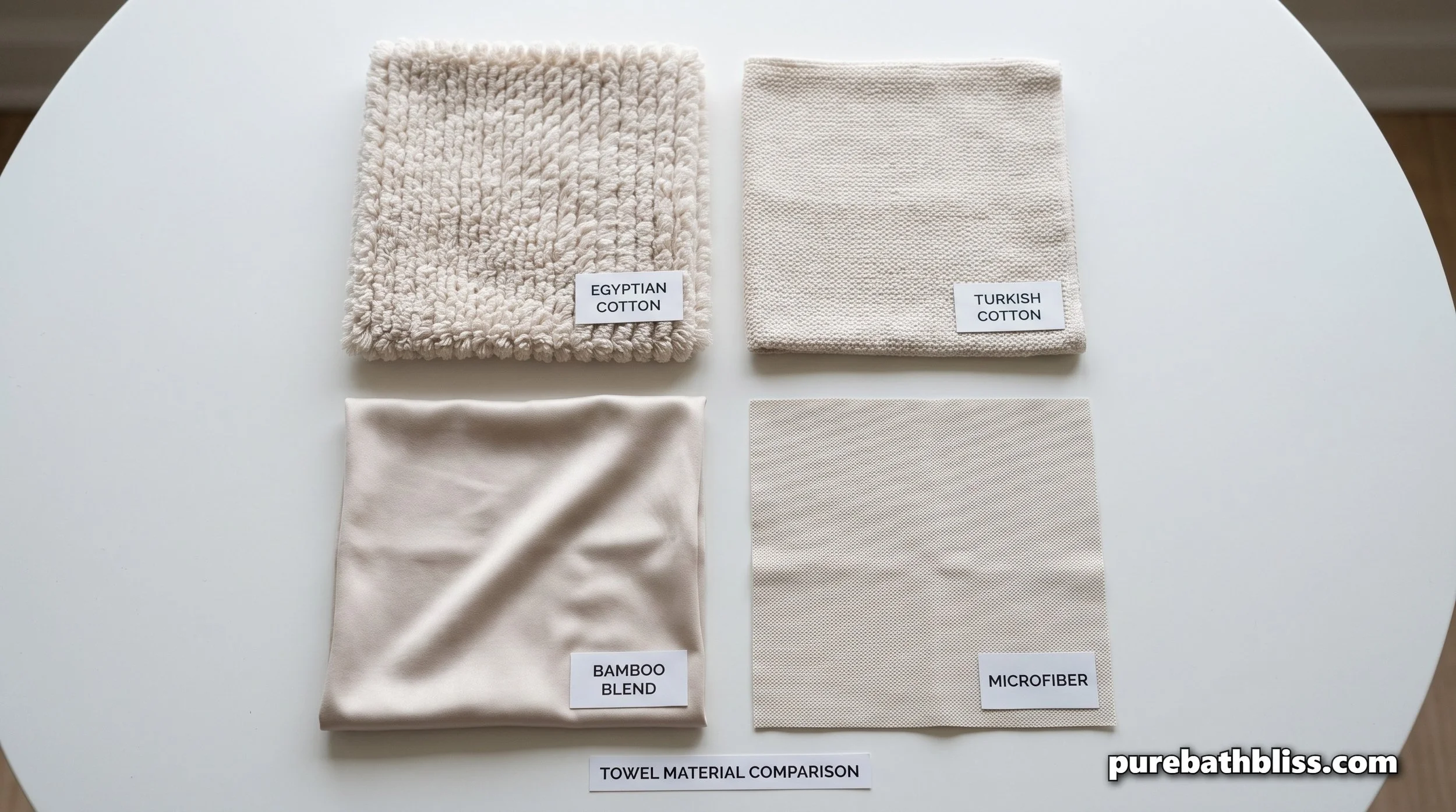
Egyptian cotton is grown in the Nile Delta and produces one of the longest natural cotton fibers available, typically 38mm or longer. The length of the fiber, called the staple length, is the most important single variable in cotton quality. Longer fibers produce smoother, stronger yarn with fewer exposed fiber ends, which means less pilling, higher absorbency per gram of fiber, and a softness that increases rather than decreases with washing as the fibers open up over time. A genuine Egyptian cotton towel at 700 GSM is one of the best bath towels you can buy. The word "genuine" is doing real work in that sentence. The Egyptian cotton labeling on commercial products is notoriously unreliable: a 2016 investigation found that many towels labeled as Egyptian cotton contained as little as 20 percent actual Egyptian cotton fiber. Look for GOTS or Oeko-Tex certification alongside the Egyptian cotton claim, and treat any price under $30 for a bath towel claiming 100 percent Egyptian cotton as a significant red flag.
Turkish Cotton
Turkish cotton, grown in the Aegean region of Turkey, also produces long-staple fibers and has a specific advantage over Egyptian cotton in one area: drying speed. Turkish cotton towels dry significantly faster than Egyptian cotton towels at equivalent GSM because the fiber structure is slightly less dense, which allows air to circulate through the weave more efficiently. The practical difference is meaningful in a household bathroom where towels are used daily. A 600 GSM Turkish cotton towel will be ready to use again in four to six hours. A 700 GSM Egyptian cotton towel may take eight to twelve hours in a bathroom with standard ventilation. For daily-use bath towels, Turkish cotton is frequently the more practical choice. For occasional use or a genuinely spa-like experience, Egyptian cotton wins on plushness and absorbency.
Pima and Supima Cotton
Pima cotton, branded as Supima when it meets the highest quality standards, is American-grown long-staple cotton with properties very similar to Egyptian cotton. It is softer and more absorbent than standard cotton, produces less pilling, and is more reliably labeled than Egyptian cotton since Supima certification is strictly controlled. A Supima-certified towel is a genuinely trustworthy premium cotton choice and often better value than equivalently priced Egyptian cotton products whose fiber content claims cannot be verified.
Bamboo
Bamboo towels are frequently marketed as the sustainable, eco-friendly, naturally antibacterial alternative to cotton and the marketing is partially accurate. Bamboo is genuinely fast-growing and requires less water than cotton to produce. New bamboo towels are genuinely very soft, often more silky-smooth than equivalent cotton at the same price point.
The problem that most bamboo towel reviews do not mention is what happens after repeated washing. Bamboo fiber, particularly bamboo rayon which is the most common form used in towels, degrades faster than long-staple cotton under frequent hot-water washing and machine drying. The absorbency that is a selling point in year one drops measurably by year two and the silky softness often gives way to a slightly stiff or scratchy texture. For someone who washes their towels weekly at a high temperature, a bamboo towel typically has a useful life of twelve to eighteen months before performance noticeably degrades. A good Egyptian or Turkish cotton towel at equivalent price should last five to ten years. For daily-use bath towels, cotton is the more durable choice. Bamboo hand towels or face cloths where the softness is the primary benefit and the durability requirement is lower are a better application for the material.
Microfiber
Microfiber towels are made from synthetic fibers, typically polyester and nylon, split into extremely fine filaments. They are genuinely fast-drying, highly absorbent in a technical sense, and very lightweight. They are also not what most people want in a bath towel because they feel synthetic against skin and because they shed microplastics into the water supply with every wash. Microfiber is the right material for gym towels, travel towels, and camping towels where weight and dry speed are the primary requirements. For the family bathroom used daily, the microplastic shedding concern alone is enough reason to choose a natural fiber alternative. Our guide to reducing toxic chemical load in the bathroom covers the microplastic shedding issue from synthetic textiles in more detail.
The Material Comparison at a Glance
| Material | Softness | Absorbency | Drying Speed | Durability | Best Use Case |
|---|---|---|---|---|---|
| Egyptian cotton | Excellent, improves with washing | Maximum | Slow | Excellent, 5 to 10 years | Guest bathrooms, luxury primary bathrooms with good ventilation |
| Turkish cotton | Very good, improves with washing | Very good | Moderate to fast | Excellent, 5 to 10 years | Daily-use family bathrooms. Best balance of quality and practicality. |
| Supima or Pima cotton | Excellent | Very good to excellent | Moderate | Excellent, 5 to 10 years | Most reliable premium cotton certification. Daily use or guest bathrooms. |
| Bamboo or bamboo blend | Excellent when new, degrades over time | Good when new, declines after 12 to 18 months | Moderate | Limited, 1 to 3 years for daily use | Hand towels, face cloths, occasional use. Not recommended for daily bath towels. |
| Standard cotton | Moderate, goes crunchy with hard water | Moderate | Moderate | Poor to moderate, 1 to 3 years | Budget option. Performance and longevity significantly below long-staple alternatives. |
| Microfiber | Synthetic feel, not plush | High technically, but feel is lacking | Very fast | Good, 3 to 5 years | Travel, gym, sport. Sheds microplastics. Not recommended for home bathroom daily use. |
Construction: What to Look for Beyond the Material
Material and GSM are the two most important factors but construction details determine the long-term performance of a towel in ways that affect whether it holds together after repeated washing or starts fraying and pilling within a year.
Terry loop height and density. Standard bath towels use a looped pile construction called terry, where small loops of yarn stand up from a flat base. The height and density of these loops determines how the towel feels and how much water it can hold. Tightly packed, tall loops hold more water but dry more slowly. Low-profile, looser loops dry faster but absorb less. This is the construction difference between a genuinely absorbent bath towel and a lightweight quick-dry towel, even at the same GSM.
Twist versus zero-twist yarn. Twisted yarn towels use tightly spun yarn that is stronger and more durable. Zero-twist yarn uses unspun cotton fibers that feel softer and more absorbent but are more fragile. A zero-twist Egyptian cotton towel feels extraordinary in the store and for the first year of use. It is also more likely to snag, pill, and lose its pile structure faster than a twisted yarn equivalent at the same fiber quality. For daily use in a family bathroom, twisted yarn is the more practical choice. Zero-twist is better suited to occasional use or a guest bathroom.
Double-stitched hems. The hem is where most cheap towels fail first. A single-stitched hem starts unraveling at the edges after a year of regular washing. Double-stitched or overlocked hems hold significantly longer. This is a construction detail you can check in a store by looking at the edges of the towel under reasonably good light. A hem that is already slightly uneven on a new towel is a reliable indicator of marginal hem construction.
Colorfast dyes. Towels that bleed color in the first few washes are using dyes with low colorfastness, which also correlates with the use of chemical fixing agents that can irritate skin. GOTS-certified organic towels use certified dyes that meet specific colorfastness and safety standards. Oeko-Tex Standard 100 certification confirms the finished product has been tested and verified free of harmful substances. Both certifications are worth looking for on any towel you are buying for regular contact with skin.
Why Cheap Towels Go Crunchy
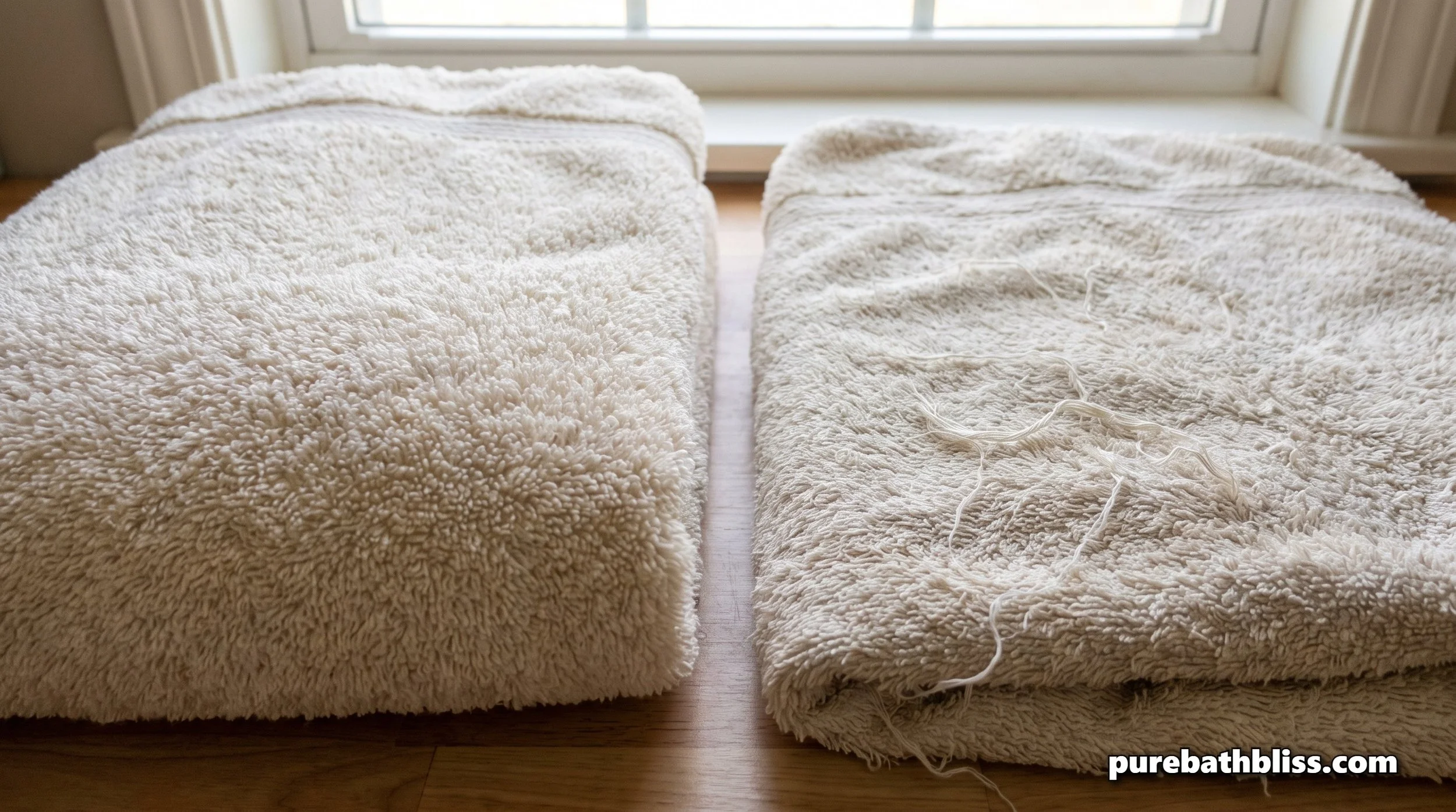
This is one of the most common bathroom textile questions and the answer is straightforward once you understand what is happening. Cheap towels are treated with silicone-based softeners and finishing chemicals during manufacturing to make them feel soft in the store. These treatments are water-soluble and wash out over the first three to six washes, revealing the actual fiber quality underneath. When the fiber quality is low, short-staple cotton with loose construction, the towel goes stiff and scratchy as the softening chemicals deplete.
The mechanism that makes even decent towels go crunchy over time is mineral buildup from hard water and detergent residue. Hard water leaves calcium and magnesium deposits in the fiber structure that stiffen the loops. Too much detergent, a very common laundry mistake, leaves residue that attracts mineral deposits and also stiffens the fabric.
The fix is simple: wash towels with half the recommended detergent quantity, add half a cup of white vinegar to the rinse cycle every three to four washes, and tumble dry on medium heat rather than high. The vinegar dissolves mineral deposits and detergent residue without damaging the fiber. Fabric softener, counterintuitively, makes the long-term crunchiness problem worse by coating the fiber loops with a film that reduces absorbency and attracts more mineral buildup over time. Skip the fabric softener entirely for bath towels. Our sister site Pure Kitchen Bliss covers the citric acid approach to softening stiff towels which applies to bath towels in exactly the same way it applies in the kitchen.
The Certifications Worth Paying Attention To
GOTS (Global Organic Textile Standard) is the gold standard for organic textiles. It covers the entire supply chain from raw fiber through processing and manufacturing, requiring that at least 70 percent of the fiber is certified organic and that all processing chemicals meet strict environmental and health standards. A GOTS-certified towel is the most reliable guarantee available that the organic claims on the label are genuine.
Oeko-Tex Standard 100 tests the finished product rather than the supply chain. It confirms that every component of the towel, including dyes, processing chemicals, and finishing treatments, has been tested and verified free of harmful substances at concentrations above defined safety thresholds. It does not certify organic fiber but it does guarantee chemical safety in the finished product.
Supima certification on a towel claiming Pima or Supima cotton is one of the few fiber origin claims you can actually trust. The Supima Association strictly controls use of the name and audits its members. A Supima-certified towel genuinely contains American-grown Pima cotton. Egyptian cotton certification is considerably less reliable as discussed above.
What to Actually Buy
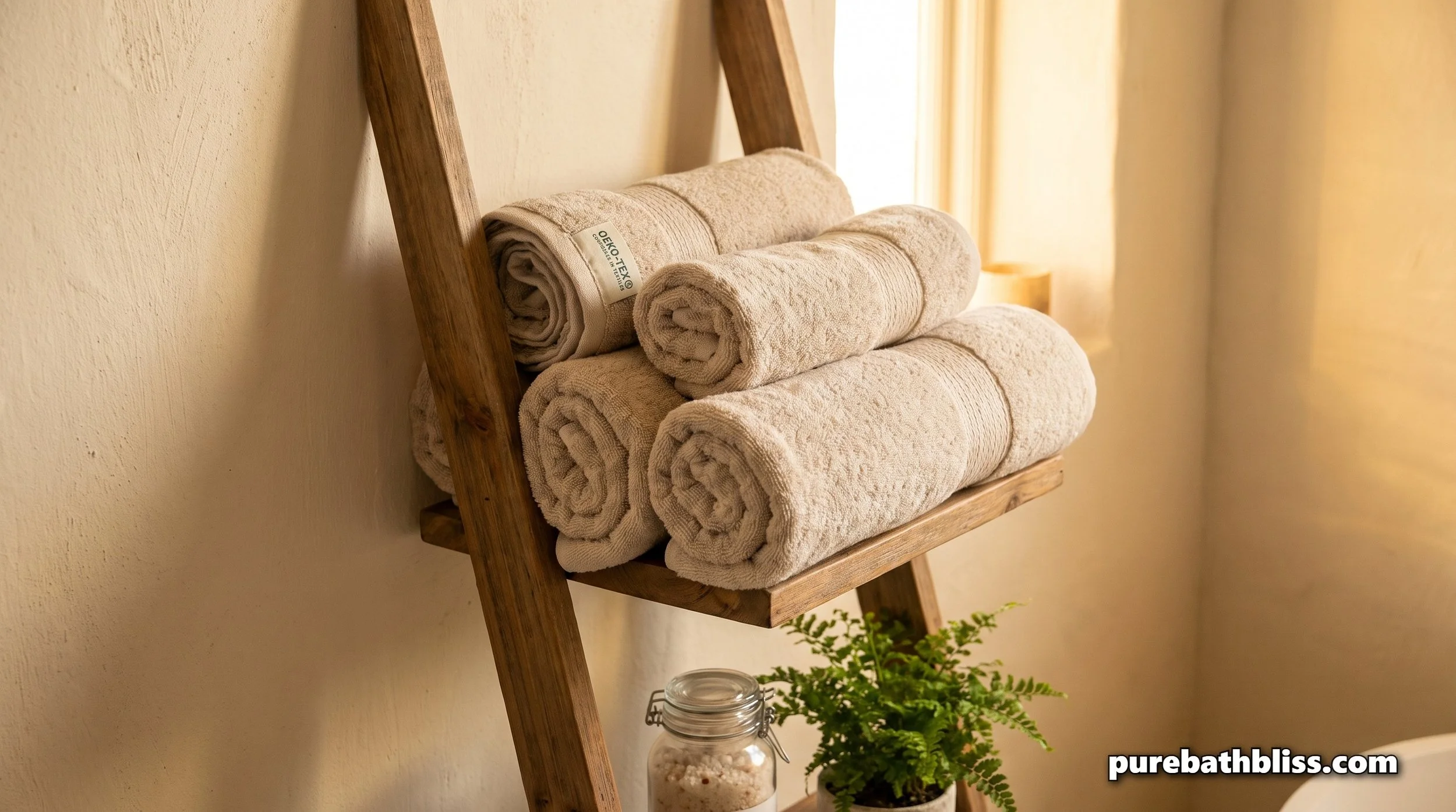
For the primary family bathroom used daily by adults: a 600 to 700 GSM Turkish cotton or Supima cotton towel with Oeko-Tex Standard 100 certification. Turkish cotton at this weight gives you the absorbency and plushness of a premium towel with a drying time that suits daily use. Turkish cotton bath towels at 600 to 700 GSM in this certification range represent the best balance of quality, longevity, and practical performance available at most price points.
For a guest bathroom or occasional use: 700 to 800 GSM Egyptian cotton or Supima cotton with GOTS certification if budget allows. The higher GSM is appropriate here because the towels are not being used daily and have sufficient time to dry between uses. GOTS-certified organic cotton bath towel sets in this weight range are the best choice for a guest bathroom where the impression the towel makes is as important as its daily practicality.
For children's bathrooms: 400 to 550 GSM in a quick-drying Turkish cotton or cotton-bamboo blend. Children's towels get used more frequently and need to dry faster between uses. Lighter weight also means children can manage them more easily. A lightweight organic cotton towel set for children at 400 to 500 GSM is practical without sacrificing the non-toxic material standards that matter particularly for products in daily contact with children's skin.
For gym or travel: microfiber if weight is the priority. Natural fiber if microplastic shedding concerns outweigh the convenience. A compact Turkish cotton travel towel at 300 to 400 GSM is the natural fiber alternative that is genuinely light enough for travel use.
How to Display and Store Towels for Maximum Lifespan
The display approach matters for both the bathroom aesthetic and the towel's longevity. A towel that is folded and stacked tightly on a shelf in a humid bathroom with poor ventilation will develop mildew in the lower layers faster than one hung on an open rail with good air circulation. Our guide to the spa fold towel technique covers the hotel-style folds that display towels attractively while maintaining the air circulation that prevents mildew. The rolled towel in a basket is the most practical storage approach for a family bathroom because it allows individual towels to be removed without disturbing the rest of the stack and keeps the display looking organized regardless of how many towels have been taken.
Replace bath towels when they no longer absorb water efficiently, when the pile has flattened significantly, or when they develop a musty smell that does not fully disappear after washing. For a quality Turkish or Egyptian cotton towel at 600 to 700 GSM washed weekly, this typically happens at five to eight years with proper care. For a bamboo towel at equivalent quality, expect two to three years. For a budget cotton towel at 400 GSM or below, expect one to two years before performance is noticeably compromised.