Originally published Nov 16, 2025 · Updated October 17, 2026
Transparency Note: We independently select these products based on research and user reviews. If you buy something through our links, we may earn a commission.
The little screen at the tip of your faucet is called an aerator, and it controls how much water comes out every time you turn on the tap. On many older faucets, it lets through 2.2 gallons per minute, the federal maximum. A water saving replacement costs a few dollars, takes a few minutes to install, and can cut that flow by a third or more without making hand washing or tooth brushing feel any different.
According to the EPA's WaterSense program, faucets account for more than 15 percent of indoor water use, and the agency estimates that an average family can save around 700 gallons a year by installing WaterSense labeled faucets or aerators. Because a lot of faucet water is warm, those savings also come with a small cut in water heating energy. It is not the biggest upgrade in the bathroom, but it is the cheapest and easiest by a wide margin.
The catch is that aerators are not one size fits all. They come in several thread sizes, some screw on from the outside and others are hidden inside the spout and need a special key, and the right flow rate for a bathroom sink is different from a kitchen sink. Most people who give up on this job do so because they bought the wrong size or could not get the old one out. This guide covers how to identify yours, swap it, and pick a flow rate you will actually like.
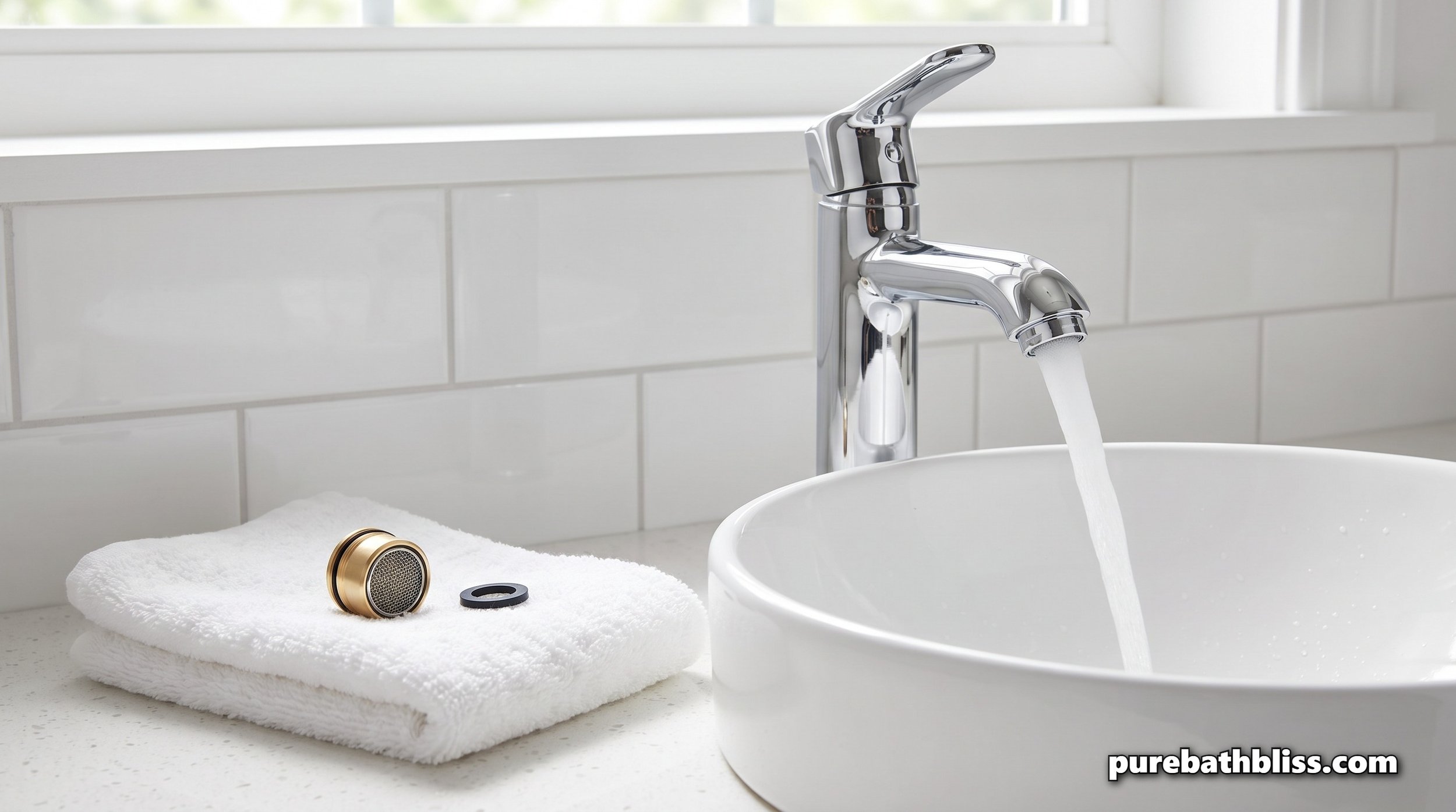
How Aerators Work and Which Flow Rate to Choose
An aerator does two jobs. It contains a small flow restrictor that limits how many gallons per minute pass through, and it uses fine screens to mix air into the water, which makes a smaller flow feel full and soft rather than thin and splashy. Many better aerators also include pressure compensation, labeled PCA, which keeps the flow close to its rating even when your water pressure changes.
Flow rates are stamped on the side of most aerators in tiny print. The federal maximum for faucets is 2.2 gallons per minute. To earn the WaterSense label, a bathroom faucet or aerator must use 1.5 gallons per minute or less, and California and some other states set an even lower limit of 1.2 for bathroom faucets. Aerators are also commonly sold at 1.0 and 0.5 gallons per minute for situations where you mainly need a quick rinse.
For most bathroom sinks, 1.0 to 1.5 gallons per minute is the sweet spot. Hand washing, tooth brushing, and face washing all work comfortably in that range. I would go to 1.0 for a bathroom used mostly by adults and 1.5 if the sink is also used for filling a cup for rinsing or for kids who like a stronger stream. Below 1.0, some people find the flow too gentle for comfortable use.
Kitchen sinks are different. A lower flow saves water when the tap is running for rinsing, but it does nothing when you are filling a pot, because the pot needs the same amount of water regardless, and it just takes longer to fill. For the kitchen, 1.5 to 1.8 gallons per minute is a reasonable balance, and a swivel aerator that switches between a stream and a spray is worth considering. If your kitchen faucet also has a pull out sprayer that leaks, our sister site's guide to fixing a leaky kitchen sink sprayer hose covers that repair.
| Where | Recommended Flow | Notes |
|---|---|---|
| Federal maximum (any faucet) | 2.2 GPM | Common on older faucets |
| WaterSense bathroom faucet | 1.5 GPM or less | Some states, including California, limit to 1.2 GPM |
| Bathroom sink (adults) | 1.0 to 1.2 GPM | Comfortable for hand washing and brushing |
| Bathroom sink (families) | 1.5 GPM | Stronger stream for kids and rinsing cups |
| Kitchen sink | 1.5 to 1.8 GPM | Lower flow only slows pot filling, not saves |
| Exposed aerator sizes | Regular, junior, tom thumb | Male or female threads; dual thread fits most regular faucets |
| Hidden cache aerator sizes | M16.5, M18.5, M21.5, M22, M24 | Needs a matching removal key |
Identify Your Aerator Before You Buy
The most common mistake with this job is buying the wrong size, so start by figuring out what you have. Look at the tip of the faucet. If you can see a round metal or plastic housing with flat sides or a knurled edge that screws onto the outside of the spout, you have a standard exposed aerator. If the end of the spout is flush and smooth with only a screen or a small plastic insert visible inside it, you have a hidden aerator, often called a cache aerator, which needs a removal key.
For exposed aerators, the next question is thread type. If the threads are on the outside of the faucet spout and the aerator screws over them, the aerator has female threads. If the threads are on the inside of the spout and the aerator screws into it, the aerator has male threads. Then there is size: regular, junior, and tom thumb are the common sizes, with regular being the most widespread on older faucets. Many replacement aerators are dual threaded, with both male and female threads, which makes them fit most regular sized faucets either way.
The easiest way to get it right is to remove the old aerator first and take it with you to the hardware store, or compare it to a coin: a regular size aerator is roughly the size of a quarter, and a junior is closer to a nickel. If you are ordering online, measure the outside diameter of the faucet tip and check whether the threads are inside or out before you buy.
Hidden cache aerators come in metric sizes, commonly M16.5, M18.5, M21.5, M22, and M24, and many major faucet brands use them. You will need the correct size key to remove the insert. An inexpensive multi size key set, such as this five size cache aerator key set, covers most faucets and is worth keeping in a drawer. Your faucet manufacturer's website will usually list the replacement aerator part number for your model, which is the surest way to get a matching cache insert at the right flow rate.
What You Need for This Job
A replacement aerator in the right size and flow rate, such as the Neoperl 1.0 GPM WaterSense dual thread aerator for bathrooms or the Neoperl 1.5 GPM dual thread aerator for a stronger flow.
A cache aerator key set if your faucet has a hidden aerator.
A rag or a strip of rubber to protect the finish, slip joint pliers or an adjustable wrench, an old toothbrush, and a cup of white vinegar for any stuck or scaled threads.
Step by Step: Swapping an Exposed Aerator
You do not need to shut off the water supply for this job; closing the faucet handle is enough, since the aerator sits after the valve. Put the stopper in the sink or lay a small towel over the drain, because aerators have several tiny parts, including washers and screens, and they love to disappear down the drain.
Try to unscrew the old aerator by hand first, turning it counterclockwise as you look up at it from below. Many will come off with a firm grip, especially if your hands are dry. If it will not budge, wrap the aerator in a rag or a piece of rubber, then grip it with slip joint pliers or an adjustable wrench and turn gently. The rag protects the chrome finish from the jaws. Do not squeeze hard, since older aerator housings are thin and can deform.
If it is stuck with mineral scale, fill a small plastic bag with white vinegar, slip it over the faucet tip so the aerator is submerged, secure it with a rubber band, and leave it for an hour. The vinegar dissolves the deposits that lock the threads. Our guide to using white vinegar in the bathroom covers the same trick for showerheads. Once the old aerator is off, clean the faucet threads with an old toothbrush.
Check that the rubber washer is seated inside the new aerator, then thread it on by hand, clockwise, making sure it starts straight rather than cross threading. Tighten it firmly by hand, then give it a slight extra snug with the wrapped pliers if needed. Thread seal tape is usually unnecessary here, because the rubber washer does the sealing, and tape can actually prevent the aerator from seating against the washer properly. Turn the water on and check for leaks at the threads; if it drips, tighten slightly more.
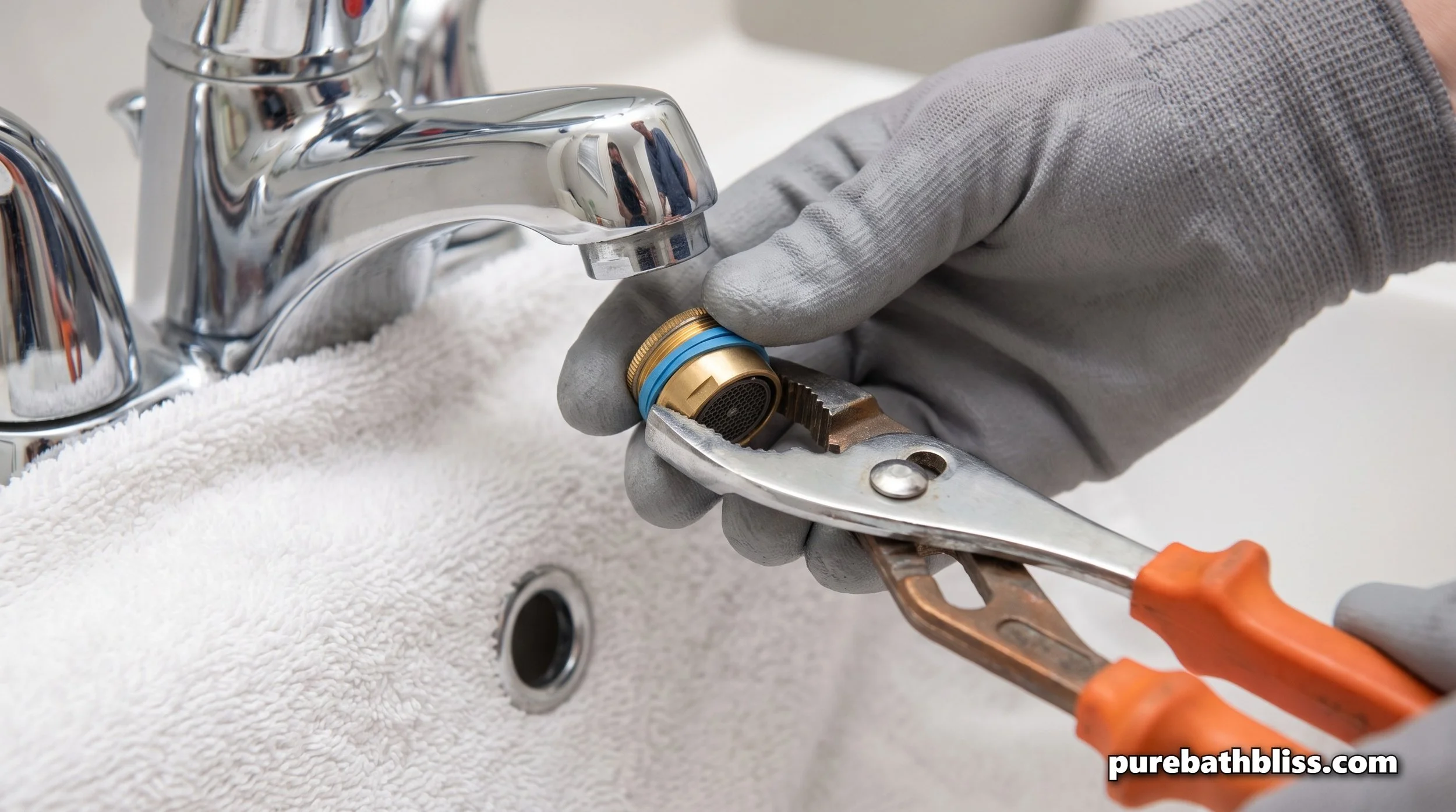
Step by Step: Removing a Hidden Cache Aerator
Hidden aerators are where most people get stuck, but with the right key they are just as quick. Look into the end of the spout. You will see a plastic insert with notches or tabs around its edge. Try each key in your set until you find the one that fits snugly into those notches without wobbling.
Push the key into the insert, then turn it counterclockwise. The insert should unscrew and drop out, often with a small rubber washer above it. If it is tight, a few minutes of the vinegar bag trick helps here too. Be gentle; the plastic insert is thin, and forcing a poorly fitting key can strip the notches.
Clean the insert and the inside of the spout, then either reinstall the original insert if you only wanted to clean it, or install a lower flow replacement made for your faucet model. Many cache aerators come in several flow rates from the faucet manufacturer, so you can often buy a 1.2 or 1.0 GPM insert that fits exactly. Screw it in clockwise with the key until it is snug, then test for leaks.
One tip from experience: when you find the right key size, write it on a piece of tape inside the vanity door. Aerators need cleaning every few months in hard water areas, and you will save yourself the trial and error next time.
Maintenance and Troubleshooting
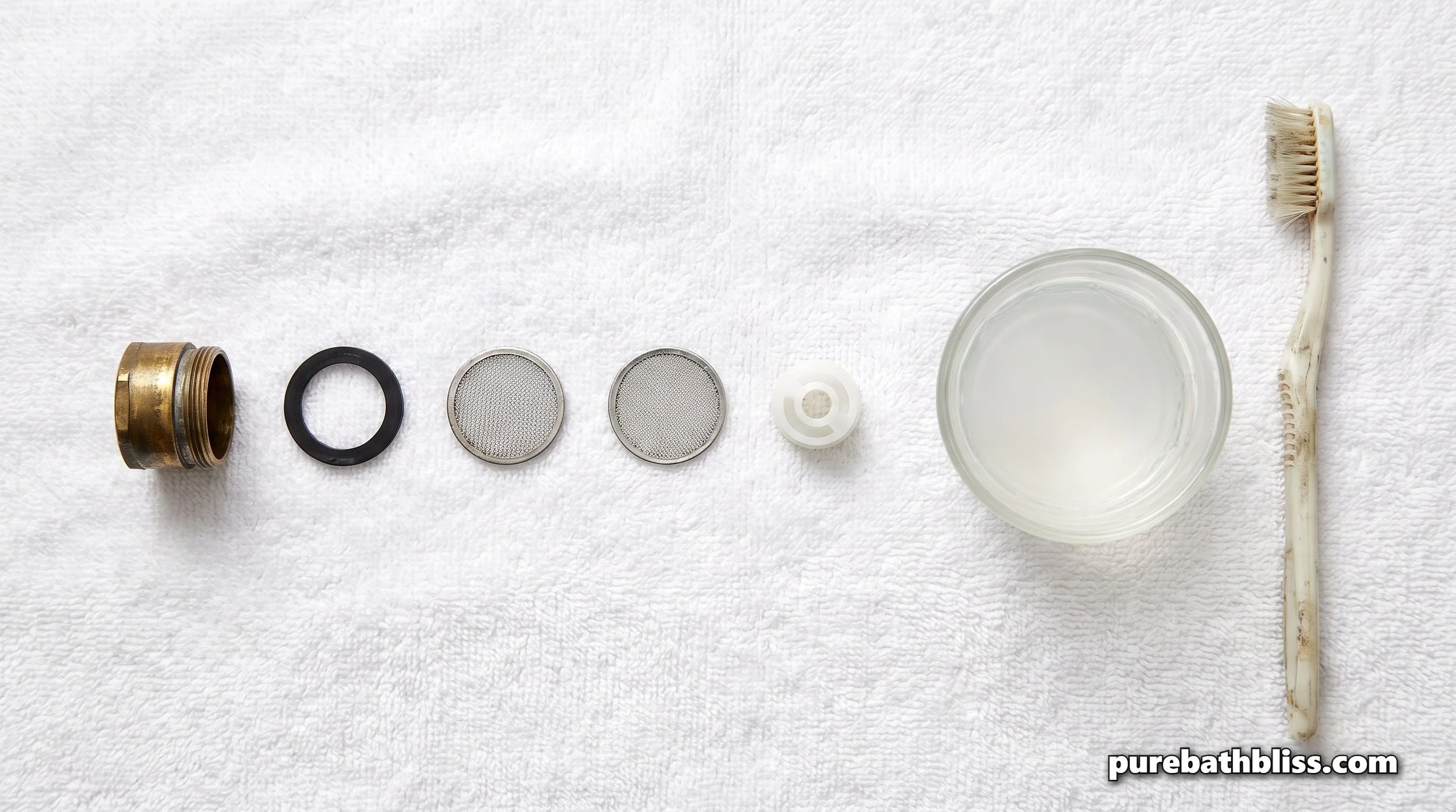
In hard water areas, aerators gradually clog with mineral scale and with small bits of sediment from the pipes. The sign is a flow that slowly gets weaker or starts to spray sideways. Unscrew the aerator every few months, take it apart if it separates, soak the parts in white vinegar for an hour or overnight, scrub the screens with an old toothbrush, rinse, and reassemble in the same order. Lay the parts out in a line as you remove them so you remember the order.
If the flow is suddenly weak after any plumbing work, sediment is the usual cause. When the water supply is shut off and turned back on, it often stirs up debris that collects in the aerator screen. Removing and rinsing the aerator usually fixes it in minutes.
If water sprays out sideways around the aerator, the washer is missing, damaged, or not seated, or the aerator is cross threaded. Remove it, check the washer, and reinstall it carefully. If the flow feels far weaker than expected after installing a new low flow aerator, check the stamped flow rate; it is easy to buy a 0.5 GPM aerator by mistake when you wanted a 1.0 or 1.5.
Finally, if your faucet drips from the spout even when it is turned off, the aerator is not the problem; the cartridge or washer inside the faucet body is worn. That is a separate repair, and a dripping faucet wastes far more water than any aerator saves, so it is worth fixing promptly.
Where Aerators Fit in a Water Saving Bathroom
Aerators are the easiest win in a bathroom water upgrade, but they are not the biggest. The toilet and the shower use far more water, so if you are working through the whole room, our bathroom water audit covers every fixture in order of impact. For the shower, our guide to choosing a low flow showerhead that still feels powerful covers the next step up.
Habits still matter at the sink. Turning off the tap while brushing your teeth or shaving saves more water than any aerator, because no water is better than slower water. In a house with kids, a low flow aerator also helps limit how much water runs while little ones get distracted at the sink.
If you have older toilets in the house, they are often the next best target after the faucets. Our guide on making an old toilet use less water covers what actually works and what is a myth.
The Bottom Line
A faucet aerator swap takes a few minutes and a few dollars, and an average family can save around 700 gallons a year by switching to WaterSense rated aerators. Identify your aerator first: exposed or hidden, male or female threads, and regular, junior, or tom thumb size. Take the old one to the store if you can, and pick a dual thread replacement for the widest fit.
For bathrooms, choose 1.0 to 1.5 gallons per minute; for kitchens, 1.5 to 1.8. Skip the thread tape, rely on the rubber washer, and keep a cache key set if your faucets have hidden aerators. Clean them every few months in hard water areas, and the flow will stay strong for years.
Greg is a Red Seal Carpenter, coffee shop owner, dad of four, and founder of Pure Bath Bliss. He writes about making smarter choices for your home and family.