Japandi Bathroom Design: The Complete Guide to Getting It Right
Transparency Note: We independently select these products based on research and user reviews. If you buy something through our links, we may earn a commission.
Farmhouse bathrooms peaked around 2022. Shiplap, apron sinks, and mason jar accessories had their moment and then the saturation point arrived where the style started feeling like a template rather than a choice. The design category that replaced it on Pinterest, in Houzz project galleries, and in renovation conversations is Japandi, the fusion of Japanese minimalism and Scandinavian hygge, and it has been building momentum for three years to the point where it is now the dominant bathroom aesthetic in high-end residential design.
The appeal is not hard to understand. A Japandi bathroom is calm in a way that farmhouse never was, because calm is the point rather than a side effect of the design choices. It ages well because it is built on a philosophy of natural materials and honest craftsmanship rather than a specific look tied to a cultural moment. And it aligns naturally with the non-toxic, natural material approach to the home that this site is built on, because a bathroom that uses solid wood, handmade ceramics, natural stone, and linen cannot contain the synthetic compounds that a mass-produced, high-gloss, plastic-rich bathroom inevitably does.
Here is the complete guide to what Japandi actually means, the five principles that define it in practice, the specific materials and color choices that make it work, and how to achieve different levels of the aesthetic depending on your budget and renovation scope.
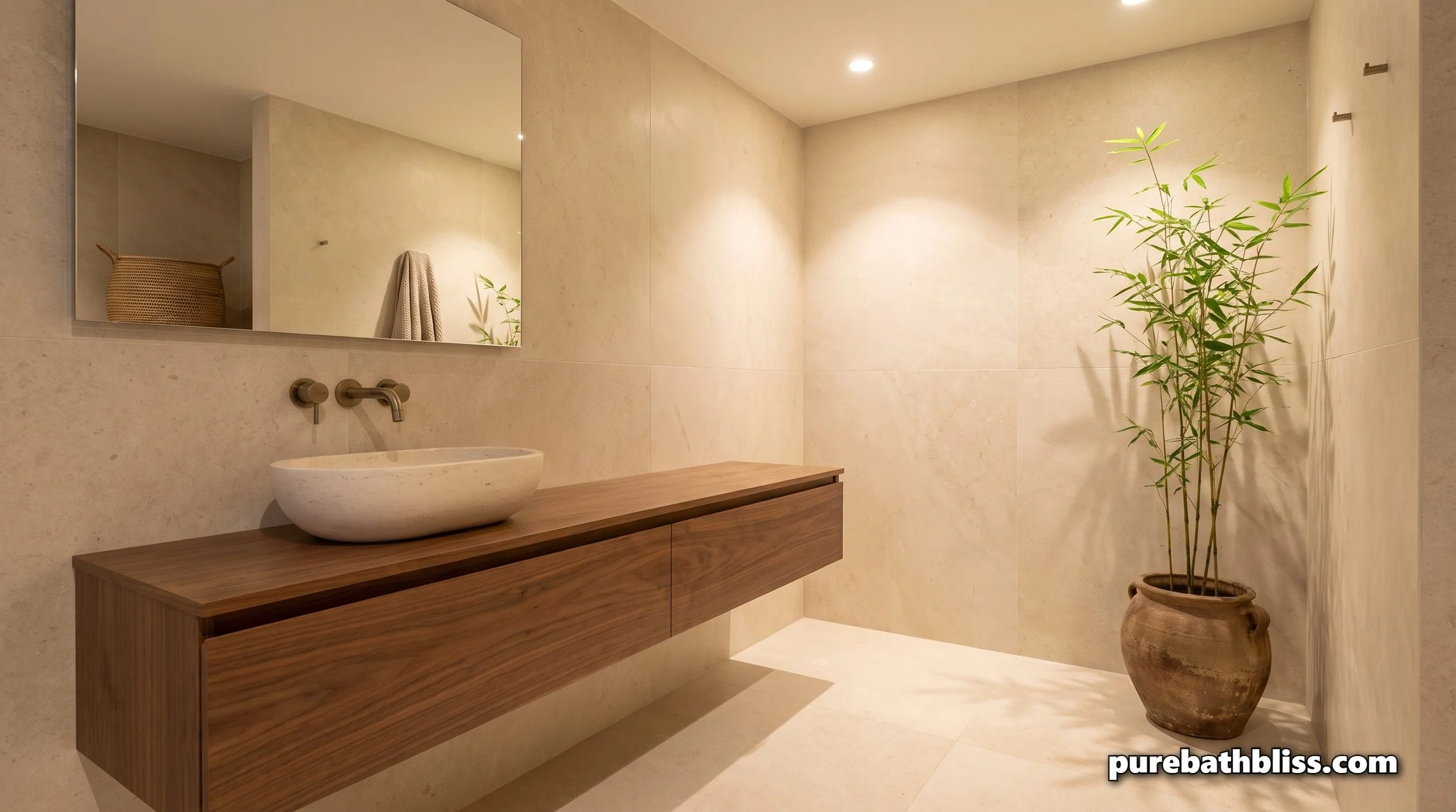
What Japandi Actually Means
Japandi is a portmanteau of Japan and Scandi, and it is more than an aesthetic category. It is the intersection of two distinct design philosophies that happen to share several foundational values.
The Japanese contribution is wabi-sabi, a philosophical framework that finds beauty in imperfection, impermanence, and incompleteness. Wabi-sabi is why Japandi spaces use materials that develop a patina, solid wood that darkens with age, linen that softens with washing, handmade ceramics with slightly uneven glazing, rather than materials that try to look perfect indefinitely. A factory-uniform ceramic soap dish is not Japandi. A slightly off-round bowl thrown by a maker's hands is.
The Scandinavian contribution is hygge, the Danish and Norwegian concept of creating warmth, ease, and cozy intentionality in a space. Hygge is why Japandi spaces are warm rather than cold, why the wood tones are honey and walnut rather than bleached white, and why the lighting is layered amber rather than bright overhead white.
The combination of these two philosophies produces a design approach where every object in a room is there for a reason, where natural materials are used because of their sensory and environmental honesty rather than their visual effect, where clutter is eliminated not for minimalism's sake but because negative space is considered as important as filled space, and where the room is designed to feel calming to be in rather than impressive to photograph. In a bathroom specifically, this translates directly to a better daily experience rather than just a better-looking room.
The Five Principles of a Japandi Bathroom
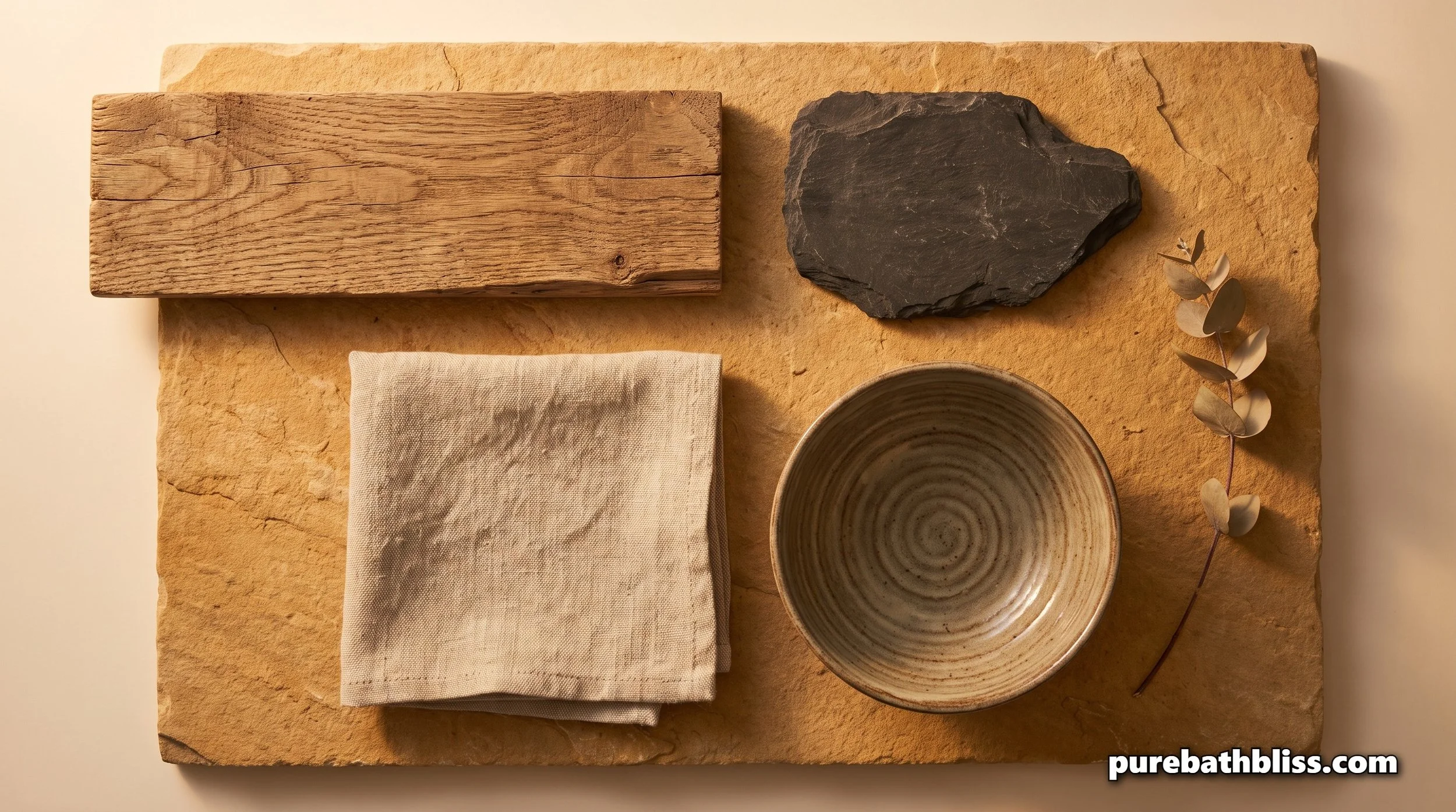
Principle 1: Natural Materials Only
This is the non-negotiable foundation. Japandi uses wood, stone, linen, clay, bamboo, and rattan. It does not use lacquered surfaces, synthetic materials presenting as natural ones, or anything with a high-gloss finish. In a bathroom context, this means solid wood rather than MDF with wood-look veneer, stone or stone-look matte porcelain rather than polished marble-look gloss tile, handmade ceramics rather than factory ceramics, and natural fiber textiles rather than polyester towels or bath mats. The natural material rule also supports the non-toxic bathroom approach: a bathroom built from natural materials cannot contain the synthetic plasticizers, formaldehyde releasers, and synthetic fragrance compounds that manufactured composite materials routinely do.
Principle 2: A Warm, Grounded Palette
The 2026 Japandi palette has shifted from the cool, neutral palette of its earlier iterations toward warmer earth tones. The current palette is warm white, soft sand, light clay, and warm greige as the base, supplemented by honey oak, walnut, and dark ash wood tones, with accent colors of muted sage green, terracotta, soft indigo, and moss. Nothing artificial, nothing loud. Walls should be in shades that read like natural surfaces: limestone white, warm plaster, clay beige, or undyed concrete. Avoid pure cool white without warm undertones, which reads as clinical rather than calm. Avoid stark contrast, which reads as dramatic rather than grounded.
Principle 3: Layered Warm Lighting
The lighting in a Japandi bathroom is one of the most impactful single changes available and one of the most consistently underspecified in renovation planning. Japandi lighting is warm, layered, and at 2700K color temperature rather than the 4000K or higher that most standard bathroom vanity lights produce. A 2700K bulb produces the amber warmth of candlelight. A 4000K bulb produces the bright white of a commercial office. The difference in how a bathroom feels to be in at 6am or 9pm is significant and completely determined by this number on the bulb packaging. Layered means at least two sources: task lighting at the vanity mirror and ambient lighting from a separate ceiling fixture or recessed lights. Overhead-only lighting, however warm the bulb, produces harsh shadows that undermine the spa quality of the space.
Principle 4: Negative Space as a Design Element
The Japanese concept of ma refers to the intentional use of negative space, the empty space between objects, as a design element in its own right rather than simply a gap waiting to be filled. In a Japandi bathroom, the empty counter space beside the sink is not a failure to accessorize. It is a deliberate design choice. The rule of thumb for Japandi accessorizing is a maximum of five objects on any open surface, and each of those five objects should earn its place by being either functional or genuinely beautiful, not decorative for decoration's sake. A hand-thrown ceramic soap dish is both functional and beautiful. A collection of decorative seashells is neither. Clutter is the enemy of the calm that Japandi is designed to produce.
Principle 5: Purposeful Imperfection
Wabi-sabi's acceptance of imperfection is what most distinguishes Japandi from standard minimalism, which tends toward clinical perfection. A Japandi bathroom actively embraces materials and objects that show their making and their age. The slightly uneven glaze on a handmade ceramic vessel. The grain variation in a solid wood vanity. The subtle texture variation in a handmade tile. The way a linen towel wrinkles rather than lying flat. These imperfections are not flaws to be corrected. They are evidence that the objects are made from natural materials by human hands, which is exactly the quality that makes them appropriate for a Japandi space.
The Materials That Define a Japandi Bathroom
| Element | Japandi Choice | Avoid | Why |
|---|---|---|---|
| Wall surface | Large format matte stone-look porcelain, limewash paint, clay plaster, microcement, tadelakt | Glossy subway tile, polished marble look, bright white gloss | Matte surfaces absorb light rather than reflecting it, producing warmth rather than clinical brightness |
| Vanity material | Solid walnut, honey oak, or dark ash. Wall-mounted floating design. | White painted MDF, laminate with printed wood texture, floor-standing with visible legs in multiple finishes | Natural grain development over time is the wabi-sabi quality that manufactured finishes cannot replicate |
| Sink | Stone vessel or undermount in matte limestone, travertine, or concrete | Polished white porcelain, chrome-edged undermount, glass vessel | Natural stone reads as honest material. Polished porcelain reads as manufactured. |
| Hardware finish | Aged brass, unlacquered brass, or matte black | Polished chrome, brushed nickel, gold plate | Aged and unlacquered finishes develop patina over time, expressing the wabi-sabi principle through metal |
| Towels | Natural linen or Turkish cotton in undyed, greige, sage, or warm white | Bright white polyester-cotton blend, patterned or embroidered towels | Natural fibers age gracefully. Synthetic blends do not develop the patina quality that Japandi values. |
| Accessories | Handmade ceramics with visible throwing marks, natural wood, stone, bamboo | Factory ceramics with uniform glaze, plastic accessories, chrome dispensers | The evidence of making is the quality, not a flaw. Factory uniformity is the opposite of wabi-sabi. |
| Lighting color temperature | 2700K warm white, layered from at least two sources | 4000K or higher cool white, single overhead fixture only | 2700K produces amber warmth. 4000K produces office brightness. The number on the bulb determines the entire feeling of the room. |
Wall Surfaces
The standard subway tile that defines farmhouse bathrooms is specifically what Japandi moves away from. The preferred wall surfaces for a Japandi bathroom in 2026 are large format matte stone-look porcelain in warm sand or greige tones, limewash paint which produces the textured depth that flat paint cannot, clay plaster or microcement for a seamless organic finish, and tadelakt, a waterproof Moroccan lime plaster that is the most authentically wabi-sabi wall finish available for a wet environment. Each of these surfaces catches light differently throughout the day and develops character over time rather than looking the same on day one and day one thousand. Our guide to microcement in the bathroom covers the application requirements and maintenance for the most popular of these seamless finishes.
The Vanity
A floating vanity in solid wood is the centerpiece of a Japandi bathroom. Wall-mounted rather than floor-standing, which creates the visual lightness that makes a Japandi bathroom feel open rather than heavy. Warm wood tones, honey oak, walnut, or dark ash, rather than painted white or light Scandinavian blonde. Handle-free doors with push-to-open mechanisms or minimal integrated pulls rather than decorative hardware on the cabinet fronts. The vanity should look as though it was made rather than purchased, which means solid wood construction with visible grain rather than laminate or MDF with printed wood texture. The stone vessel sink or undermount stone sink in matte limestone or travertine completes the natural material pairing.
Hardware and Fixtures
The 2026 Japandi hardware shift is one of the most significant updates to the aesthetic from its earlier iterations. The original Japandi palette used brushed nickel or matte black exclusively. The 2026 version has moved to aged brass and unlacquered brass as the preferred hardware finish, with matte black remaining as an appropriate dark accent. Aged brass ages naturally, darkening in recessed areas while the raised surfaces remain bright, which is the visual expression of wabi-sabi applied to metal. Unlacquered brass starts bright and develops a warm, lived-in patina over months and years. Both are the opposite of the eternally bright, identical-looking polished chrome that conventional bathroom hardware attempts to maintain.
Aged brass bathroom faucets in a simple, low-profile design without decorative scrollwork or traditional detailing are the right choice for the Japandi hardware approach. Similarly, aged brass towel bars and hooks with a minimal cross section and no decorative elements at the mounting points are what distinguishes Japandi hardware from farmhouse brass, which tends toward heavier profiles with more decorative detail.
The Japandi Bathroom Accessories
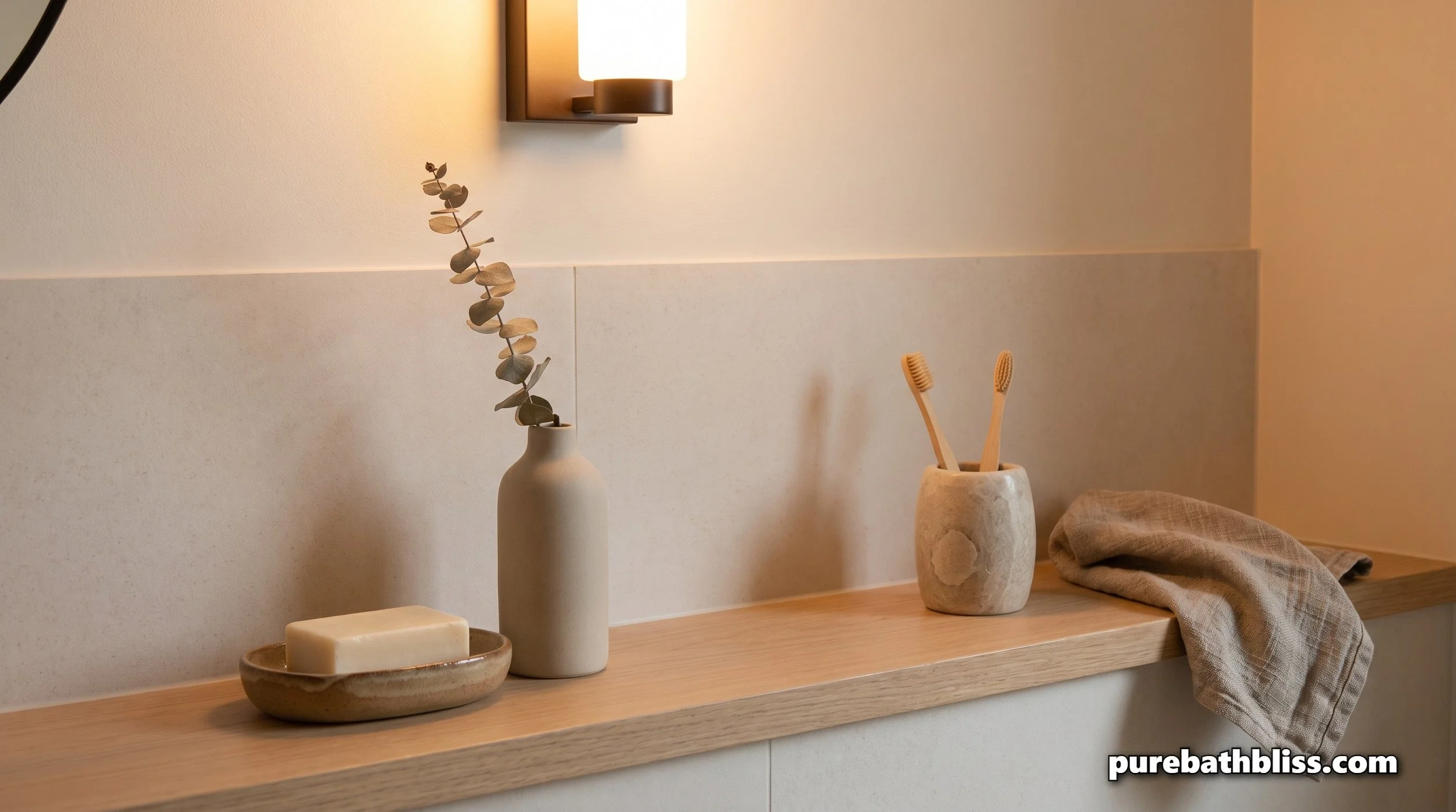
The accessories are where most Japandi bathroom attempts go wrong. The principle of fewer, better objects is straightforward in theory and difficult in practice for anyone accustomed to a fully accessorized bathroom counter. The test for every object: is it functional, beautiful, or both? If it is neither, it does not belong in a Japandi bathroom.
Ceramics. Handmade ceramic soap dishes, toothbrush holders, and small vessels with visible throwing marks, slightly irregular glazing, and matte or semi-matte finishes in warm sand, greige, or sage tones are the most direct expression of the wabi-sabi principle in a bathroom accessory. Factory ceramics with perfectly uniform glazing are not Japandi. The irregularity is not a quality issue. It is the quality.
Textiles. Linen towels in undyed, warm greige, or muted sage tones rather than bright white cotton. Linen has the natural texture variation, the slight wrinkle, and the softening-with-washing quality that aligns with wabi-sabi's acceptance of imperfection. Natural linen bath towels also happen to be among the most durable and fast-drying towel options available, which suits a Japandi bathroom where every object should earn its place practically as well as aesthetically. The spa fold technique we cover in our hotel towel guide produces the rolled display that suits a Japandi bathroom counter or open shelf.
Plants. A single plant rather than a collection. Bamboo, snake plant, or a small moss arrangement in a handmade ceramic pot. The plant provides the living, natural element that connects the bathroom to the outside world in a way that no decoration can replicate. It also improves air quality, which connects naturally to the healthy home approach that runs through everything on this site. Our guide to plants that thrive in low-light bathrooms covers the specific species that do well in the warm, humid conditions of a bathroom without natural light.
Dried botanicals. A single stem of pampas grass, dried eucalyptus, or dried flowers in a narrow ceramic or bamboo vase is the Japandi botanical accessory that works in a bathroom where a live plant is not practical. It adds organic texture and natural color without requiring care or creating humidity concerns. The key is restraint: one stem in one vase, not a large arrangement.
The Japandi Scent Layer
A Japandi bathroom smells of natural materials rather than synthetic fragrance. The scent philosophy is the same as the visual one: honest, natural, restrained. A single reed diffuser with cedarwood, hinoki cypress, sandalwood, or white tea essential oils rather than a synthetic room spray or plug-in. The reed diffuser from our DIY reed diffuser guide in an amber glass vessel with natural rattan reeds is the exact presentation that fits the Japandi aesthetic: functional, beautiful, and made from honest materials. The scent blend for a Japandi bathroom specifically: cedarwood 40 percent, hinoki or cypress 30 percent, white tea or yuzu citrus 30 percent. Warm, woody, faintly aromatic, and completely natural.
The same natural material philosophy that defines the Japandi bathroom applies to the kitchen in the Japandi home. The walnut and oak knife strip that Pure Kitchen Bliss covers in their wood-encased magnetic knife strip guide is a perfect example of the Japandi principle applied to a kitchen accessory: natural wood material, honest function, beautiful without trying. The same design logic that chooses a walnut knife strip over a stainless one chooses a walnut towel bar over a chrome one.
Achieving Japandi at Three Budget Levels
| Budget Level | Total Spend | What Changes | What Stays | Japandi Impact |
|---|---|---|---|---|
| Refresh | $500 to $2,000 | Lighting bulbs to 2700K, towels to linen, accessories to handmade ceramics, one plant, dried botanicals, reed diffuser with Japandi scent blend, counter declutter | Existing tile, vanity, fixtures, hardware | Surprisingly significant. Lighting and declutter alone transform how the room feels. Linen and ceramics shift the material palette immediately. |
| Partial renovation | $3,000 to $8,000 | Everything in refresh plus: limewash or clay plaster paint on walls, aged brass hardware replacement throughout, new linen window treatment, possibly a new vanity if existing is painted MDF | Existing tile and plumbing rough-in | Strong. Wall surface and hardware are the two elements that most define the Japandi character after lighting. A room with aged brass and textured walls reads as Japandi even with existing tile. |
| Full renovation | $15,000 to $40,000 | Complete tile replacement with large format matte stone-look porcelain or tadelakt, new floating solid wood vanity with stone sink, aged brass fixtures throughout, recessed 2700K lighting, all accessories and textiles | Plumbing rough-in position (unless full wet room conversion) | Transformative. A fully renovated Japandi bathroom is the closest a residential bathroom can get to a high-end boutique hotel spa without crossing into custom design territory. |
The entry point for a Japandi bathroom that genuinely achieves the aesthetic is lower than most people assume because the principle of fewer, better objects means the total accessory spend is often less than a conventional bathroom refresh. A $3,000 to $5,000 Japandi bathroom refresh is absolutely achievable if the existing bones are good and the renovation scope is limited to paint, accessories, textiles, lighting, and one or two key fixture swaps. A full Japandi bathroom renovation with new vanity, tile, and fixtures runs $15,000 to $40,000 depending on market and material selection, but the design philosophy means there are no unnecessary elements spending budget without delivering value. Everything in a Japandi bathroom earns its cost by being genuinely functional, genuinely beautiful, or both.