Transparency Note: We independently select these products based on research and user reviews. If you buy something through our links, we may earn a commission.
If you have been on TikTok in the past six months you have seen the videos. Someone installs a filtered showerhead and films their hair two weeks later. The before is dry, frizzy, and dull. The after is noticeably shinier, softer, and more defined. The comment section is full of people saying they had the same experience. The videos are compelling enough that the filtered showerhead category has become one of the fastest growing segments in bathroom products in 2026, with the Jolie filtered showerhead specifically generating hundreds of thousands of views across the platform.
I approached this category with the same skepticism I bring to any viral bathroom product. I have been in enough renovation projects to know that what looks transformative in a before and after video does not always hold up under scrutiny. So I looked at the actual filtration science, the certification data, the dermatologist guidance, and the specific claims being made by brands selling everything from $30 budget filters to $200 premium systems. Here is what the evidence actually says.
The short version: filtered showerheads genuinely work for chlorine removal and the skin and hair benefits from that are real and scientifically documented. The marketing around hard water softening and heavy metal removal is significantly overstated in most brands. The difference between a certified filter and a scam filter is significant and easy to spot once you know what to look for.
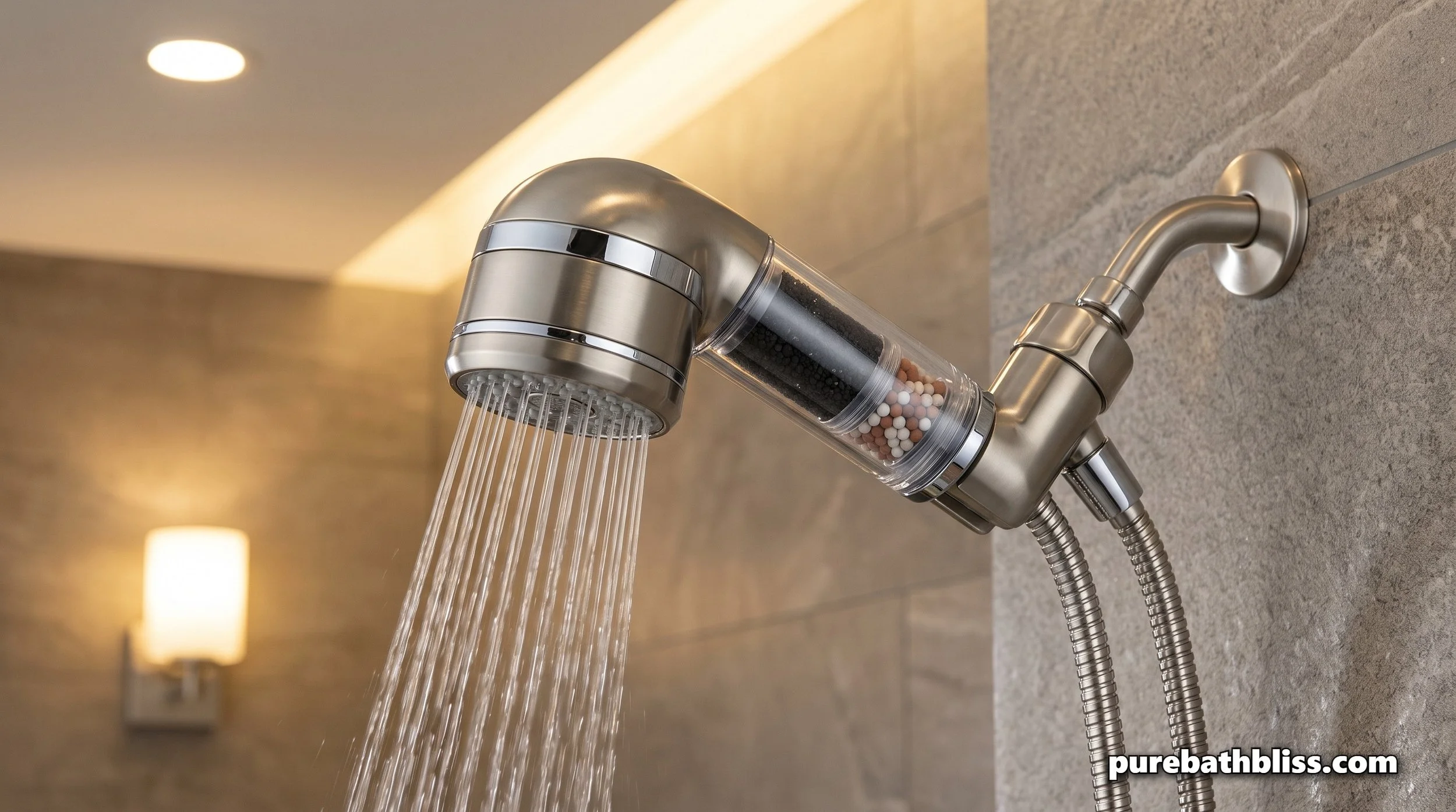
Why This Went Viral: The TikTok Filtered Showerhead Moment
The filtered showerhead trend on TikTok is genuinely one of the more legitimate viral bathroom product categories of 2026, which is a low bar given some of what comes through the platform, but worth acknowledging. The before and after hair transformation videos are compelling because the underlying mechanism is real. Chlorine in municipal water strips natural oils from hair and skin. Removing chlorine from shower water reduces that stripping effect. Hair that is not repeatedly stripped of its oils is shinier, softer, and less prone to breakage. The results people are filming are not fabricated. The science behind them is sound.
What Is Actually in Your Shower Water
Municipal water treatment in the United States adds chlorine or chloramine to drinking water to kill harmful bacteria and make it safe to consume. This is a genuinely important public health measure and the chlorine in your tap water is serving a real purpose. The problem is that the same chlorine that kills waterborne bacteria also strips natural oils from skin and hair when you shower with it daily.
Board-certified dermatologist Dr. Jenna Queller, quoted in CNN Underscored's June 2026 filtered showerhead review, describes the mechanism directly: chlorine strips natural oils from skin and hair, contributing to dryness and irritation. Approximately 85 percent of American homes have hard to very hard water, meaning the water also contains elevated levels of dissolved calcium and magnesium minerals that leave scale deposits on shower surfaces and can leave a film on hair and skin after showering.
A filtered showerhead addresses the chlorine problem effectively in certified models. The hard water mineral problem is a different matter entirely, and this is where the most significant marketing exaggeration in the category occurs.
What Filtered Showerheads Actually Do
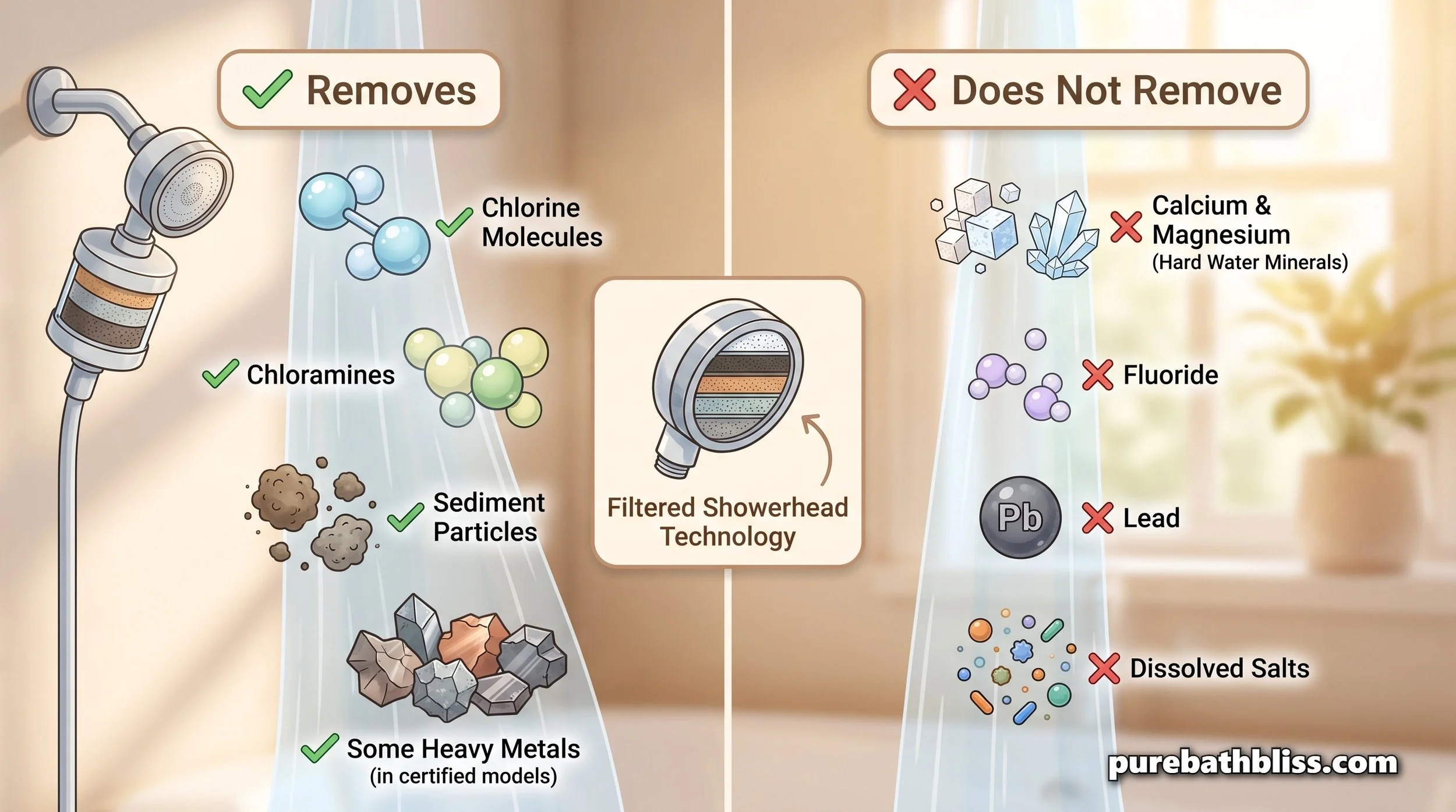
What they genuinely remove. A quality certified filtered showerhead using KDF-55 filtration media, which is a copper-zinc alloy that neutralizes chlorine through an electrochemical reaction, will reliably remove 85 to 99 percent of free chlorine from shower water depending on water temperature, flow rate, and the age of the filter cartridge. Calcium sulfite, the other common filtration media, converts chlorine to chloride, a harmless compound that is a natural electrolyte in the human body. Both approaches are effective for chlorine. Some certified models also reduce chloramine, a chlorine compound increasingly used by municipalities as an alternative to free chlorine, though chloramine is harder to remove and the removal rate is typically lower than for free chlorine.
What they do not remove despite the marketing. This is the most important thing to understand about the filtered showerhead category. A shower filter does not soften hard water. Hard water softening requires ion exchange, a process that replaces calcium and magnesium ions with sodium ions. This requires a whole-home water softener or a dedicated point-of-use softening system. No showerhead filter using KDF or calcium sulfite media achieves meaningful hard water softening regardless of how the packaging describes the product. If hard water mineral buildup on your shower tiles and glass is your primary problem, a showerhead filter will not solve it. A whole-home water softener will.
Similarly, certified shower filters do not remove fluoride, lead, or dissolved heavy metals at meaningful levels. The physics of shower filtration, hot water at high pressure flowing at 1.5 to 2.5 GPM through a small cartridge, limits what any showerhead filter can capture. Brands claiming to remove 10 to 15 or more contaminants including fluoride and heavy metals with no third-party certification are, in the assessment of Interior Medicine's 2026 filtered showerhead review by water systems experts, making claims that no shower filter has ever been certified to deliver. The pattern to watch for: a long list of contaminants claimed, no NSF or third-party certification, no published test data, and filtration media that sounds exotic but has no regulatory backing.
| Contaminant | Does a Filter Remove It? | What Actually Removes It | Skin and Hair Impact |
|---|---|---|---|
| Free chlorine | ✅ Yes, in certified KDF-55 and calcium sulfite models | KDF-55, calcium sulfite filtration media | High. Daily chlorine exposure strips skin oils and hair cuticle lipids. |
| Chloramine | ⚠️ Partially, in some certified models. Lower removal rate than free chlorine. | Catalytic carbon, some KDF media at high contact time | Moderate. Check whether your municipality uses chlorine or chloramine. |
| Sediment and particulates | ✅ Yes, most filters include a sediment layer | Mesh or fiber sediment pre-filter | Low to moderate. Protects showerhead nozzles more than skin directly. |
| Hard water minerals (calcium and magnesium) | ❌ No. Shower filters do not soften hard water. | Whole-home water softener using ion exchange | High. Hard water minerals leave film on skin and hair. Not addressable by showerhead filter. |
| Fluoride | ❌ No certified shower filter removes fluoride at shower conditions. | Reverse osmosis (drinking water only) | Minimal skin or hair impact from shower fluoride exposure. |
| Lead and heavy metals | ❌ Not at shower conditions. No showerhead filter is certified to remove lead. | Whole-home or under-sink certified lead filter | Primarily a drinking water concern rather than a showering one. |
| Bacteria | ⚠️ KDF-55 has bacteriostatic properties that inhibit bacterial growth in the filter but does not disinfect shower water. | Municipal chlorination (which the filter partially removes) is what controls bacteria in the water supply. | Minimal concern for healthy adults in municipal water areas. |
How to Spot a Scam Filter
The demand surge driven by TikTok has attracted brands whose marketing outpaces their evidence significantly. The price range of the category, from $20 budget inline filters to $200 premium showerhead systems, spans products with genuine third-party certification and products with no independent testing whatsoever. Here is exactly how to tell the difference.
NSF 177 certification is the gold standard. NSF Standard 177 is a voluntary testing standard maintained by NSF International, a global public health and safety organization. A product certified to NSF 177 has been independently tested and verified to reduce free chlorine in shower water by a specific percentage under standardized test conditions. This is the certification that Kyle Postmus, a water systems expert and senior manager at NSF, recommends looking for specifically when buying a showerhead filter. An NSF 177-certified filter has proved its chlorine removal claim under conditions that replicate actual shower use. A filter without this certification has not.
What the filtration media disclosure tells you. The filtration media inside a showerhead filter is the actual mechanism doing the work. KDF-55 (high-purity copper-zinc alloy) and calcium sulfite are the two media with documented effectiveness for chlorine removal under shower conditions. A filter that discloses these media specifically is telling you what is inside and how it works. A filter with a long list of proprietary or exotic-sounding media, vitamin C beads, infrared ceramic balls, tourmaline, without independent testing of their effectiveness under shower conditions, is describing marketing rather than filtration chemistry.
The 99.9 percent removal claim at unrealistic timeframes. Many budget filters claim 99.9 percent removal of chlorine and a list of other contaminants for unrealistically long filter lifetimes. The reality of shower filtration is that KDF-55 and calcium sulfite are effective at removing chlorine for approximately 90 days of normal household use at which point the media is exhausted and removal rates drop significantly. A filter claiming 99.9 percent removal for six months or a year, particularly one without NSF certification to back the claim, is not representing its actual performance trajectory honestly.
The Skin and Hair Benefits: What the Science Actually Supports
Setting aside the marketing exaggerations, the genuine benefits of reducing chlorine in shower water for skin and hair are well-supported by dermatological evidence and by the mechanism of how chlorine interacts with skin and hair structure.
For hair. Chlorine oxidizes the lipid layer of the hair cuticle, the protective outer layer of each hair strand, weakening its ability to retain moisture and leaving the cuticle raised rather than flat. Raised cuticles produce the frizzy, dull appearance that the TikTok before videos show. Reducing chlorine exposure allows the cuticle to retain its natural lipid layer, producing the shinier, smoother appearance the after videos demonstrate. The results are most pronounced for color-treated hair, where the oxidizing effect of chlorine accelerates color fading, and for naturally fine or dry hair where the lipid layer is already thinner.
For skin. The mechanism is the same as for hair but at the level of the skin barrier. Chlorine disrupts the skin's acid mantle, the thin layer of protective oils and fatty acids at slightly acidic pH that forms the outermost skin barrier. We covered this mechanism in detail in our guide to organic soap versus synthetic detergent bars. Daily chlorine exposure from shower water compounds the barrier disruption effect of conventional soap products, producing the tightness, dryness, and irritation that many people experience after showering. Reducing chlorine from the water alone produces a measurable reduction in post-shower skin tightness for most people, particularly those with eczema, psoriasis, or general skin sensitivity.
For the shower environment. Chlorine in hot shower water converts to trihalomethanes (THMs) in steam, volatile compounds that are inhaled during the shower. Reducing chlorine from shower water also reduces THM formation in the steam, which has implications beyond skin and hair for anyone showering in an enclosed space daily. Our guide to harmful chemicals in shampoo and body wash covers the steam inhalation exposure route in detail.
The Three Models Worth Buying in 2026
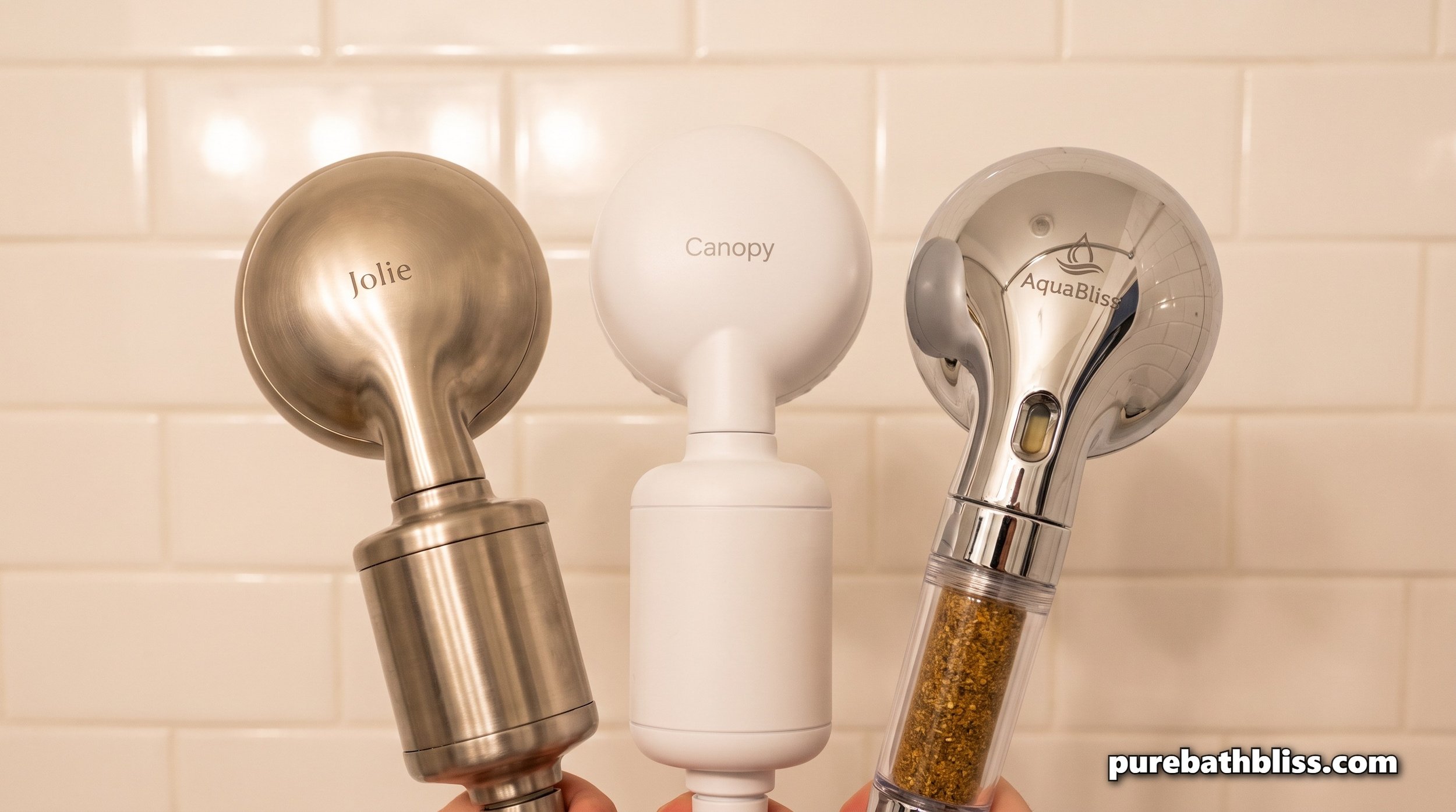
1. Jolie Filtered Showerhead — Best Overall and Most Viral
The Jolie Filtered Showerhead is the product that launched the filtered showerhead TikTok moment, and it earns its reputation with genuine substance. It uses KDF-55 and calcium sulfite dual filtration, is backed by six independent third-party studies, and is the most aesthetically considered product in the category, available in multiple finishes, including brushed steel, chrome, and matte black. The honest caveat: Jolie tests its chlorine removal rate in-house rather than through an independent third-party lab and reports 85 percent removal for 90 days. This is a believable and honest claim, unlike brands promising 99.9 percent. It is not NSF 177 certified, which is a genuine limitation for buyers who want the highest level of independent verification. For most households, the documented real-world results and the high-quality construction make it the best overall recommendation in the category.
2. Canopy Filtered Showerhead — Best for Hair and Scalp
The Canopy Filtered Showerhead is the dermatologist recommendation for hair and scalp health specifically, recommended by expert dermatologists in the Forbes 2026 filtered showerhead review. Its filtration system is specifically designed to address the scalp microbiome and hair cuticle concerns that drive the TikTok transformation videos, and its filter replacement system is the most user-friendly of the three recommendations. The filter replacement indicator removes the guesswork from knowing when the cartridge needs changing, which is the maintenance detail that most people get wrong with showerhead filters and that most significantly affects long-term performance.
3. AquaBliss High Output Shower Filter — Best Budget Option
The AquaBliss High Output Shower Filter is the inline filter version, meaning it attaches between your existing showerhead and the shower arm rather than replacing the showerhead entirely. This makes it the right choice for anyone who already has a showerhead they like, including the eco-friendly rain showerhead we cover in our guide to eco-friendly rain showerheads, and does not want to replace it with a filtered version. At under $40 it is the most accessible entry point into filtered showering and installs in under five minutes with no tools. Filter cartridges last approximately 10,000 gallons and are widely available as replacements.
The Hard Water Problem: What a Filter Cannot Fix
If the primary problem in your shower is hard water, meaning visible scale on the shower glass and tiles, white deposits on the showerhead nozzles, and a film on your skin after showering, a filtered showerhead will reduce the chlorine load but will not address the mineral content that causes scale and film. Hard water contains dissolved calcium and magnesium ions that require ion exchange to remove, a process that a showerhead filter cannot perform.
The hard water mineral issue affects more than your shower experience. The same calcium and magnesium ions that build up on your showerhead nozzles build up on kitchen appliances, dishwashers, and washing machines. Our sister site Pure Kitchen Bliss covers the hard water effect on towels and kitchen textiles in detail, including the citric acid descaling approach that removes mineral buildup from fabric fibers the same way white vinegar removes it from showerhead nozzles.
For hard water households, the most effective interventions are, in order of cost and impact: a showerhead filter for the chlorine and partial mineral benefit, a whole-home water softener for the complete hard water solution, or a combination of both. The showerhead filter addresses the hair and skin chemistry. The water softener addresses the scale, the appliance damage, and the full household mineral load. They solve different parts of the same problem and work well together.
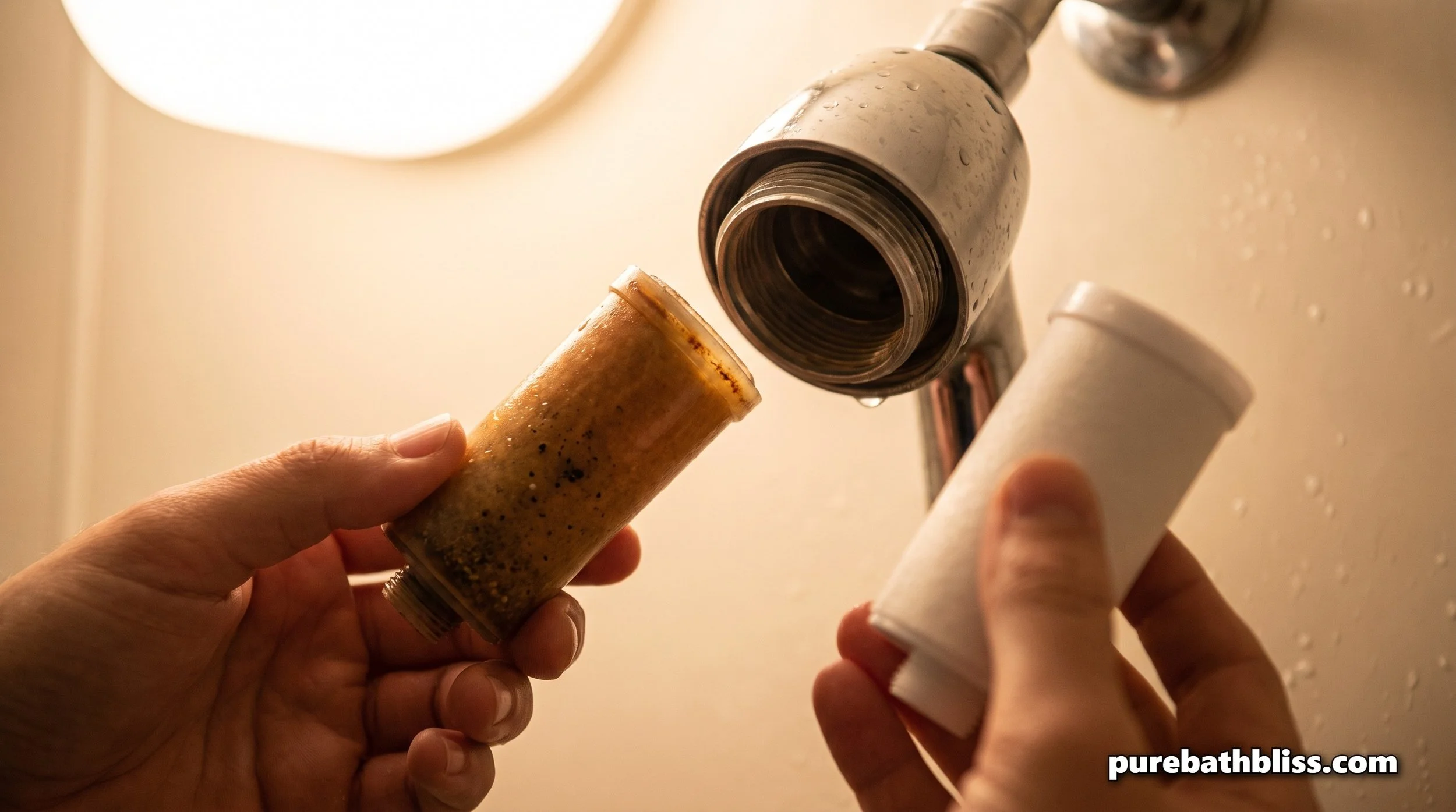
Installation: Five Minutes, No Plumber Required
Every filtered showerhead in the three recommendations above installs with no tools beyond a wrench for final tightening and standard half-inch NPT thread that is universal in North American plumbing. The process is the same as replacing a standard showerhead: remove the existing head, apply plumber's tape to the shower arm thread, thread on the new filtered head or the AquaBliss inline adapter, and hand-tighten followed by a quarter turn with a wrench. Total installation time is three to five minutes.
The one installation consideration worth noting is shower arm compatibility. The Jolie and Canopy are complete showerhead replacements that work on any standard shower arm. The AquaBliss inline filter attaches between any existing showerhead and arm. If your existing showerhead uses a non-standard connection, confirm compatibility before ordering, though this is uncommon in post-1990 North American plumbing.
The Filtered Showerhead Comparison
| Model | Price Range | Filtration Media | NSF 177? | Filter Life | Best For |
|---|---|---|---|---|---|
| Jolie | $165 to $185 | KDF-55 and calcium sulfite | No, but 6 independent third-party studies | 90 days | Best overall. Most aesthetically designed. Strongest TikTok track record. |
| Canopy | $115 to $150 | Proprietary filter with activated carbon | No, but dermatologist recommended in Forbes 2026 review | 90 days with indicator | Best for hair and scalp health specifically. Easiest filter replacement. |
| AquaBliss High Output | $35 to $50 | KDF, calcium sulfite, activated carbon | No, but widely tested by independent reviewers | 10,000 gallons, approximately 6 months | Best budget option. Inline design preserves existing showerhead. |
The verdict on whether filtered showerheads work is yes, specifically for chlorine removal, and the skin and hair benefits from that removal are real and scientifically supported. The TikTok results are genuine. The hard water softening claims are not. NSF 177 certification is the mark of a filter that has proved its chlorine removal under independent testing. KDF-55 and calcium sulfite are the filtration media that produce those results. A filter that costs $25 with no certification and a 15-item contaminant removal list is a marketing product rather than a filtration product. Spend slightly more on one of the three certified or independently tested recommendations above and the results will match what you have been watching on TikTok.