Originally published Nov 12, 2025 · Updated September 24, 2026
Transparency Note: We independently select these products based on research and user reviews. If you buy something through our links, we may earn a commission.
Most bathroom paint failures are not technique failures. They are material failures. The wrong paint in a bathroom does not peel because it was applied poorly. It peels because it was not designed for an environment where the temperature swings fifteen degrees multiple times daily, relative humidity spikes to ninety percent during every shower, and steam deposits soap and shampoo compounds on every surface including the painted walls. Applying a standard interior latex paint correctly in a bathroom produces the same result as applying it poorly, just slightly later.
As a Red Seal Carpenter I have painted a significant number of bathrooms professionally and have been called back to assess paint failures in bathrooms I did not paint. The failure patterns are consistent. Peeling at the ceiling line where steam accumulates most heavily. Bubbling behind the toilet from condensation. Mould establishing under the paint film at grout lines where the primer was not mold-blocking. Every one of those failures was a material selection problem rather than an application problem.
The good news is that the zero-VOC paint category has matured significantly in the past five years and there are now several formulas that genuinely perform in bathroom conditions rather than just carrying the right certifications on their labels. Here are the five I recommend, why each one works at a technical level, and what to look for and avoid in the category generally. The complete application technique, primer selection, and cure protocol are covered in our guide to how to paint a bathroom correctly.
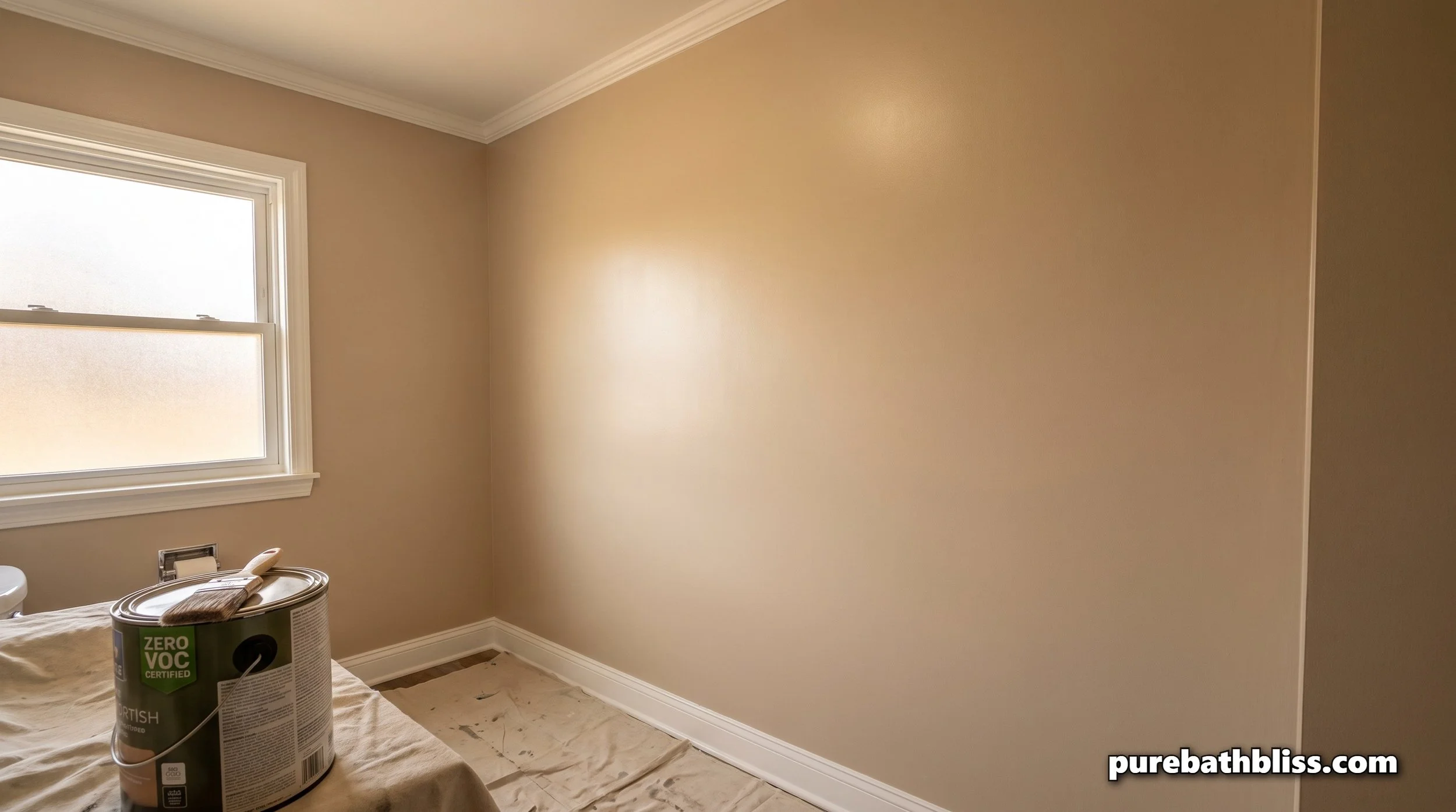
Why Most Bathroom Paints Fail: The Science
Understanding why bathroom paint fails helps you evaluate marketing claims rather than taking them at face value. There are three distinct failure mechanisms in bathroom paint and each requires a different material response.
Moisture vapor transmission failure. When steam contacts a painted surface it exerts hydrostatic pressure against the paint film. Paint that is too permeable allows moisture vapor to pass through and condense on the substrate behind it, where it promotes mould growth and eventually forces the paint film off the wall. Paint that is not permeable enough traps moisture behind the film and produces blistering. The correct specification is 100 percent acrylic latex at satin or semi-gloss sheen, which produces a film with the right balance of moisture resistance and controlled permeability for bathroom conditions. This is why we specify 100 percent acrylic in the painting guide and not vinyl acrylic or alkyd.
Mould under the paint film. Mould establishing behind the paint rather than on its surface is the failure that painting over cannot fix. It requires a mold-blocking primer that contains a biocide in the primer film itself, not just in the topcoat. A zero-VOC topcoat over a standard primer in a bathroom with existing mould spores in the substrate is the combination that produces the black blooming pattern most people have seen through white paint within six months of painting.
VOC off-gassing in an enclosed space. A bathroom is the smallest room in most houses and typically has the least ventilation. VOCs off-gassing from conventional paint in a 5 square metre bathroom with a door closed during curing reach significantly higher concentrations than in a larger, better-ventilated room. Zero-VOC paints eliminate this entirely. The VOC concern in a bathroom is also ongoing rather than just during the painting process because each steam shower raises the temperature of the paint film slightly and can accelerate residual off-gassing from paints that are not fully zero-VOC.
What the Certifications Actually Mean
The certification landscape for eco-friendly paint is genuinely confusing and worth understanding before buying. Not all certifications are equivalent and some carry more weight than their prominence on the label suggests.
GREENGUARD Gold is the most meaningful third-party certification for indoor air quality in paint. It requires independent testing to confirm the product meets strict chemical emission limits, including limits on formaldehyde, heavy metals, and a comprehensive list of VOCs. The Gold designation is specifically tested against standards for children's environments, making it the stronger choice for household bathrooms used by children. A GREENGUARD Gold label means a third party has verified the claims rather than the manufacturer self-certifying.
Green Seal GS-11 covers environmental impact across the full product lifecycle including manufacturing process, not just the finished product's emissions. It is a meaningful supply chain certification that is harder to obtain than GREENGUARD and carries genuine environmental credibility beyond the VOC content of the paint itself.
Declare Label is a full ingredient transparency disclosure used by a small number of manufacturers including ECOS Paints. It lists every ingredient in the formula and identifies which ones appear on the Living Building Challenge Red List of harmful chemicals. It is the most transparent certification available in the paint category and is particularly useful for households with chemical sensitivities who need to know exactly what is in the product rather than just what certification threshold it meets.
| Paint | VOC Status | Certification | Mould Resistance | Best Finish for Bathrooms | Price per Gallon | Best For |
|---|---|---|---|---|---|---|
| Benjamin Moore Aura Bath & Spa | Zero VOC base. Tinted may vary by colorant. | GREENGUARD Gold | Excellent. Microban built into paint film. Does not wash off over time. | Matte (bathroom-specific formula only). Satin also available. | $80 to $90 | Best overall recommendation for most bathrooms. Bathroom-specific formulation. |
| Sherwin-Williams Harmony | Zero VOC | GREENGUARD Gold | Very good. Standard mildewcide package plus VOC reduction from other room sources. | Satin or Eggshell | $65 to $75 | Best for households with air quality concerns. Actively reduces VOCs from other sources. |
| AFM Safecoat Zero VOC | Truly zero VOC. Third-party verified. | Third-party tested. No biocides or fungicides. | Good. Achieved through breathable formula rather than chemical biocide. | Semi-Gloss for maximum bathroom durability | $75 to $85 | Only appropriate option for multiple chemical sensitivity households. No biocides. |
| ECOS Paints | Zero VOC. Declare Label full ingredient transparency. | Declare Label. Third-party tested. | Excellent with optional mildewcide additive. Air Purifying formula captures formaldehyde. | Satin or Semi-Gloss | $65 to $70 | Best for full ingredient transparency. Right for households that want to verify every compound. |
| Portola Roman Clay | Zero VOC. Lime-based mineral formula. | Zero VOC. Natural lime alkalinity provides antifungal property. | Outstanding. Lime's natural alkalinity inhibits mould without chemical biocide. | Textured matte. Trowel applied not rolled. | $90 to $110 | Best for decorative textured finishes. Japandi and Mediterranean bathroom aesthetics. |
The Five Recommendations
1. Benjamin Moore Aura Bath and Spa — Best Overall for Most Bathrooms
Benjamin Moore Aura Bath and Spa is the only paint in the Benjamin Moore lineup specifically formulated for bathroom conditions rather than adapted from a general interior formula. The distinction matters because bathroom-specific formulation means the resin system, the mildewcide package, and the film build have all been engineered for high-humidity cycling rather than meeting a general interior standard that happens to include a mildewcide. The Microban antimicrobial protection is built into the paint film itself rather than added as a surface treatment, which means it does not wash off over time. The matte finish is exclusive to this line and unusual for a bathroom paint, most of which specify satin or semi-gloss minimum. The matte works here because the Aura formula's film density provides moisture resistance that lower-sheen conventional paints cannot achieve. GREENGUARD Gold certified, zero VOC in the base before tinting. The tinted formula may carry minimal VOC from the colorant depending on the colour chosen. At $80 to $90 per gallon it is the premium option in this list and for most residential bathrooms it is the right call.
2. Sherwin-Williams Harmony — Best for Households With Air Quality Concerns
Sherwin-Williams Harmony is the formula I recommend most often to clients who ask specifically about indoor air quality rather than durability as the primary concern. The odor elimination technology in Harmony does something that no other paint in this list does: it actively reduces VOC concentrations from other sources in the room, including off-gassing from cabinets, cleaning products, and personal care products, not just from the paint itself. In a small bathroom with significant chemical load from conventional personal care products, this is a meaningful functional addition rather than a marketing claim. The technology uses a titanium dioxide photocatalytic reaction that breaks down organic compounds in the room air when activated by light. GREENGUARD Gold certified, zero VOC, available in flat, eggshell, and satin finishes. The satin is the appropriate specification for most bathroom wall surfaces. At $65 to $75 per gallon it sits in the mid-range of this list.
3. AFM Safecoat Zero VOC — Best for Chemical Sensitivity Households
AFM Safecoat is the only paint in this list that specifically excludes fungicides, biocides, and plasticizers from the formula entirely. Every other zero-VOC paint in the category includes a mildewcide package of some kind, which is what provides the mould resistance. AFM Safecoat achieves mould resistance through a breathable formula that does not provide the sustained moisture conditions mould requires, rather than through a chemical biocide. For households with multiple chemical sensitivity, where even the biocide compounds in other zero-VOC paints can trigger reactions, AFM Safecoat is the only appropriate option. It has been the reference standard for MCS-appropriate paint for decades and the quality of the finished film reflects that long formulation history. Third-party tested to confirm zero VOC rather than self-certified. Available in flat, eggshell, and semi-gloss. The semi-gloss is particularly durable for bathroom applications. Not available at most paint stores and typically purchased direct or through specialty retailers, which adds lead time to a project.
4. ECOS Paints — Best for Full Ingredient Transparency
ECOS Paints is the most transparent paint brand in the zero-VOC category. The Declare Label ingredient disclosure lists every compound in the formula, which is the standard that makes it straightforward to verify that no ingredient on the Living Building Challenge Red List is present. The Air Purifying formula within the ECOS range adds a formaldehyde-capturing component that is relevant in bathrooms where MDF vanities, particleboard cabinetry, or laminate surfaces are off-gassing formaldehyde into the enclosed space. The optional mildewcide additive allows you to dial in the antimicrobial protection level rather than accepting whatever is built into the base formula. Tintable to over a thousand colours. Zero VOC confirmed by third-party testing. At $65 to $70 per gallon it is competitive with Sherwin-Williams Harmony. The same VOC-elimination philosophy that makes ECOS appropriate for the bathroom applies in the kitchen where our sister site Pure Kitchen Bliss covers the correct approach to cleaning and maintaining zero-VOC cabinet finishes without the harsh degreasers that degrade low-VOC paint films.
5. Portola Paints Roman Clay — Best for Textured Decorative Finishes
Portola Roman Clay is the outlier in this list because it is a lime-based mineral paint rather than an acrylic latex. Lime is naturally antifungal because its high alkalinity, a pH above 12 when wet, creates conditions that mould cannot survive. As the lime carbonates over weeks after application, the pH drops to a stable alkaline level that still inhibits mould without the pH being high enough to damage substrates. The textured, suede-like matte finish it produces is visually unlike any other paint on this list and is what makes Portola relevant to the bathroom despite being a specialist product. For Japandi bathrooms, Mediterranean-inspired spaces, or any bathroom where a plaster-like texture is part of the design intent, Roman Clay produces a result that no acrylic latex can replicate. The finish is also naturally breathable, which suits the humidity cycling of a bathroom well. The application technique is different from standard paint and requires two or more thin coats applied with a trowel or wide spatula rather than a roller, which adds application time but produces a genuinely handcrafted surface. Zero VOC. Premium pricing at $90 to $110 per gallon. Not the right choice for a standard bathroom repaint but the correct choice when the textured finish is the design goal.
What to Avoid in the Eco-Friendly Paint Category
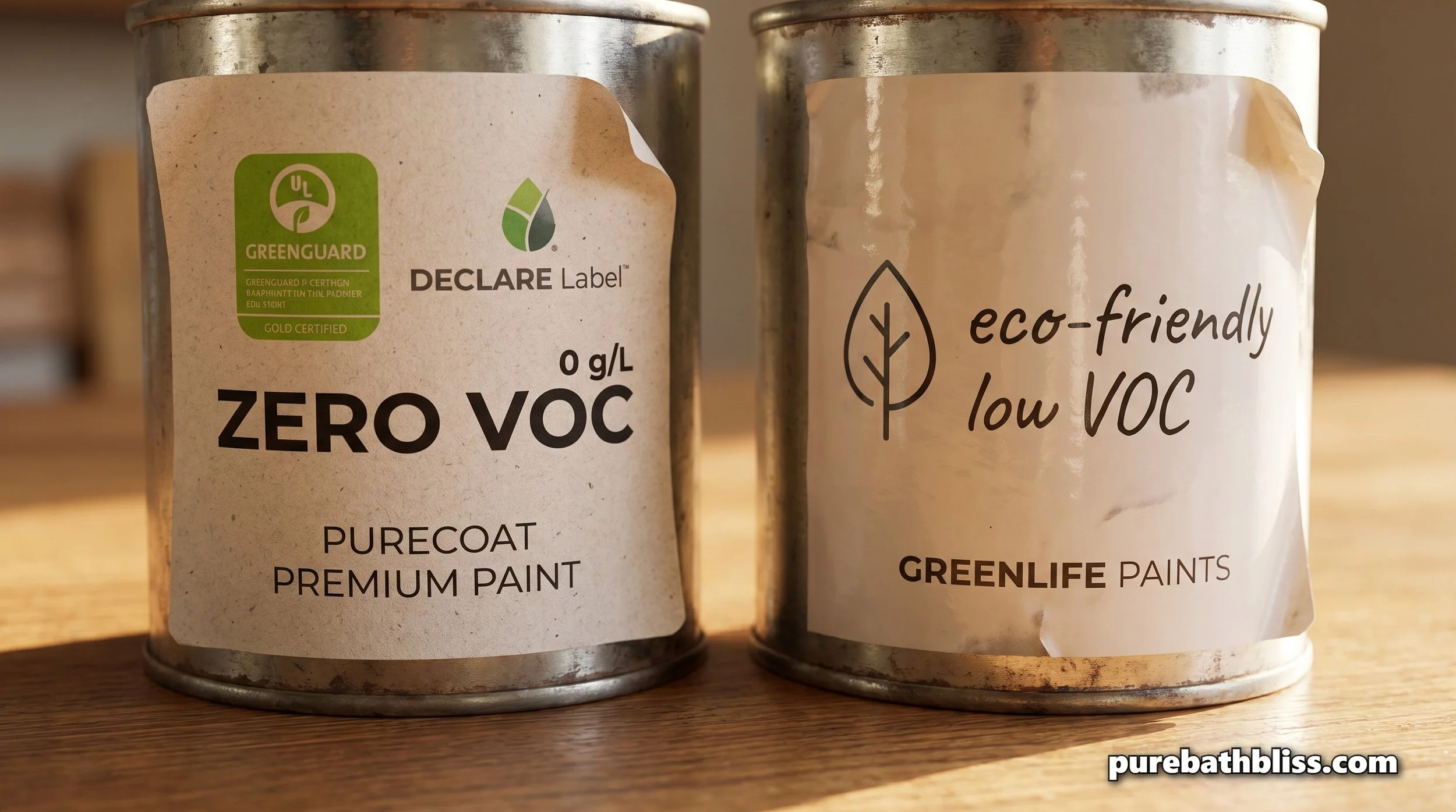
Self-certified zero VOC without a specific g/L figure. A zero VOC claim on a paint label without a specific grams per litre figure and without third-party certification is a marketing claim rather than a verified specification. The paint industry's own definition of low VOC allows up to 50 g/L and some manufacturers apply zero VOC language to products in the 5 to 15 g/L range that technically qualify under some definitions but are not genuinely zero emission. Look for a specific number, ideally below 5 g/L, and a third-party certification mark rather than a self-certified label claim.
Vinyl acrylic binder rather than 100 percent acrylic. Vinyl acrylic is cheaper to manufacture than 100 percent acrylic and produces a film with lower moisture resistance and less flexibility through temperature cycling. In a bedroom or living room the difference in performance over ten years is marginal. In a bathroom it is significant. The binder type is typically listed in the technical data sheet rather than on the consumer label, but most manufacturers will confirm whether a product is 100 percent acrylic or vinyl acrylic if you ask the question directly at the paint counter.
Flat or matte finishes from non-bathroom-specific formulas. A flat or matte conventional paint in a bathroom is one of the most reliable ways to produce a paint failure within two years. Flat paint is porous by design, which allows moisture absorption that promotes mould and makes the surface impossible to clean without removing paint. The one exception is the Benjamin Moore Aura Bath and Spa matte discussed above, which achieves mould resistance through its specific film density rather than through sheen. No other flat or matte finish should be used on bathroom walls from any brand in this list or otherwise.
The Primer Question
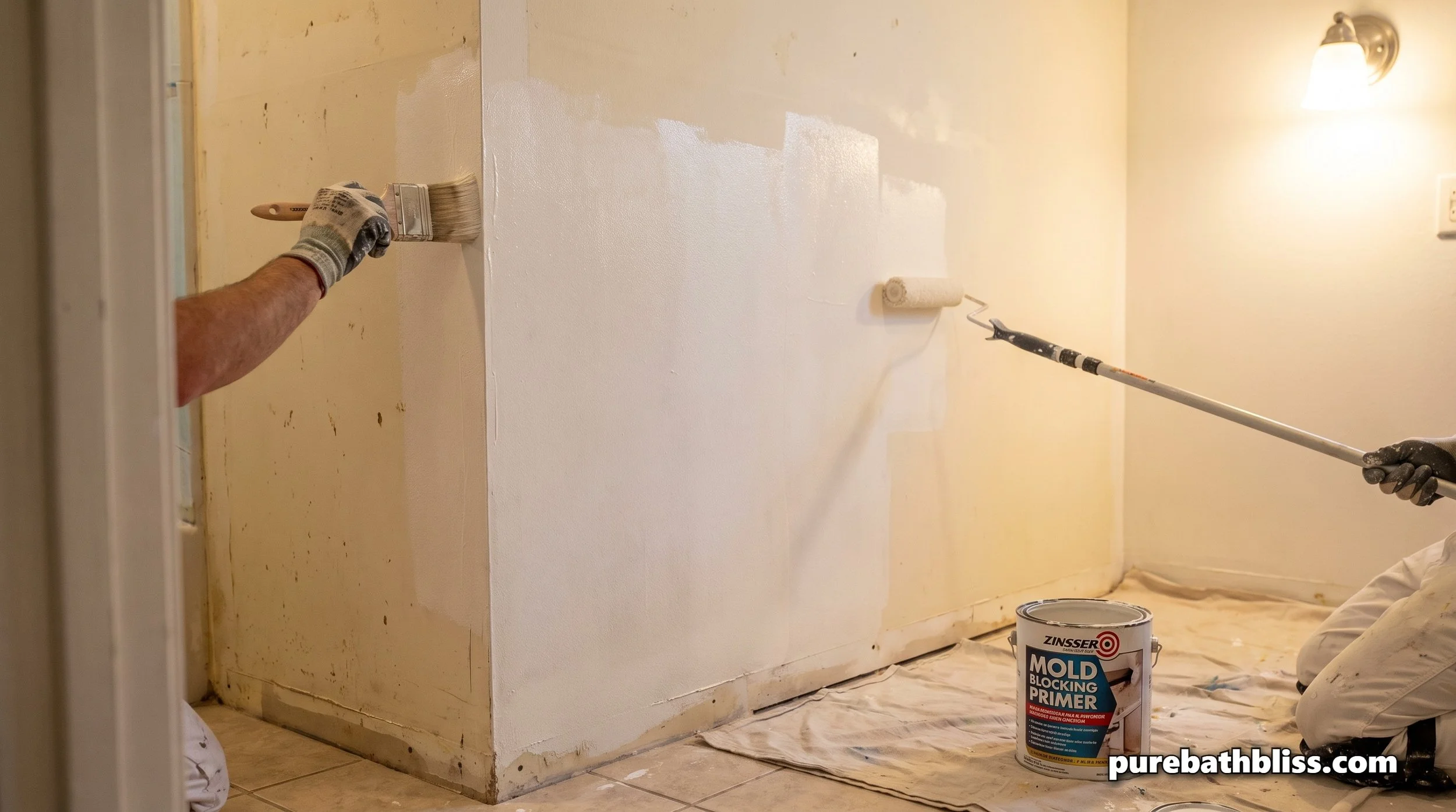
None of the five paints above performs correctly over an unprimed or inadequately primed bathroom wall. The primer is as important as the topcoat in determining whether the paint job lasts five years or fifteen, and in a bathroom the primer has a specific job that standard primers cannot do.
A mold-blocking primer containing a biocide in the primer film itself is the non-negotiable specification for any bathroom surface that will receive paint. Zinsser Bulls Eye 1-2-3 Water-Based Primer is water-based, mold-blocking, dries in one hour, and adheres to glossy surfaces without sanding. Zinsser Mold Killing Primer is the stronger option for any surface with a history of mould or significant moisture staining. ECOS Universal Primer is the zero-VOC primer option for households specifying zero-VOC throughout the project. All three are compatible with every topcoat in this list.
The full primer selection, application sequence, and the specific cure protocol that most bathroom paint guides do not cover adequately are in our complete guide to painting a bathroom correctly. The paint is the visible result. The primer is what makes that result last.
Greg is a Red Seal Carpenter, coffee shop owner, dad of four, and founder of Pure Bath Bliss. He writes about making smarter choices for your home and family.