Are Bamboo Toothbrushes Actually Better? The Honest Guide to Bristles, Mold, and What to Buy
Originally published Oct 17, 2025 · Updated July 25, 2026
Transparency Note: We independently select these products based on research and user reviews. If you buy something through our links, we may earn a commission.
When I first committed to reducing the synthetic compound load in our bathroom, the toothbrush seemed like the obvious easy win. Swap the plastic handle for bamboo, done. My first experience with a bamboo brush was a disaster. It developed black mold on the handle within a week, and the bristles felt like I was scrubbing my gums with wire. I almost went back to my plastic brush that same afternoon.
After that I actually researched the category properly rather than buying whatever was ranked first. What I found changed how I think about the bamboo toothbrush entirely. The mold problem is real but entirely solvable with one storage change. The plastic problem is also real but in the opposite direction from what most bamboo toothbrush marketing implies: the handle swap is the easy part. The bristles are where most brands are not telling you the complete story.
Here is the honest picture, from the microplastic research to the mold science to the specific brands that are worth buying and why.
The Plastic Problem Nobody Talks About: It's the Bristles
The bamboo toothbrush industry has a marketing problem that most buyers do not discover until they read the fine print. The handle swap from plastic to bamboo is genuine and meaningful. The bamboo handle is compostable, biodegradable, and grown from a plant that regenerates without replanting and requires no pesticides or fertilizers. Moso bamboo, which is what most quality brush handles are made from, grows up to three feet per day in some conditions, making it one of the most renewable raw materials available for any manufactured product.
The bristles are a different story. The part of the toothbrush that contacts your gums, tongue, and the soft tissue of your mouth twice daily is almost always still made from nylon, a petroleum-derived synthetic plastic. The handle changed. The part that actually matters for the plastic-in-your-mouth question stayed the same.
A 2025 peer-reviewed study published in Ecotoxicology and Environmental Safety found that plastic toothbrush bristles release up to 2.3 million microplastic particles per year directly into the mouth. The researchers used Raman spectroscopy to identify microplastic fragments released during routine brushing from mechanical forces, temperature changes, and pH fluctuations. These particles were not simply rinsed away. Research shows microplastics have bioadhesive properties and can adhere to oral tissues, including the gingival sulcus, the pocket between your teeth and gums, from which small particles can permeate through the oral mucosa and enter systemic circulation.
The same study found that when independent researchers lab-tested bamboo toothbrushes claiming biodegradable Nylon-4 bristles, the bristles were actually standard Nylon-6 in multiple cases. Another brand advertising natural bristles had bristles that tested as polyester. The labeling problem in this category is significant and knowing the specific terms to look for is the most practically useful thing you can take from this guide.
The Bristle Types Decoded
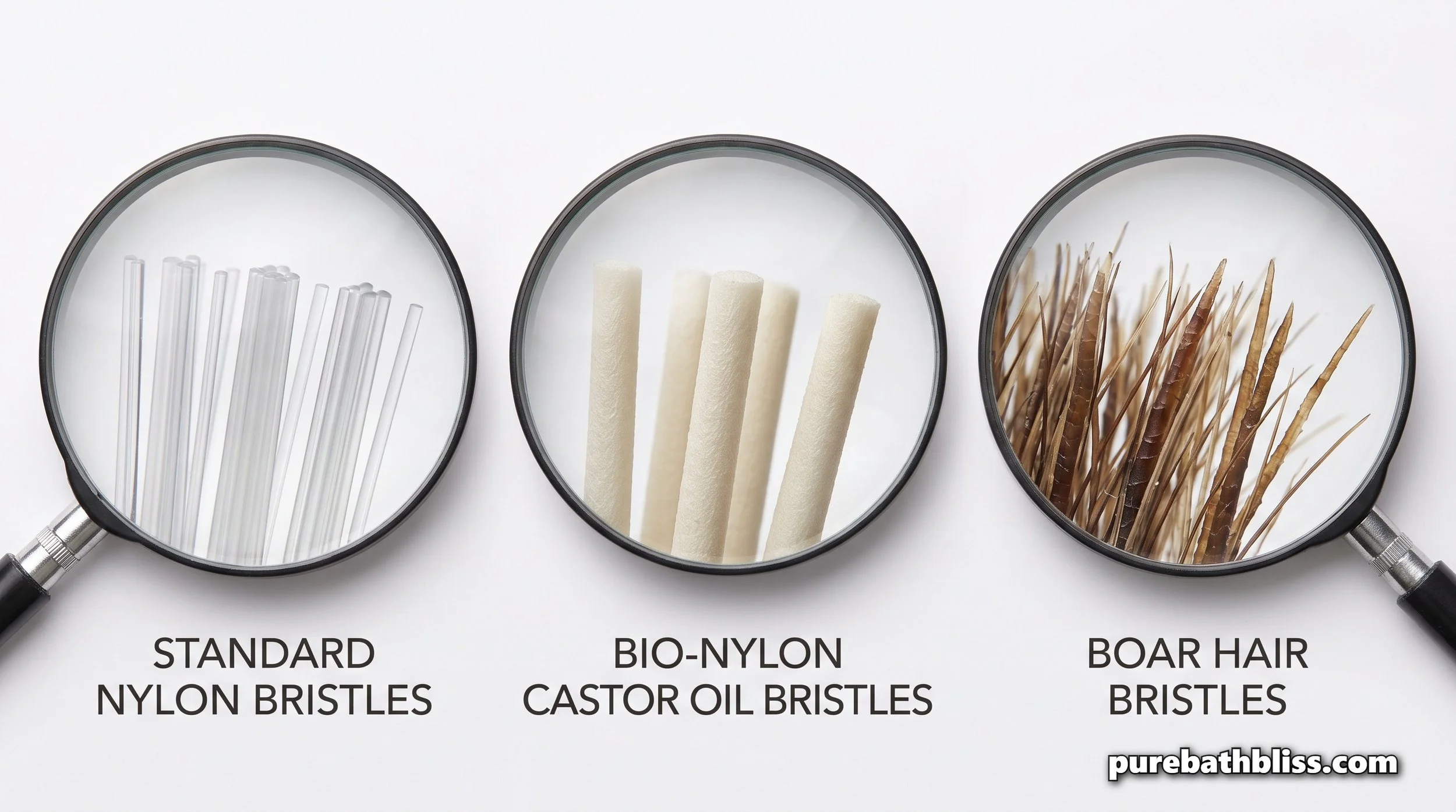
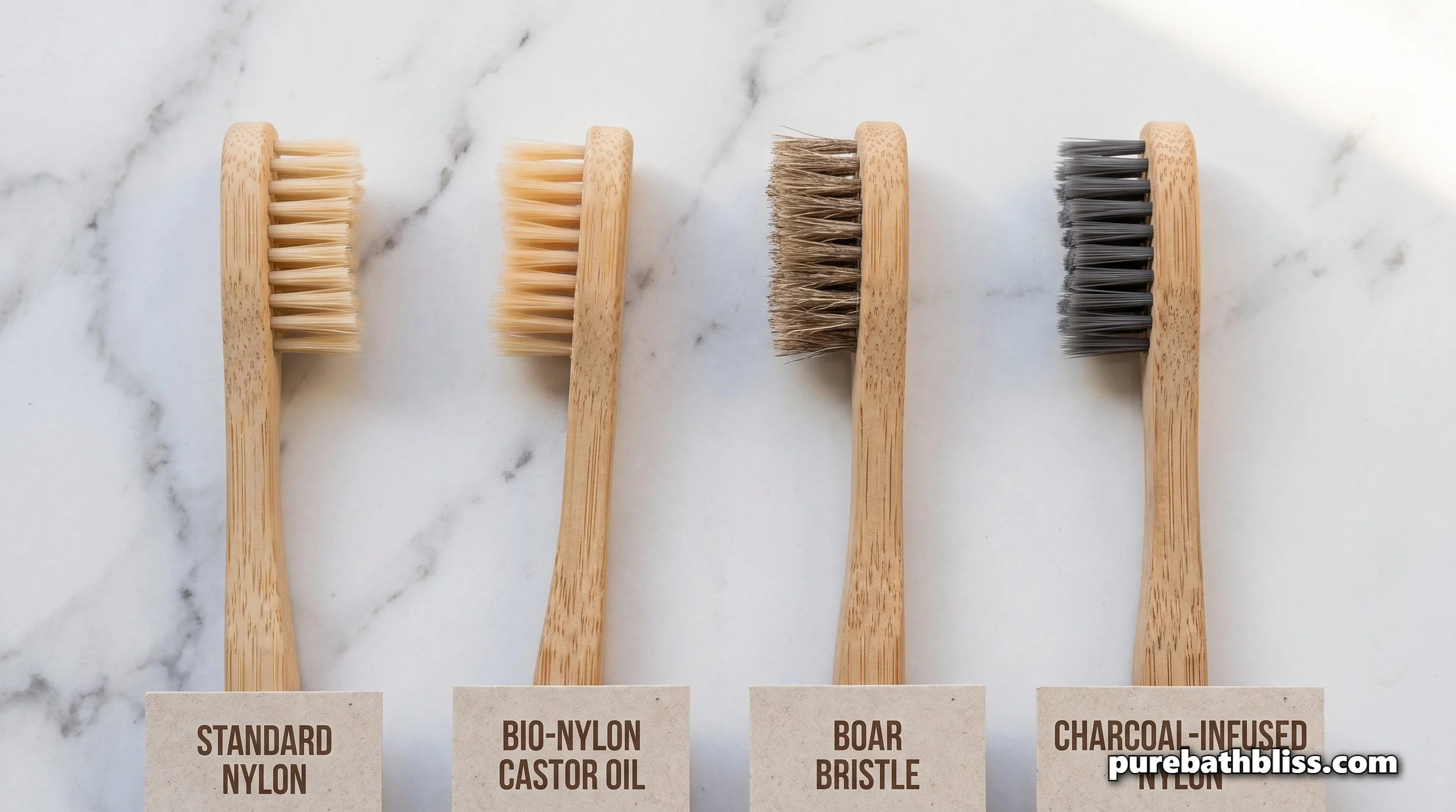
Nylon-6 (Standard)
Nylon-6 is the most common bristle material in bamboo toothbrushes and in conventional plastic toothbrushes. It is petroleum-derived, BPA-free, and the most effective bristle material for dental cleaning based on ADA standards. It is not biodegradable and will not break down in compost. Any brush with Nylon-6 bristles must have those bristles removed before the handle can be composted. The nylon bristles go in the trash. A bamboo toothbrush with Nylon-6 bristles is a genuine improvement over a fully plastic brush in terms of handle sustainability but provides no bristle-related microplastic reduction.
Bio-Nylon or Nylon-1010 (Castor Bean Oil)
Bio-nylon bristles are made from castor bean oil rather than petroleum. They are still a synthetic polymer, still require commercial composting facilities rather than backyard composting to break down fully, and still shed microplastic particles during brushing, though the environmental footprint of the production process is measurably lower than petroleum nylon. Brands labeling bristles as "plant-based," "bio-nylon," or "castor oil nylon" are referring to this material. It is a genuine improvement over Nylon-6 in production footprint but not a fully plastic-free or fully biodegradable solution. The honest description is that it is the best currently available vegan compromise between dental effectiveness and reduced petroleum dependency.
Boar Hair (The Only Truly Plastic-Free Bristle)
Boar hair bristles are the only commercially available bristle material that is fully plastic-free and fully biodegradable. They are natural animal hair from pigs, which means they are not vegan. The original article flagged boar bristle as unhygienic, but this is not well-supported by the evidence. A 2022 lab study confirmed that bamboo brush handles with natural antimicrobial compounds showed 95 to 99 percent lower bacterial counts after 12 to 24 hours of storage compared to plastic, and boar hair itself has naturally varying diameter and taper that is more similar to the texture of human gum tissue than synthetic nylon filaments. For non-vegan households where complete plastic elimination is the priority, boar bristle bamboo brushes from brands like PRIMALS and Gaia Guy are the only products that achieve this.
Charcoal-Infused Nylon
Charcoal-infused nylon bristles appear in many premium bamboo brushes and are marketed for whitening and detoxifying benefits. The charcoal infusion does not meaningfully change the biodegradability or microplastic characteristics of the underlying nylon. Charcoal bristles are still Nylon-6 with activated charcoal particles embedded in the filament. They are no more biodegradable than standard nylon bristles and the claimed dental whitening benefits are not well-supported by independent clinical evidence. They are an aesthetic and marketing feature rather than a functional or environmental improvement over standard nylon.
| Bristle Type | Material Source | Biodegradable? | Microplastic Risk | Vegan? | Verdict |
|---|---|---|---|---|---|
| Nylon-6 | Petroleum-derived synthetic polymer | No | High. Up to 2.3 million particles per year per 2025 study. | Yes | Most common. Best cleaning. Remove before composting handle. |
| Bio-nylon or Nylon-1010 | Castor bean oil, plant-derived but still synthetic polymer | Partially. Requires commercial composting, not backyard. | Moderate. Still sheds microplastics but lower petroleum footprint. | Yes | Best vegan compromise. Genuine improvement over Nylon-6 in production footprint. |
| Boar hair | Natural animal hair from pigs | Yes, fully. Backyard compostable with handle. | None. No synthetic polymer content. | No | Only truly plastic-free option. Best choice if not vegan. |
| Charcoal-infused nylon | Nylon-6 with activated charcoal particles embedded | No. Same as standard Nylon-6. | High. Same microplastic risk as standard nylon. | Yes | Marketing feature. No environmental or dental improvement over standard nylon. |
The Handle: Why Moso Bamboo Specifically
The panda question comes up every time bamboo products are discussed and it is worth answering directly. Most quality bamboo toothbrush handles are made from Moso bamboo, a species that is naturally inedible to giant pandas, which feed specifically on smaller-diameter bamboo species. Moso is also one of the densest and most dimensionally stable bamboo species available, making it well-suited to handle construction. The concern about panda habitat is not relevant to Moso-sourced products.
Heat treatment of the handle surface is the feature worth looking for in a quality brush. The carbonization process, which creates the distinctive dark-streaked appearance in many premium bamboo brushes, hardens the outer surface of the bamboo, closes the grain, and significantly increases moisture resistance. Heat-treated handles are measurably more resistant to the surface mold problem that makes most people's first bamboo toothbrush experience disappointing. Carnauba wax coating at the base of the handle, where the bristle head meets the stem and where water accumulates most during use, provides additional moisture protection and is the detail that separates handles that last three months from ones that develop mold at the base in the first two weeks.
The environmental credentials of the bamboo handle are genuine. Bamboo is one of the fastest-growing plants on earth. It regenerates without replanting, requires no pesticides or fertilizers in most growing conditions, sequesters carbon during growth, and produces a material that, in a well-designed product, is fully compostable at end of life after the bristles are removed. The handle is genuinely better than plastic from an environmental lifecycle perspective. The question is just whether the bristles match the handle's credentials.
The Mold Problem: Why It Happens and How to Prevent It
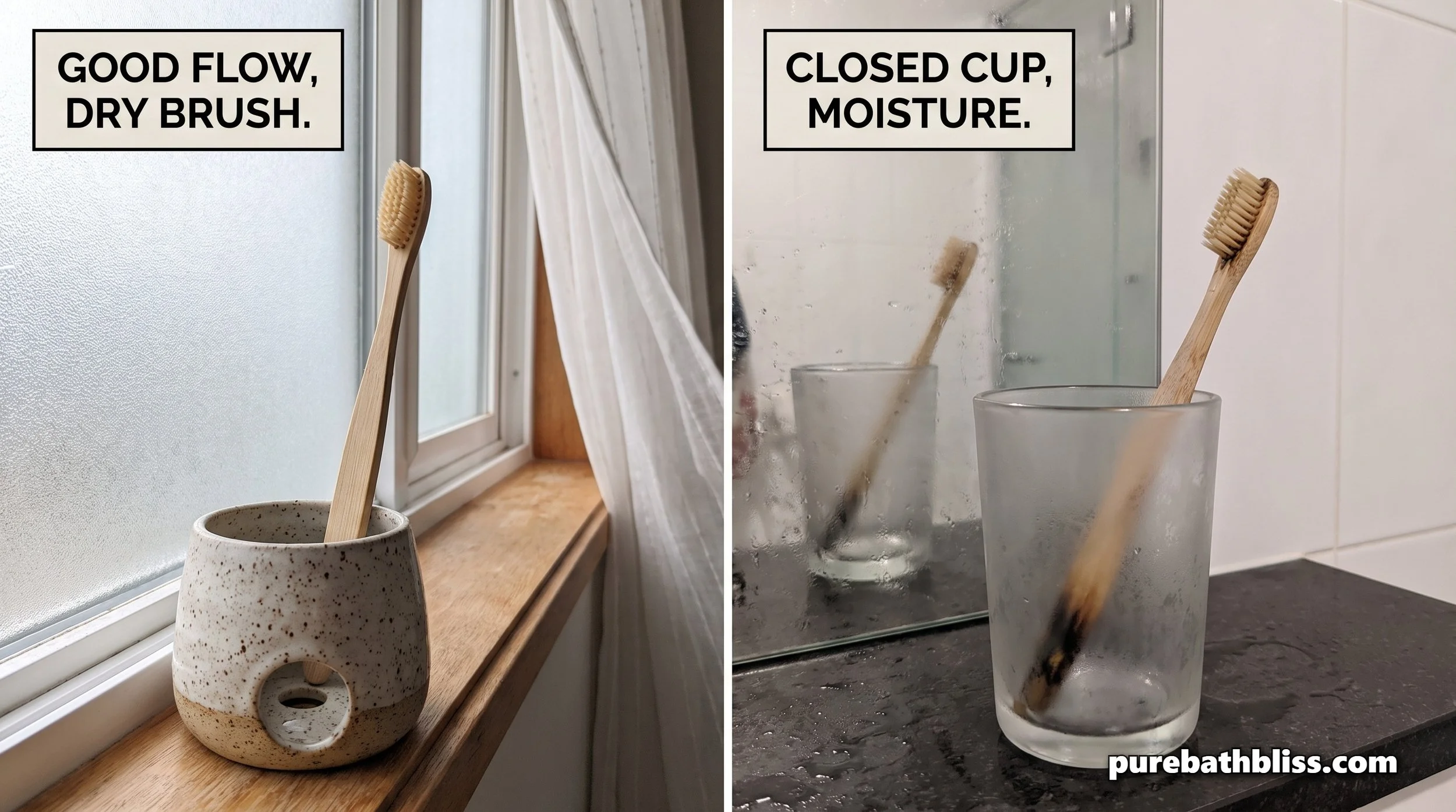
The mold problem that ends most people's bamboo toothbrush experiment is not a material defect. It is a storage problem. Bamboo is a natural porous material. Left sitting in standing water at the base of a closed ceramic cup in a humid bathroom, it will absorb that water and develop mold at the grain. This is the same process that makes any untreated wood damp and eventually moldy in a wet environment. The solution is storage rather than product selection.
The dry-down rule. After brushing, give the handle a quick wipe with your towel before putting it away. This takes five seconds and is the single most effective mold prevention habit. Most of the moisture that causes handle problems comes from water that sits on the handle surface rather than from moisture the handle absorbed during brushing.
Air circulation is everything. Never store a bamboo toothbrush in a closed cabinet, a travel case, or any enclosed space while it is damp. The brush needs airflow around all sides to dry properly between uses. This is the opposite of what most bathroom toothbrush storage looks like.
The self-draining holder. A self-draining toothbrush holder with a hole in the base, made from diatomaceous earth, bamboo, or draining ceramic, allows water to wick away from the base of the handle rather than pooling around it. This is the storage upgrade that makes bamboo brushes last reliably for their full three-month replacement cycle. A diatomaceous earth holder is the highest-performing option because the material actively absorbs and evaporates moisture from the base of the handle continuously.
The naturally occurring antimicrobial compounds in bamboo, specifically lignin-derived phenols and furans, provide genuine passive protection that standard plastic handles do not. A 2022 lab study confirmed bacterial counts on bamboo brush handles were 95 to 99 percent lower after 12 to 24 hours compared to plastic handles in equivalent storage conditions. The bamboo material is working in your favor. Good storage lets it work properly.
Does It Clean As Well As a Plastic Brush?
A clinical study comparing bamboo and plastic toothbrushes over eight weeks found that the reduction in gum bleeding was virtually identical: 21 percent for bamboo versus 22.7 percent for a standard nylon brush. Dental professionals consistently agree that cleaning performance depends far more on bristle design, softness, and brushing technique than on the handle material. A bamboo brush used correctly cleans as effectively as a plastic brush used correctly.
The ADA recommendation for bristle softness is soft to extra-soft for most adults, particularly those with gum sensitivity or enamel erosion. Most bamboo brushes are available in soft bristle variants and this is the right choice for most people regardless of handle material. The handle geometry of most bamboo brushes is slightly more angular than contoured plastic handles, which some people find less comfortable in the first week of use. The difference typically disappears within a few days as the grip adapts.
The Brands Worth Buying
Best overall: A heat-treated Moso bamboo toothbrush with soft BPA-free nylon bristles is the most practical starting point for most households. It delivers the genuine handle sustainability benefit with the dental cleaning performance of standard nylon, and the honest labeling of what the bristles are. Subscription packs of four or eight ensure the three-month replacement habit is easy to maintain without buying individually each time.
Best vegan compromise: Castor oil bio-nylon bristle bamboo brushes from brands like SeaTurtle reduce the petroleum content of the bristles while maintaining vegan credentials and ADA-appropriate cleaning performance. The most honest product in this category.
Best fully plastic-free option: Boar bristle bamboo toothbrushes from brands like PRIMALS and Gaia Guy are the only products where neither the handle nor the bristles contain any synthetic plastic. Not vegan. Genuinely plastic-free.
Best complete sustainable oral care system: Pair any bamboo brush with vegan silk or corn-starch floss in a refillable glass jar and toothpaste tablets in compostable packaging to eliminate plastic from the complete morning and evening routine. The toothbrush is the most visible swap. The floss and toothpaste are where the remaining plastic in the dental routine accumulates. Our guide to reducing toxic chemicals in the bathroom covers the priority order for non-toxic swaps across the full bathroom product range, of which the toothbrush is one part.
The Three-Step Disposal Protocol
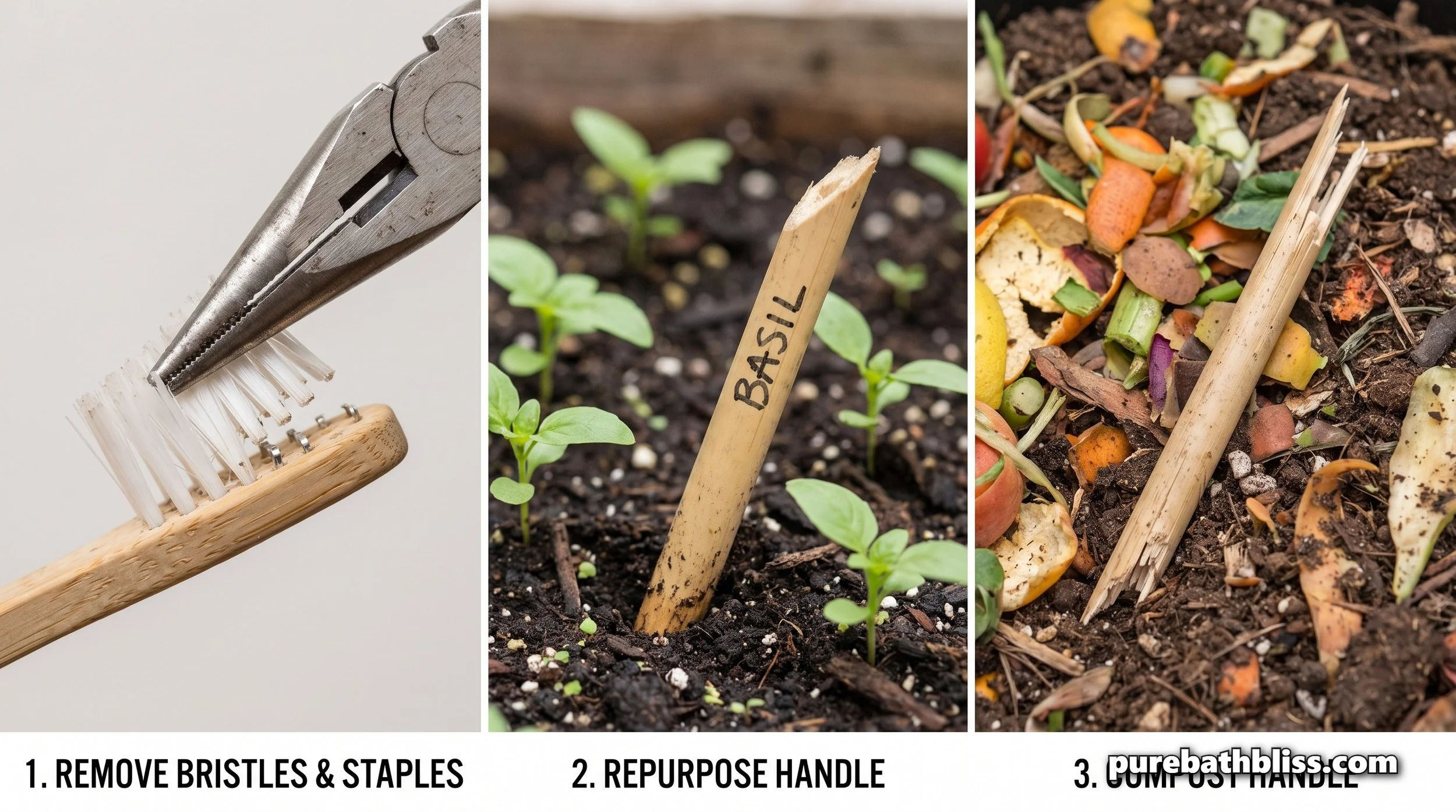
The environmental benefit of a bamboo toothbrush is fully realized only if it is disposed of correctly. Throwing a bamboo brush in the trash with the bristles still attached means the handle ends up in landfill where without adequate oxygen it decomposes very slowly, and the bristles remain plastic regardless of the handle material.
Step 1: Remove the bristles. Use a pair of pliers to pull the bristle tufts out of the head. You will see small aluminum or metal staples that hold them in place. These staples can typically be recycled with metal recycling. The nylon bristle tufts go in the general waste bin. This takes about ninety seconds and is the critical step that makes the rest of the disposal genuinely eco-friendly.
Step 2: Repurpose the handle. Bamboo toothbrush handles make excellent garden plant markers for herbs and seedlings. They can also be used as stirring sticks for small quantities of paint or finishing material. A handle that goes through one or two repurposing uses before composting has extracted maximum value from the material.
Step 3: Compost the handle. The bare bamboo handle without bristles can go in a backyard compost pile where it typically breaks down within four to six months under active composting conditions. If you do not compost at home, many municipal green waste collection programs accept untreated bamboo. The same non-toxic home approach that applies to the toothbrush applies to the broader kitchen and home textile routine. Our sister site Pure Kitchen Bliss covers eco-friendly non-toxic dish soap alternatives for anyone extending the synthetic compound reduction from the bathroom into the kitchen simultaneously.
The Complete Bamboo vs Alternatives Comparison
| Toothbrush Type | Handle Sustainability | Bristle Sustainability | Cleaning Performance | Mold Risk | Best For |
|---|---|---|---|---|---|
| Standard plastic | Poor. Non-biodegradable, petroleum-derived. | Poor. Nylon-6, up to 2.3M microplastic particles per year. | Excellent | None | Nothing. No reason to choose over bamboo. |
| Bamboo with Nylon-6 | Excellent. Compostable handle after bristle removal. | Poor. Same bristle microplastic risk as standard plastic. | Excellent | Low with proper storage | Most practical starting point. Handle improvement is genuine. |
| Bamboo with bio-nylon | Excellent | Moderate. Reduced petroleum footprint, still sheds some microplastic. | Very good | Low with proper storage | Best vegan option for reduced overall plastic footprint. |
| Bamboo with boar bristle | Excellent | Excellent. Fully biodegradable, no synthetic polymer. | Good. Softer than nylon, adjustment period for some users. | Very low. Natural antimicrobial properties. | Best plastic-free option. Not vegan. |
| Recycled plastic | Moderate. Circular economy but still petroleum-derived. | Poor. Same nylon microplastic risk. | Excellent | None | Better than virgin plastic but worse than bamboo on end-of-life disposal. |
| Electric with replaceable heads | Good. Body lasts years. Only head replaced. | Poor. Standard nylon bristles on most heads. | Superior. Clinical evidence favors electric over manual. | None | Best cleaning performance. SURI model offers plant-based heads and take-back program. |
The bamboo toothbrush is a genuine improvement over a standard plastic toothbrush in handle sustainability, antimicrobial handle properties, and biodegradable end-of-life disposal. The bristle situation is more complicated than most brands advertise and understanding the specific terms on the label is the most important single piece of information in this guide. A heat-treated Moso bamboo handle with correctly labeled bristles, stored in a self-draining holder and properly disposed of after three months, is one of the most impactful small swaps available in a non-toxic bathroom transition.