Transparency Note: We independently select these products based on research and user reviews. If you buy something through our links, we may earn a commission.
The reed diffuser is one of those gifts that looks considerably more expensive than it is to make. A commercial reed diffuser in a beautiful amber glass vessel with natural rattan reeds sells for $30 to $50 at most home goods retailers. The homemade version, using the same vessel, the same reeds, and significantly better essential oils than most commercial products use, costs $6 to $8 per diffuser to make and outperforms the commercial version on scent throw because you are using pure essential oils rather than the fragrance oil dilutions that most retail diffusers contain.
Made as a gift set of two, with a Christmas blend card and a simple kraft paper and twine presentation, a pair of DIY Christmas reed diffusers is a gift that costs under $20 to assemble and that recipients consistently receive as something genuinely thoughtful and considerably more valuable than its actual cost.
Here are four Christmas blends designed specifically for bathroom use, the exact base recipe, the vessel and reed choices that produce the best results, and the packaging approach that elevates a homemade diffuser from craft project to considered gift.
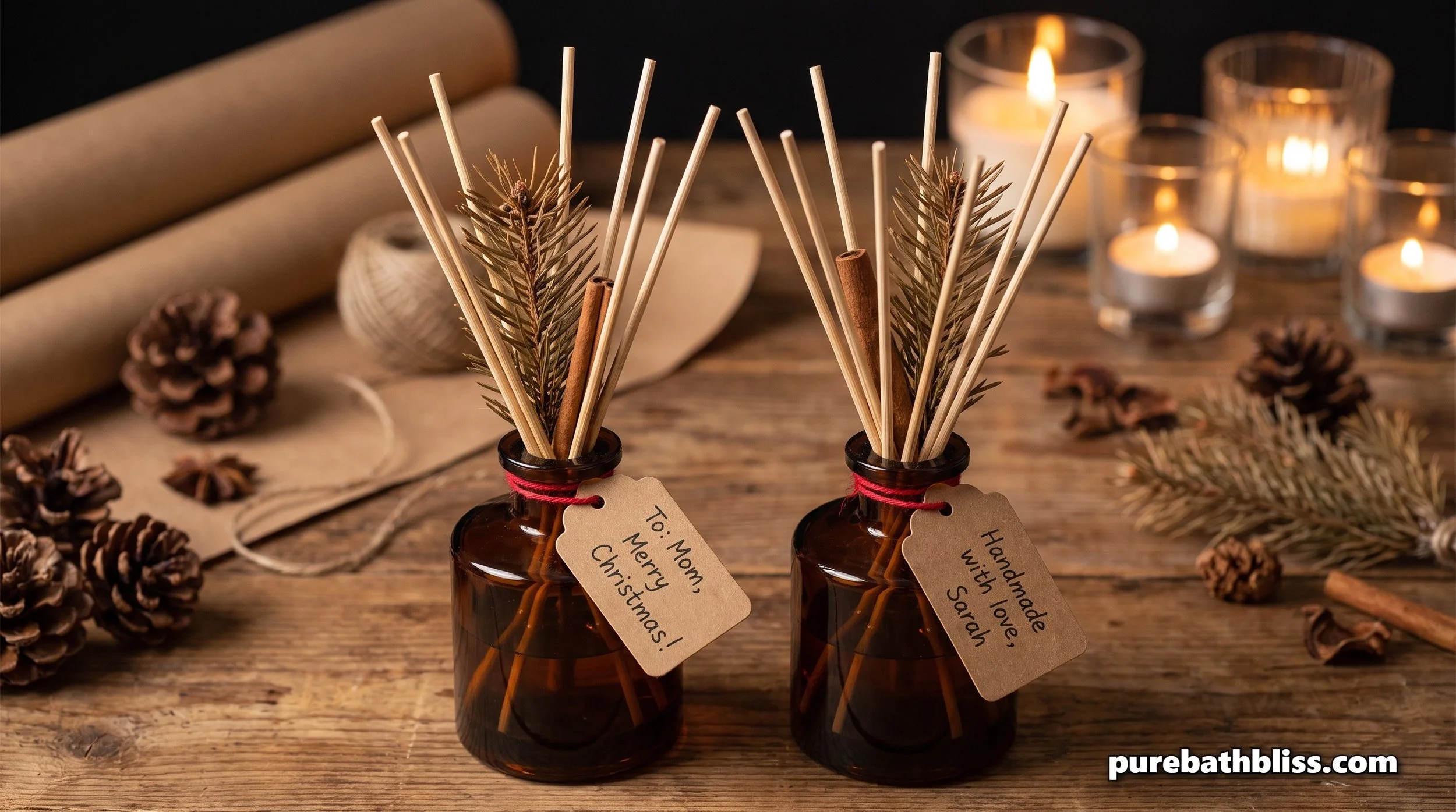
The Base Recipe
The base recipe is the same for all four Christmas blends. The ratio of carrier oil to essential oil is the critical variable that determines scent throw, longevity, and the speed at which the reeds transport the oil from the vessel to the air. Our full guide to making a DIY reed diffuser covers the chemistry behind this ratio in detail. For a gift-focused batch, the quantities below produce two complete diffusers per blend, which is the right amount for a paired gift set.
Per Diffuser
60ml fractionated coconut oil as the carrier base. Fractionated coconut oil is odorless, colorless, and has the right viscosity to travel up rattan reeds at a consistent rate. It also keeps indefinitely without going rancid, which matters for a gift that may sit for a few weeks before being opened.
20ml pure essential oil blend of choice from the four Christmas blends below. This 75 to 25 carrier-to-oil ratio produces a scent throw comparable to premium commercial diffusers.
6 to 8 natural rattan reeds, approximately 25cm long. Rattan reeds outperform synthetic reeds significantly. Bamboo skewers are a reasonable substitute but produce slightly less consistent diffusion.
One amber or cobalt glass vessel of 80 to 100ml capacity with a narrow neck opening. The narrow neck slows evaporation and extends the diffuser's life to six to eight weeks.
Method
Combine the fractionated coconut oil and essential oil blend in a small glass bowl or measuring cup. Stir gently rather than shaking to avoid introducing air bubbles that reduce diffusion consistency.
Pour into the glass vessel using a small funnel. Fill to approximately three quarters of the vessel capacity to leave room for the reeds.
Insert the reeds, allowing them to soak for five minutes, then flip them so the saturated ends are uppermost. This initial flip activates the diffusion immediately and impresses recipients who open the gift and can already smell the blend.
Instruct the recipient to flip the reeds every two to three days to refresh the scent. Include this on the gift card.
The Four Christmas Blends
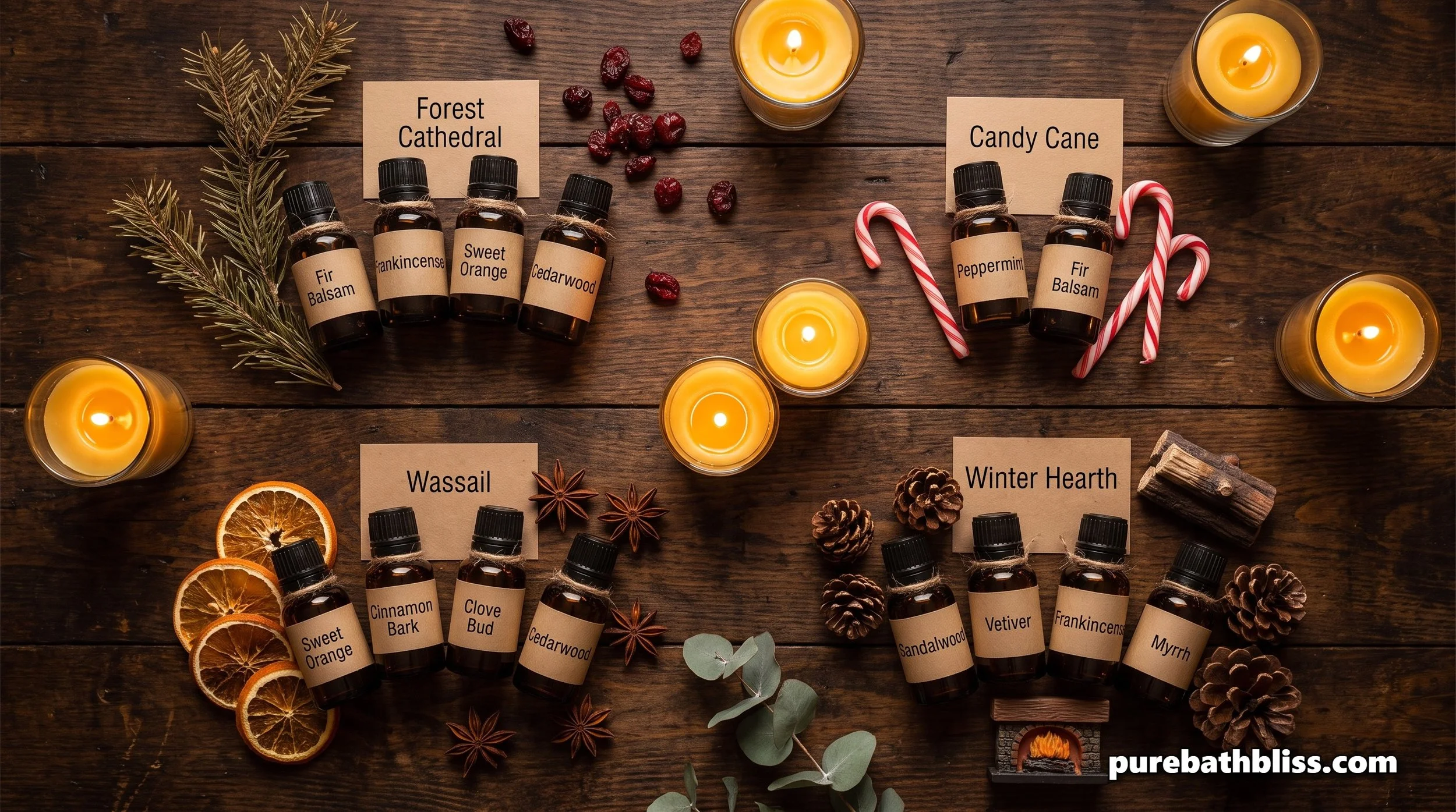
Blend 1: Forest Cathedral
Fir balsam, frankincense, sweet orange, and cedarwood
Fir balsam: 8ml
Frankincense: 6ml
Sweet orange: 4ml
Cedarwood: 2ml
Character: Deep, resinous, and sophisticated. The most genuinely distinctive Christmas blend available from natural sources. The fir balsam provides the fresh evergreen top note, the frankincense gives depth and warmth, the sweet orange brightens it, and the cedarwood grounds the whole composition. Best for a primary bathroom or bedroom used for evening bathing. The gift card description: "A stone cathedral with a Christmas tree in the corner. Pine, incense, and winter light."
Blend 2: Candy Cane
Peppermint, fir balsam, and sweet orange
Peppermint: 10ml
Fir balsam: 6ml
Sweet orange: 4ml
Character: Bright, cool, and instantly recognizable as Christmas. The most universally appealing of the four blends, suitable for recipients of any taste and for guest bathrooms where the scent needs to work across different preferences. Also genuinely deodorizing and sinus-clearing, which makes it practical as well as festive. The gift card description: "Christmas morning and candy cane and cold air. Clean, bright, and immediately festive."
Blend 3: Wassail
Sweet orange, cinnamon bark, clove bud, and cedarwood
Sweet orange: 8ml
Cinnamon bark: 4ml
Clove bud: 4ml
Cedarwood: 4ml
Character: Warm, spiced, and food-adjacent. The olfactory equivalent of mulled cider or spiced wine, making it the most festive-feeling of the four blends for Christmas entertaining. Best for a guest bathroom used during a Christmas gathering. Note that cinnamon bark and clove bud are both skin sensitizers and should not be applied directly to skin. In a reed diffuser at this concentration they are well within safe limits for passive diffusion in a ventilated bathroom.
The gift card description: "Spiced orange and warm wood. The smell of a Christmas kitchen and a crackling fire."
Blend 4: Winter Hearth
Sandalwood, vetiver, frankincense, and myrrh
Sandalwood: 7ml
Vetiver: 5ml
Frankincense: 5ml
Myrrh: 3ml
Character: Rich, ancient, and deeply warming. The most sophisticated of the four blends and the one that polarizes most strongly, people either love it immediately or find it too resinous. Best given to recipients who appreciate frankincense and incense-adjacent scents, anyone who mentions liking churches, old wood, or deep perfume. The gift card description: "Frankincense and myrrh. Ancient wood and warm resin. Christmas as it was before candy canes."
The Blend Quick Reference
| Blend | Key Oils | Character | Best For | Botanical Accent |
|---|---|---|---|---|
| Forest Cathedral | Fir balsam, frankincense, sweet orange, cedarwood | Deep, resinous, sophisticated | Adults, primary bathroom, evening use | Small dried pine sprig |
| Candy Cane | Peppermint, fir balsam, sweet orange | Bright, cool, instantly festive | Anyone, guest bathrooms, families with children | Mini candy cane or dried peppermint stem |
| Wassail | Sweet orange, cinnamon bark, clove bud, cedarwood | Warm, spiced, food-adjacent | Christmas gatherings, guest bathrooms, entertaining spaces | Cinnamon stick and dried orange slice |
| Winter Hearth | Sandalwood, vetiver, frankincense, myrrh | Rich, ancient, deeply warming | Incense and resin lovers, sophisticated recipients | Small piece of sandalwood or resin |
Vessel and Reed Choices
The vessel is the most visible element of the gift and the one that determines whether the diffuser looks commercial or homemade. The distinction between a beautiful homemade diffuser and a craft project that looks homemade is almost entirely in the vessel choice.
Amber glass vessels with a narrow neck opening of 2 to 3cm are the right choice for a bathroom diffuser gift. The amber color is beautiful, protects the essential oils from UV degradation, and reads as sophisticated rather than cheap. Empty amber glass reed diffuser bottles in 80 to 100ml capacity with cork or cap stoppers are available in multipacks that significantly reduce the per-unit cost when making a batch of gifts.
Natural rattan reeds in 25cm length are the correct reed for a bathroom diffuser. Natural rattan diffuser reeds are available in packs of 50 to 100 that provide enough reeds for an entire batch of gift diffusers. Six reeds per diffuser is the sweet spot between scent throw and longevity. More reeds produce a stronger initial scent but the diffuser oil depletes faster.
Fractionated coconut oil is the carrier base that outperforms all other commonly used alternatives including dipropylene glycol and isopropyl myristate for home use because it is odorless, colorless, non-toxic, and indefinitely shelf-stable. Fractionated coconut oil in a 250ml bottle provides enough carrier for approximately four gift diffusers.
The Packaging That Makes It a Gift
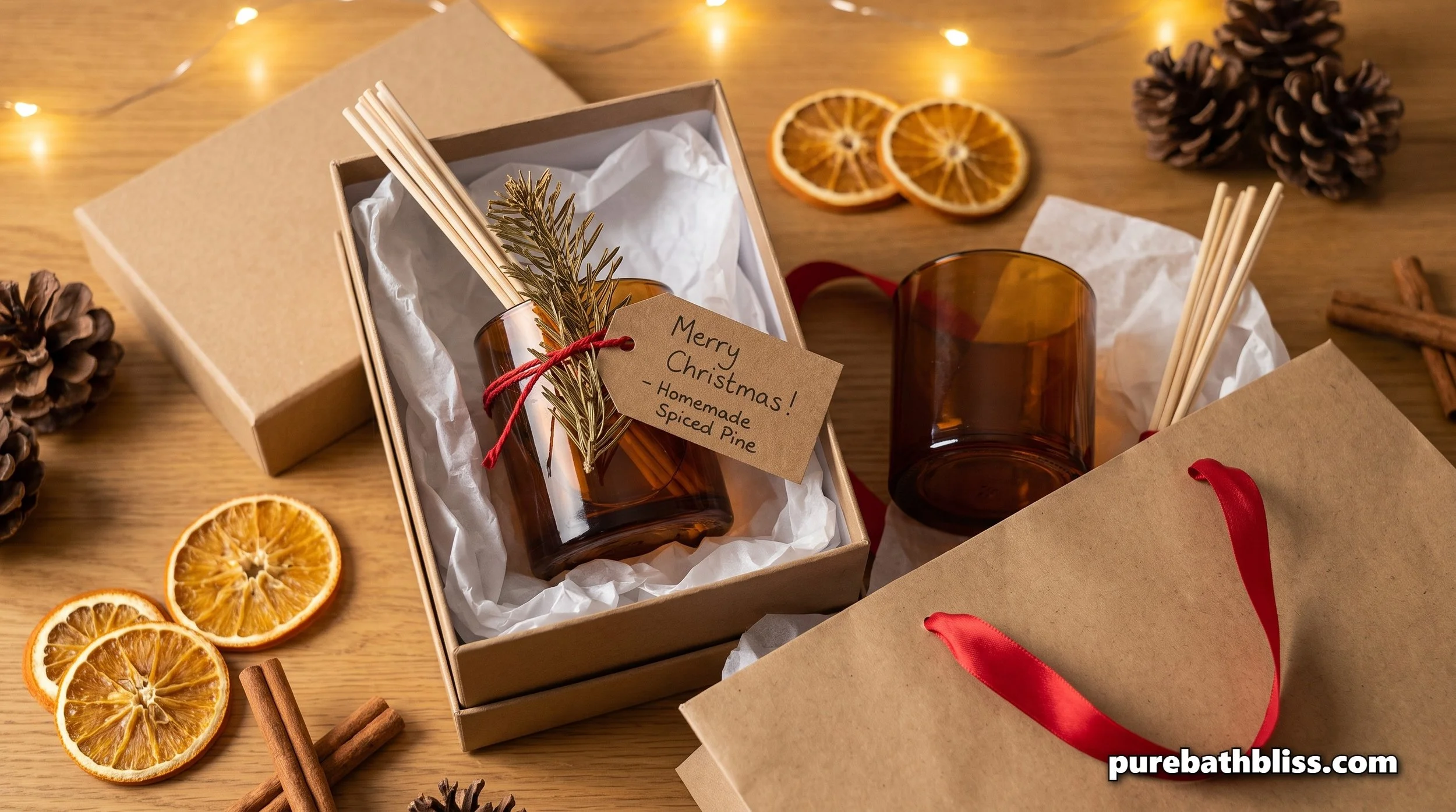
The packaging is what separates a homemade diffuser that looks like a gift from one that looks like a project. Three packaging elements do all the work.
The botanical accent. Before inserting the reeds, tuck a small dried element into the reed bundle, a sprig of dried pine, a dried orange slice, two cinnamon sticks, or a small dried cedar stem. This element should correspond to one of the primary scent notes in the blend. For Forest Cathedral, a pine sprig. For Candy Cane, a small dried peppermint stem or a mini candy cane as a visual nod. For Wassail, a cinnamon stick and a dried clove-studded orange slice. For Winter Hearth, a small piece of sandalwood or a resin incense cone. Secure the botanical element to the reed bundle with a small piece of red twine.
The gift card. A handwritten or printed kraft paper tag approximately 6cm by 9cm attached to the neck of the vessel with red twine. The front of the card shows the blend name in a clean font. The back shows the four key ingredients, the care instructions (flip reeds every two to three days, top up with fractionated coconut oil when the vessel runs low, lasts six to eight weeks), and a one-sentence blend description from the gift card descriptions above. This card is the element that communicates that the gift was made with knowledge and intention rather than assembled quickly.
The outer packaging. A kraft gift box with a tissue paper nest for a single diffuser, or a flat kraft gift bag with two diffusers side by side for the paired set. Red and white baker's twine as a handle tie and a small dried pine cone tucked under the bow completes the presentation. The entire packaging cost for a paired set is under $3 in kraft paper, tissue, and twine materials.
Making a Batch for Multiple Recipients
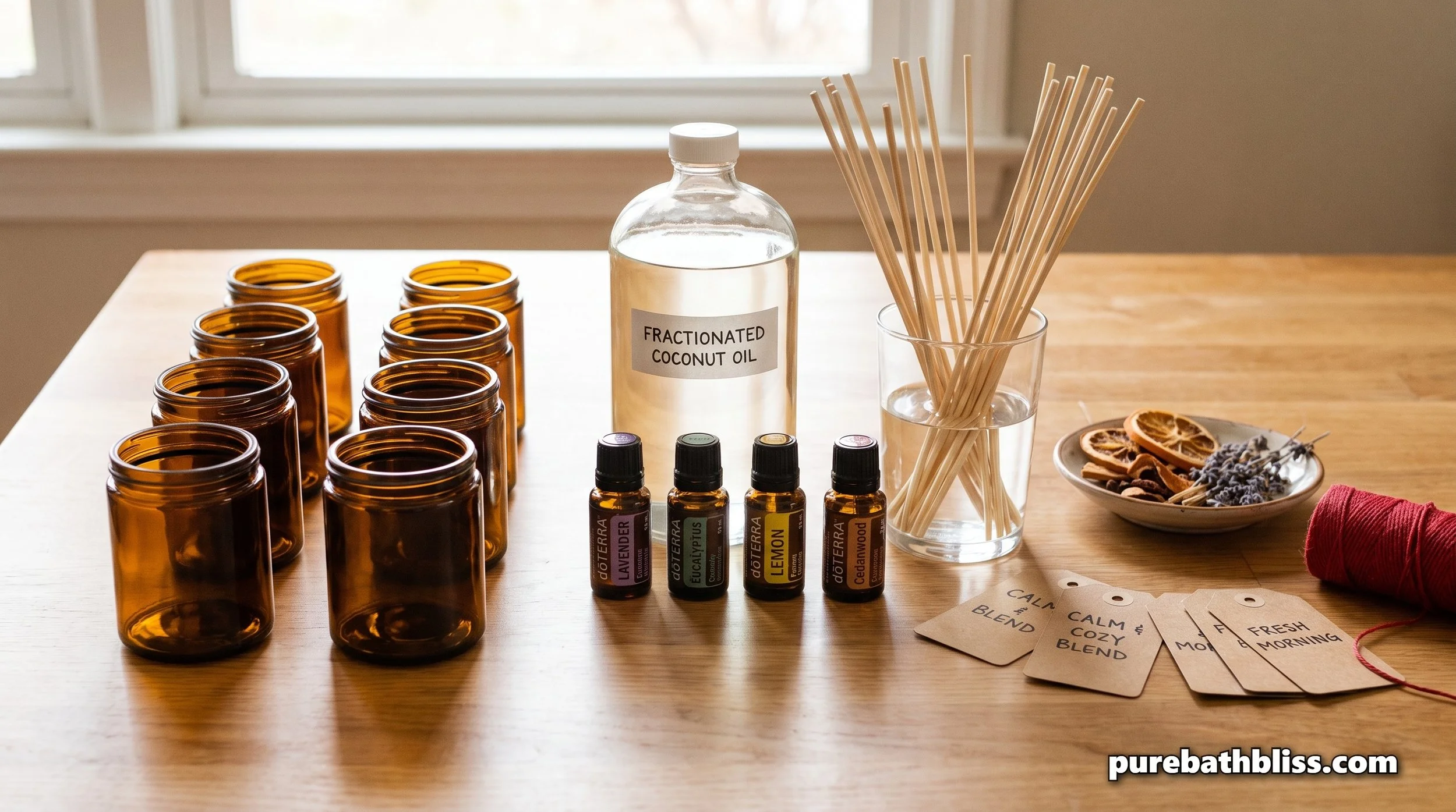
The economics of making a batch of diffuser gifts improve significantly at scale. A batch of eight diffusers, two each of all four blends, requires approximately one hour of active work and costs under $60 in total materials, which works out to under $8 per diffuser. The same diffusers in commercial form would cost $30 to $45 each.
The most efficient batch approach is to set up four stations, one per blend, and fill all eight vessels before moving on to reeds, botanical accents, and packaging as a separate stage. Mixing the carrier oil and essential oils for all four blends before pouring means the oil ratios are consistent across each pair rather than slightly variable from eyeballing each vessel individually.
Materials shopping list for a batch of eight diffusers:
Eight 80 to 100ml amber glass vessels with narrow necks
One 250ml bottle of fractionated coconut oil
Fir balsam, frankincense, sweet orange, cedarwood, peppermint, cinnamon bark, clove bud, vetiver, sandalwood, and myrrh essential oils (10ml bottles of each)
One pack of 50 natural rattan reeds
Kraft gift boxes or bags, tissue paper, red twine, kraft tags
Dried botanicals: pine, cinnamon sticks, dried orange slices, cedar stems
The full reed diffuser making process, including troubleshooting for weak scent throw and the optional alcohol addition that some makers use to increase diffusion speed, is covered in our DIY reed diffuser guide. For a complete Christmas bathroom gift package combining a diffuser set with DIY bath bombs and a beeswax candle, see our DIY bathroom gift sets under $20 guide, which covers the full assembly and presentation for a complete natural bathroom gift at every budget.